A Short History of Halifax Minster
By Peter Thornborrow & Paul Gwilliam
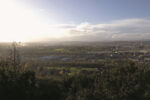
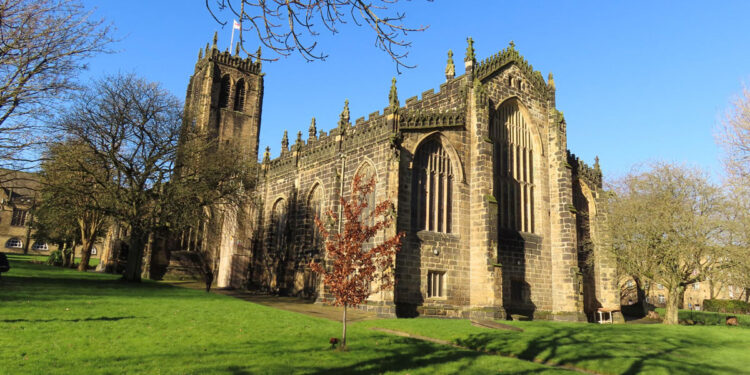
The elevated view of this magnificent church from Southowram Bank showcases its construction: the chancel with its large east window and clerestory windows, the lower south aisle chapel, the nave with its embattled parapet, the roof extending over the Holdsworth Chapel, and the cross in the centre defining the position of the chancel arch inside. The nave and chancel are nearly the same length, meeting the tall west tower with its twin-belfry louvred windows and crocketed pinnacles. The church, rebuilt between 1450 and 1480, is in a Perpendicular Gothic style with large pointed-arched windows with long mullions and tracery heads and embattled parapets.
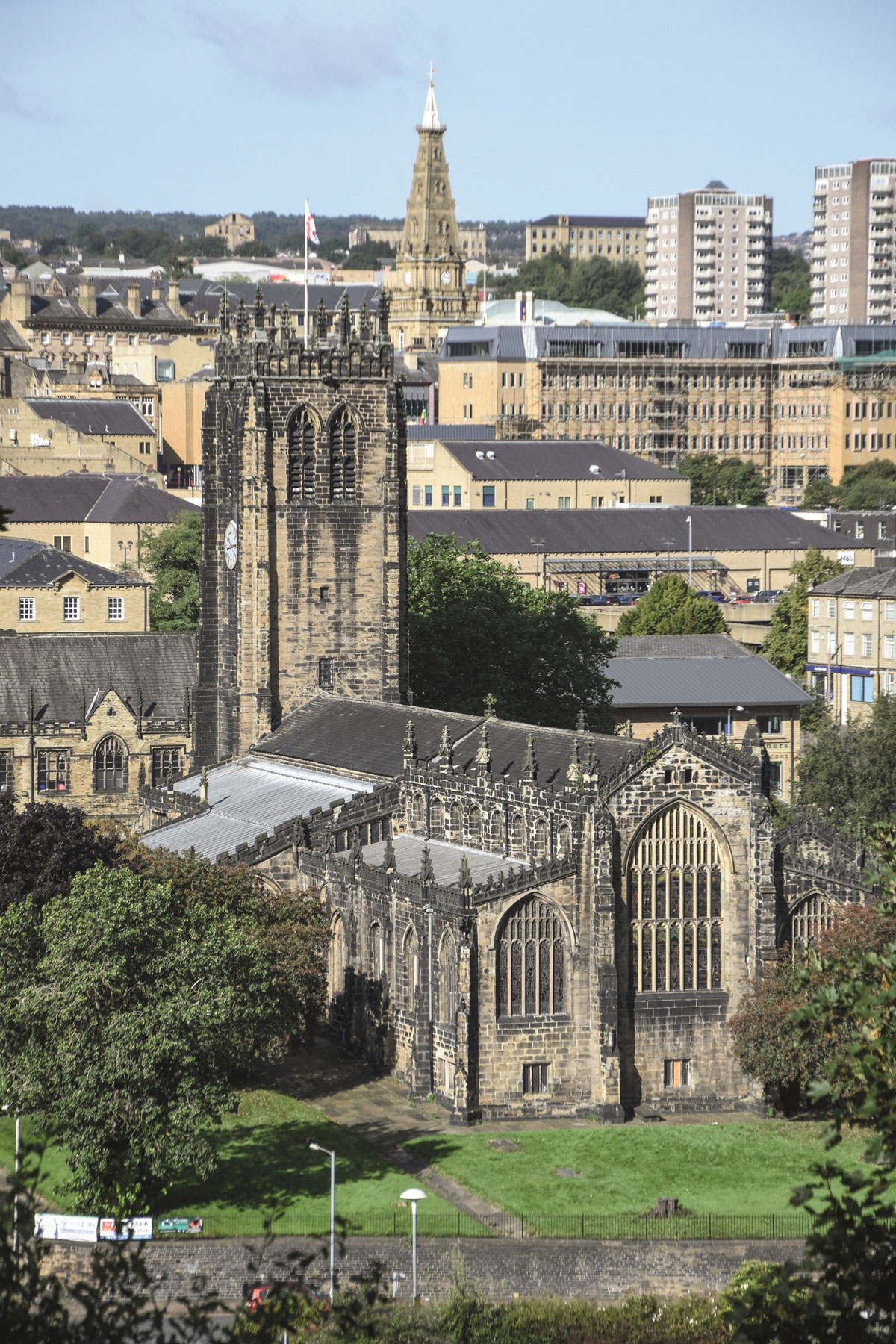
This elevated view shows the different roofs of the church and tower
“Detached pinnacles”
Interior fragments of an earlier twelfth-century Norman church remain; zig-zag chevron decoration was revealed during Victorian renovations under Sir George Gilbert Scott and his son Oldrid. In the porch, note the twelfth-century grave slab carved with clipping shears. Walking around the outside, the first bay is the remainder of the original tower with a large sundial. The monumental detached tall tower was built at the west end, its buttresses with long quoins joining it to the nave. The lean-to north aisle contains the oldest masonry, having two Early English lancet windows and a shouldered, arched doorway (c. 1290) covered by the porch. The Rokeby Chapel, added in 1533, stands virtually detached and features an extraordinary unique parapet with leaf-shaped merlons. These are then carried around the chancel and above its east gable with unusually decorated buttresses with three concave offsets.
The Holdsworth Chapel, added in 1554, has windows framed by detached pinnacles and flying buttresses supporting grotesque gargoyles: one with a ram’s head, two with dragon heads, and a man playing bagpipes. The south chancel aisle has unique Commonwealth windows, added in 1652/3 by Dorothy Waterhouse, with leaded glass lights that replaced broken windows smashed during the Civil War’s occupation by Scottish troops in 1645 – they also removed the font.
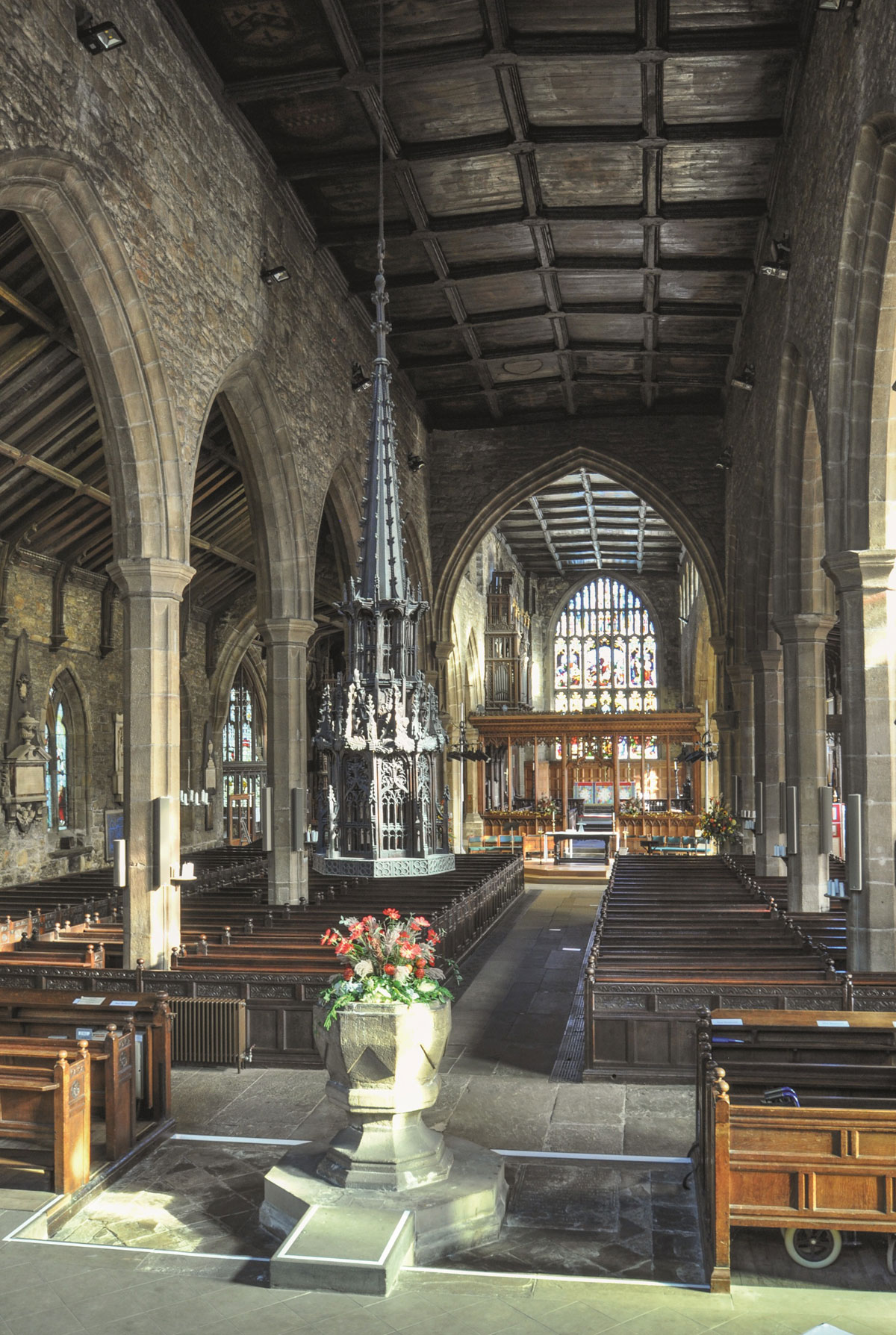
View of the nave. Note the font and cover.
“Octagonal tower”
Inside, the architecture impresses with the wide lofty five-bay nave, Gothic arcades, and a dark-oak coffered ceiling was painted with the coats of arms of each vicar between 1696 and 1703. The chancel arch was raised higher for the clerestory, while the chancel’s coffered ceiling features the heraldic coats of arms of local families. The leaded west window of 1657 illuminates the medieval octagonal font with its outstanding carved-oak cover, like a miniature octagonal tower filled with delicate tracery rising to a tapering crocketed steeple; it is one of the finest in the country. The carved-oak pews, dating from 1633 to 1634, are also equally fine, as are the walnut double-twist altar rails installed in 1698. The life-sized wood carving of Old Tristram and the memorial to Dr John Favour are notable curiosities. The colourful stained-glass east window by Hedgland, installed in 1855/56, depicts the life of Christ.
 “Reordered”
Francis Pigou, a favourite of Queen Victoria, modernised the church with the help of the Scotts family, removing galleries and lowering the box pews in the nave. The famous Snetzler organ of 1766 was moved to the chancel and given a superb new case. Complementing this, traditional choir stalls for a surpliced choir were installed. The south chancel chapel was dedicated as a memorial chapel for the Duke of Wellington’s Regiment in 1951, where their colours (flags) are laid up including those from the Crimea, Dettingen and the Battle of Waterloo. The oak furnishings by Robert Thompson feature his signature carved mice.
In 1983, the church was reordered, removing eight rows of pews from the nave and adding a dais with a new altar and choir stalls, bringing the liturgy and choir into the body of the church, which is central to the life of the town and used by many different organisations for public events and concerts.
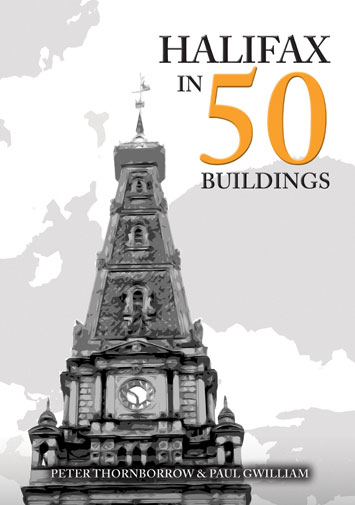
Article taken from Halifax In 50 Building published by Amberley Publishing
Top image: Halifax Minster by Colin Park, via Wikimedia Commons / Geograph, licensed under CC BY-SA 2.0