Nevis Island, Caribbean – Travel Review

By Kevin Pilley, October 2025
We extended our family on Nevis. Much to our surprise. Because it certainly wasn’t planned. But we came back from the West Indies with a new family member and a beautiful memento of a very happy and relaxing fortnight in the Caribbean.
She is a girl and she weighs over twenty stone. She has no teeth and has very large, paddle-like feet. Her skin is very leathery. She is quite cumbersome and only active for small parts of each day. If she follows anyone, she follows my wife – although, admittedly, that lady hasn’t started attacking small boats. Yet.
Every guest at the Four Seasons Resort on Nevis adopts a turtle. Every visitor comes away with a tan and a critically endangered leatherback sea turtle. Ours is called ‘Idun’. We have never met and I didn’t have to pay excess luggage to bring her back home. Excess baggage on massive marine old chelonians is ridiculously prohibitive.
Nevis’s Adopt-a-Turtle programme is run in association with the Caribbean Conservation Corporation and the Sea Turtle Survival League. Green sea turtles and hawksbill turtles are also involved. The turtles are electronically tagged while nesting and you can track their movements on a website. Some can travel as much as 6,000 miles – as far as Canada. As far as I can trust satellites, Idun is presently somewhere off Chiriqui Beach, Panama.

Sea turtle on Nevis Island
“Clear, shallow waters”
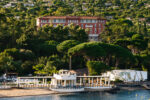
The Four Seasons is the biggest and perhaps the best hotel on one of the most laid-back – and perhaps least known, although not cheapest – Caribbean islands. The resort has one of the best spas and most scenic golf courses in the West Indies, as well as “a full spectrum of vacation facilities”. It also has unbelievably luxurious private villas to rent, complete with infinity pools, wall-to-wall chambermaids and plasma screens in every room.
Kid-friendly – although big enough to get away from them (yours and everyone else’s) – the resort rightly boasts the best restaurants on the island, and Mango Restaurant, right on the sea by the eighteenth green and overlooking the sister island of St Kitts, is the best. Agro-tourism is important and as much local produce is used as possible.
The fish is very popular – presumably because few spa-mad wives want their faces rubbed with blackened mahimahi or singed wahoo.
Oualie Beach Hotel is a small gingerbread-cottage colony on the water’s edge. It also boasts its own resident marine biologist. Undersea expert Barbara Whitman will take you snorkelling and show you amazing, colourful and odd-looking things in the clear, shallow waters. Most are native to the reefs. Only a few are American.
Nevis (which you quickly learn is pronounced ‘Nee-vis’) is a short flight from Antigua. Diana, Princess of Wales, made the island famous when, seeking privacy after her separation, she fled there and stayed at the exclusive Montpelier Plantation Inn.

Nelson plaque
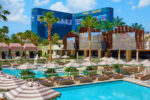
“Palm-fringed pool”
On 11 March 1787, Nelson married Frances ‘Fanny’ under the silk-cotton tree, a short stroll from Montpelier Plantation Inn. Fanny, a young widow, was the niece of the owner of the Montpelier sugar plantation. The future William IV gave the couple away. St John’s Fig Tree Church holds their wedding licence.
He arrived as captain of HMS Boreas in 1785 and spent two years enforcing Britain’s Navigation Acts, intended to keep her colonies’ trade exclusive to the mother country. He had a lookout at Saddle Hill. Nelson Spring provided his fresh water. He attended a ball at the Bath Hotel, the first tourist hotel in the Caribbean. Unsurprisingly, Nevis also has a Nelson Museum. One of the exhibits is a scrap of the Union Jack from Victory. Nelson left the island in 1798 and the couple separated in 1801.
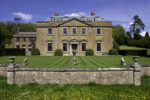
It is a strange feeling following in the flip-flop steps of royalty – and swimming in the same palm-fringed pool in which Diana displayed her breaststroke and the boys learned to “bomb” all those years ago. Although I doubt the resident Labrador didn’t sink his teeth into their beach ball and puncture it as it did ours.
In 1993, the late Diana, Princess of Wales, stayed with the young princes at the exclusive Montpelier Plantation Inn on Nevis when her separation was announced. The boutique plantation inn offers eight bungalows and 17 guest rooms and has its own private beach, Pinney’s, ten minutes away. The estate dates back to 1687 and the inn has been run by the Hoffman family since 2002. It also boasts a function room in an old sugar mill and has one of the best restaurants on the island. The Indigo Lounge Bar may very well be where William and Harry developed their taste for “molecular cocktails”.

Pool at the Montpelier
“Adopted home”
There are four other plantation inns on Nevis. The ten-acre Old Manor House offers rooms in a former hospital, forge and smokehouse, and you can enjoy afternoon tea – and the trade winds – on the terrace.
The Nisbet Plantation Beach Club is famous for its eighteenth-century Great House and its avenue of palms going down to the sea. It is named after Fanny Hamilton’s first husband, Josiah.
The main house of the Hermitage is the oldest wooden house on the island and perhaps the oldest wooden house in the Caribbean. The sitting room dates back to 1670.
“Our family discovered this old house in 1971, when it was little more than a ruin lost in the bush, when there were more people on the island riding donkeys than driving cars and the electricity went off every afternoon at 4 o’clock,” says owner Richie Lupinacci. His family originally came from Pennsylvania.
“It took us a little time to make the house habitable again, tame the jungle, install water and electricity and fill in the 1670 privy. In 1984, once we had finally perfected the rum-punch recipe, we started charging our house guests!”
Watched closely by vervet monkeys as we sipped our “Killer Bees” (rum punches), our host extolled his adopted home. “Nevis is a small island and nowhere is far away. You can drive around the entire island in 1 hour. At 800 feet above sea level we have the advantage of catching the cool trade winds that blow almost regularly out of the east. We have our own herd of cattle who help with the burgers. Our carrot cake is famous. It’s a quiet place despite the bell frogs and Cuban tree frogs. The hurricanes of 1989 and 1995 proved the soundness of this construction.”

Hermitage Inn
“Cloud-capped peak”
The Hermitage is surrounded by mango trees (brought from India in the early 1700s), breadfruit (brought from Tahiti by the British to feed the slaves, who rejected it when it was then used to feed pigs), night-blooming cereus, royal palms, coconut trees and tamarinds, as well as flamboyants – the national tree of Nevis – and St Kitts, sister island to Nevis, is only a short ferry ride away.
Nevis is as friendly a Caribbean island as you can find. Everyone sweet-talks you – and sugar coats paradise.
Columbus, who in 1493 called Nevis “Nuestra Señora de las Nieves” (Our Lady of the Snows) after its one cloud-capped peak, brought sugar plants to the New World from the Canary Islands. The discovery of tea in India made the Europeans suddenly so sweet-toothed. At one stage, slaves outnumbered the English 1,000:1. St Kitts was the centre of the industry.
The reception area of the Golden Rock is the old counting house where they counted the hogsheads. It goes back to 1801. The Drip House is where they purified the water. You can stay in the sugar-mill suite.
The sugar industry ended mainly because of the size of Nevis and St Kitts. Neither could compete with, or modernise at the same rate as, other countries. Eventually, young locals refused to work the fields because it was too hard and too hot – and bar work and water sports paid better. Sugar production officially ceased on the two islands in July 2005.

Golden hour at the Montpelier
“Lava boulders”
Golden Rock’s gardens were redesigned by Miami-based designer Raymond Jungles under the stewardship of New York artists Helen and Brice Marden, owners of Golden Rock. Helen curated the plant selection and Brice artfully positioned lava boulders that were unearthed during excavation. There are over 50 species of palms, including many that are rarely, or no longer, found in nature, including the Talipot Palm (Corypha umbraculifera), Yaray Palm (Copernicia fallaensis) and Guano Palm (Coccothrinax borhidiana). Native plants and grasses are found alongside exotic flowering trees and bushes like the pagoda flower and sausage tree. Golden Rock also boasts a collection of cycads.
During your stay, you will be serenaded by tree frogs and see purple-throated caribs, Antillean crested hummingbirds and bananaquits.
We learned many other things on Nevis. For instance, that terrapins live in brackish freshwater and that tortoises have club feet and live on land. That there are over 200 species of turtle – and that they lay up to 175 eggs between June and October. And that turtles extract salt from seawater using glands located above their eyes.
It was all very educational. I discovered much about the real Caribbean – as well as my own family. Two days after returning home I noticed that I had been replaced in my wife’s affections by the newest addition to the family. A photograph of Idun now stands on my wife’s bedside table. I have vanished. When questioned on her motives, my wife told me that she has merely replaced one ancient order of reptile with another.
Booking: booknevis.com
Luxury island experts: hummingbird.travel
Kevin Pilley is a former professional cricketer and the ex-chief staff writer of PUNCH magazine. His humour, travel, lifestyle and food & drink work appears worldwide. He has been published by over 600 titles.
Nevis Travel FAQ
Where is Nevis and how do you pronounce it?
Nevis (pronounced “Nee-vis”) is a small, laid-back Caribbean island in the West Indies, paired with sister island St Kitts.
How do I get to Nevis?
Nevis is a short flight from Antigua. You can also reach it via ferry from St Kitts.
What is the Four Seasons Resort Nevis known for?
It’s the island’s largest luxury resort, featuring a top-tier spa, a scenic golf course, multiple restaurants (including Mango on the water), and private villas with infinity pools.
What is the Adopt-a-Turtle program on Nevis?
Run with the Caribbean Conservation Corporation and the Sea Turtle Survival League, the program tags nesting sea turtles so guests can “adopt” and track them online.
Which turtle species nest on Nevis?
Leatherback, green, and hawksbill sea turtles nest on Nevis. Leatherbacks can travel thousands of miles after nesting.
When is turtle nesting season?
Typically May to August.
Can I track my adopted turtle’s movements?
Yes. Each tagged turtle’s route is viewable online so you can follow its journey after nesting.
Is the Four Seasons family-friendly?
Yes—there are kid-friendly facilities, and the property is large enough to find quieter corners when you want them.
Where can I snorkel or learn about marine life?
Oualie Beach Hotel sits on the water’s edge and even has a resident marine biologist who leads snorkel trips in the clear, shallow bay.
Which historic figures are linked to Nevis?
Princess Diana holidayed here in the 1990s. Admiral Horatio Nelson married Frances “Fanny” Nisbet on Nevis in 1797; related sites include St John’s Fig Tree Church, Nelson Spring, and the Nelson Museum.
What are notable plantation inns on Nevis?
Montpelier Plantation Inn (boutique bungalows, sugar-mill venue), Old Manor House (rooms in former hospital/forge/smokehouse), Nisbet Plantation Beach Club (iconic Great House and palm-lined avenue), and The Hermitage (possibly the oldest wooden house in the Caribbean).
What is special about Golden Rock?
Set in historic sugar-estate buildings, Golden Rock’s gardens were redesigned by landscape architect Raymond Jungles with rare palms and native plantings; you can even stay in a sugar-mill suite.
What wildlife might I see?
Vervet monkeys, tree frogs (the island’s evening soundtrack), and birds like purple-throated caribs, Antillean crested hummingbirds, and bananaquits.
How big is Nevis and how long does it take to circle the island?
You can drive around the entire island in about an hour.
What’s the food scene like?
Agro-tourism is embraced, with resorts and restaurants using local produce and fresh fish. Mango at the Four Seasons is a standout seaside spot.
What’s the story of sugar on Nevis?
Nevis and St Kitts were once major sugar islands. Production ended in July 2005; many estates are now boutique hotels and cultural sites.
Any responsible travel tips for turtle season?
Give nesting turtles space, avoid bright lights on beaches at night, don’t touch hatchlings, and follow local conservation guidance—adopting a turtle helps support protection efforts.