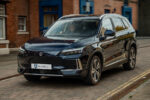
Toyota C-HR PHEV – Review

By Liam Bird
Stylish, dynamic, desirable. Those are not words that usually spring to mind when talking about a Toyota. Reliable would feature, of course it would, and so too would words such as practical, dependable, and sensible. Would one be being too harsh if forgettable was mentioned too?
There are exceptions. I remember lusting after the unashamedly wedgy, first generation MR2 soon after it was launched in the early 1980s; Toyota’s GT86 garnered rave reviews for nearly all who drove it; the Hi-lux and the Land Cruiser are both motoring icons in their own right; the GR Yaris is quite possibly one of the best hot-hatches you’ll ever get your hands on; the 2000GT changes hands for six-figure sums – if that is you can find one for sale. But has anyone ever got really excited about a Camry, a Carina, a Corolla, a RAV4, a Starlet, a Previa, or a Prius?

“Smoother design”
Perhaps in a bid to shake off a little of its dowdy image and be a bit more daring, Toyota brought us the C-HR – that’s Coupe High Rider – in 2016. It was said, in the accompanying press pack, that the C-HR was “designed to stand out both within the Toyota line-up and in the crossover market, representing Akio Toyoda’s determination to allow greater stylistic freedom and promote creative engineering to deliver eye-catching designs and more driving pleasure”. In the UK alone, Toyota shifted over 136,000 first generation C-HRs, suburbia couldn’t get enough of it: 59% of C-HR drivers switched from another brand.
Now there’s a second generation C-HR, with a slightly smoother design and slightly less origami-like creased bodywork. Nevertheless, the new C-HR still comes with the full gamut of modern styling must-haves: you can choose two-tone paint jobs, and contrasting roofs, and all C-HR get slinky LED headlights, and full width rear light bars that incorporate the C-HR logo. Apparently, the new body is more aerodynamic than the one it replaces, to aid better economy. It even gets flush-fit, pop-out, door handles.

“353.1 mpg”
Speaking of economy, Toyota claim the C-HR they lent me is capable of… Get this… From 353.1 mpg on the combined cycle.
Hmm… Even though I plugged it in a few times, and ran on electric whenever I could, I never saw the trip computer say anything higher than mid 50s mpg. Where do they get these figures from? Electric-only range incidentally is claimed to be 41 miles.
All new C-HRs are hybrids. This includes two ‘self-charging’ hybrids, a 1.8-litre unit producing 138bhp, and a 2.0-litre version with 193. And then there’s the car we have here: the more powerful 2.0-litre plug-in hybrid. This is in fact the first time there’s been a plug-in Hybrid C-HR.
It’s based on Toyota’s fifth-generation hybrid system that pairs the same 4-cylinder 2.0-litre petrol engine as mentioned above with a 161bhp electric motor, and in this case a 13.6kWh battery. Quite how the maths works for such things I’m not sure, but Toyota say this particular combination of electrons and hydrocarbons work together to produce 220bhp. That’s then sent to the front wheels via an e-CVT transmission.

“Think accurate rather than agile”
The bigger battery adds weight, an extra 200kg in fact. Thus there are new dampers at the rear axle to compensate for the mass and larger 17-inch brakes to help rein in any extra momentum.
If any of what you’ve just read makes the PHEV C-HR sound unwieldy, it’s not. However, neither is it as exciting as its shape might make you assume it is.
Think accurate rather than agile; predictable as opposed to playful. Driving the C-HR is, overall, a very pleasant experience – once that is you’ve delved into the setting menus and switched off all the ADAS speed warning bings and bongs and the dreaded lane assist. But it’s never exactly what you’d call fun. The extra kerb weight the battery adds contributes to a little more body roll than perhaps expected, and the steering, although precise and direct, feels numb and over-assisted. I’m not a big fan of CVT transmissions either, in anything. All those revs, all those mooing noises from under the bonnet. Simply put, the C-HR just doesn’t drive as good as it looks.

“Snugger around the edges”
There are a few other niggles too. There’s no rear wiper – presumably to further aid aero and fuel consumption. You really don’t appreciate how much you miss such things until they aren’t there. Of which the same could be said for the headlining. “My” C-HR came with a full panoramic glass roof. Nice as it may be on a sunny day, on a dark, rainy morning’s commute, it is to soundproofing what a mid-morning pit-stop at Greggs is to a calorie-controlled diet.
And speaking of things that might all of a sudden feel a little snugger around the edges… The boot on a 1.8-litre C-HR has 388 litres of space, the PHEV only has 310. That battery had to go somewhere, and it means you don’t get a spare wheel either.
As for the rest of the interior, as expected from Toyota, all the fixtures and fittings have been screwed together nicely, there are plenty of real buttons to operate all of the things you need to adjust on a regular basis, and both the touchscreen – 12.3 inches in this case – and the digital dash are nice and clear – if perhaps sometimes a little counterintuitive in their operation. The seats are excellent, and so too the driving position. But quite whether this is an interior that matches its host’s price tag, I’m not quite sure.

“Desirable? I’ll let you decide.”
You see, the C-HR PHEV, albeit the current flagship model of the range, costs very nearly £40,000. And that’s before you get busy with the options list: “my” C-HR came in at £43,645.
Stylish? Undoubtedly. Dynamic? Certainly not as dynamic as Toyota want you to think it might be.
Desirable? I’ll let you decide.
Toyota C-HR PHEV – Orange Edition 2.0 FWD
Engine: 1,987cc 4Cyl petrol
Transmission: e-CVT
Hybrid system max power (bhp/kW): 220/164
Electric Motor: 120kW
Battery: 13.6kWh
0-62mph: 7.4 Seconds
Max Speed: 112 mph
CO2: from 19 g/km
MPG: from 353.1 (WLTP combined)
Kerb Weight: 1,430 – 1,490 kg
Price as tested: £43,645 (OTR)