Going to the Gower: Walking Britain’s First AONB – Travel Review

By Kevin Pilley, April 2026
When you are walking around the Gower peninsula in south Wales – the first place in the UK to be officially designated an AONB, or Area of Outstanding Natural Beauty, one below National Park status – your thoughts are not just occupied by the coastal scenery, the limestone flora, the crashing waves, the coves and long beaches, the wild horses and ponies, and the black-suited cormorants clustered on the cliffs like deacons discussing the sermon after chapel.
They are mainly on how you will reward yourself at the end of your walk along the Wales Coast Path.
100-year-old ice cream? Cawl, Welsh lamb stew? Or fruit crumble and custard?
Your vision of the finishing line will revolve around tubs of Joe’s ice cream – raisin and rum, Oreo, Malteser, cherry sorbet or Welsh cake. Or maybe a caramel fudge ice cake.
The first thing you eat or drink after a long walk tastes like the best thing in the world.
Joe’s Ice Cream was founded in 1922 by Joe Cascarini, whose family from Abruzzo had opened a café in Swansea 40 years earlier to feed Italian migrant workers. Joe’s has taken over from seaweed, or laverbread – once described as “the only edible cowpat in the world”. Joe’s ice cream is now the gastronomic delight of Gŵyr.
As well as saltmarsh lamb.

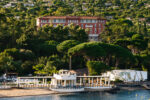
Oxwich Bay Hotel
“Washed ashore”
The rewards of staying at the Oxwich Bay Hotel are also gastronomic. There, you can reward yourself with not only the largest cheeseboard in Wales, and perhaps the world, but the best fruit crumble in Wales. If not the world.
If you get the bay-facing Three Cliffs (Tri Chlogwyn) room, you also get one of the best views from a bedroom, and one of the best post-walk collapse-and-recover locations anywhere.
Traditionally, with its Viking-named Worm’s Head (Pen Pyrod in Welsh) headland, wildflower meadows, the remains at low tide of the 1887 Helvetia, and stories of the Great Gower Gold Rush, when gold coins washed ashore from the wrecked Dollar, which was allegedly carrying the dowry of Catherine of Braganza, wife of Charles II, views from Rhossili Down across to west Wales, Lundy Island and the North Devon coastline, Rhossili beach (top image) – stretching from Spaniard Rocks to Burry Holms – gains all the plaudits.

Worm’s Head
“Rare plants”
But at four km (2.5 miles) long, Oxwich Bay is its unsung rival. At its eastern end are the cliffs of High Tor and Pobbles, after which other Old Rectory rooms in the Oxwich Bay Hotel are named. You can also stay in pods in the Secret Garden, Ivy Cottage or a static holiday home. It is a very popular wedding venue.
The hotel is set in Oxwich National Nature Reserve – a unique mix of beach, woodlands, cliffs, and salt and freshwater lakes. It is also home to rare plants such as dune gentian and round-leaved wintergreen, insects like the beachcomber beetle, and wetland birds such as water rail and little grebe, as well as the occasional wintering bittern. Go in January and February and you may well have the place almost to yourself.
And a few hardy surfers. And lucky dogs and dog walkers.
A former rectory built around 1788, the property began life as the Cliffside B&B, opened by the Williams family in 1958, before later becoming the Oxwich Bay Hotel. It is now owned by Ian Williams and is open all year round.

“Fishermen’s cottages”
The Chestnut Room’s fireplace is set into the trunk of a chestnut tree brought from the Frampton Court Estate in Gloucestershire. The large tree that runs across the room was felled from the local Penrice Estate, which extends from Horton to Oxwich.
Thirteen miles from Swansea and an hour from Cardiff Airport, Oxwich is a village of traditional white-walled fishermen’s cottages, an old post office and thatched cottages – one of which was allegedly stayed in by the preacher John Wesley.
How many beaches in Wales have a shorefront Michelin-starred restaurant? Rhossili doesn’t. Chef Hywel Griffith’s The Beach House sits right on the shore at Oxwich.
There is a public footpath along the coast from Oxwich Bay, around Oxwich Point, to Port Eynon Bay and on to Rhossili. You start at St Illtyd’s Church by the hotel.

St Illtyd’s Church
“Effigies made of local sand”
Named after a prominent figure in the early history of the Church in Wales, born in the fifth century, it is largely medieval. The tower and its bell date from the 14th century. The ancient font was allegedly brought here by St Illtyd himself in the sixth century. Near the altar are two effigies made of local sand and plaster. They occupy a recess known as Doolamur’s Hole.
According to local tradition, the armed knight and his lady represent members of the de la Mare family of Oxwich Castle who drowned in Oxwich Bay in the early 14th century. Some historians say the armour suggests the 15th century and that the figures may depict Sir John Penrees, who died in 1410.
A well in the upper churchyard dried up long ago. It was believed to be haunted. A ghostly white horse known as a ceffyl dŵr – a “water horse” – used to be seen in the churchyard before jumping into the well.
Port Eynon is the most southerly point on Gower and is thought to be named after an 11th-century Welsh prince. Once there was a booming trade in oyster fishing, limestone quarrying, lobstering and crabbing. And smuggling.
Illicit brandy is no longer hidden under the church altar or in the nearby Culver Hole, which may have been created by the little people of Gower, the Tylwyth Teg.
Now families rock-pool in its huvvers and scarras, and queue for fish and chips and ice cream at The Seafarer.
One of the oldest ceremonial human burials in western Europe was found in 1823 on Gŵyr. Dating back around 33,000 years, the red ochre-daubed bones – the so-called Red Lady of Paviland – turned out to be those of a man.

Sunset at the Gower Peninsula
“Folk tradition”
The full Gower coast walk covers just over 80km of spectacular coastline. Depending on the route taken, it can include Weobley and Oxwich castles, the Mumbles, Langland Bay, Caswell Bay, Broughton Bay, Paviland, Pwll Du and Mewslade Bay.
Legend has it that Arthur’s Stone was thrown there by him from the other side of the Loughor estuary after he found it in his shoe.
There is also a strong folk tradition on Gŵyr, best experienced at the Gower Folk Festival in June.
Whichever route you take, and whatever direction you go, there will always be a Joe’s waiting for you at your journey’s end.
The Gower is not all about plunging cliffs, bellowing blowholes, and large expanses of heather, gorse and sand. It is also about large tubs of freshly churned vanilla ice cream. With vermicelli sprinkles.
Or, if you go to the Oxwich Bay Hotel, chef Phillipa Barnett’s tasty handiwork and very welcome, very generous portions.
More info:
oxwichbayhotel.co.uk
visitwales.com

Kevin Pilley is a former professional cricketer and the ex-chief staff writer of PUNCH magazine. His humour, travel, lifestyle and food & drink work appears worldwide. He has been published by over 600 titles.