The Ladies Football Club – Review – Sheffield Crucible Theatre
By Clare Jenkins, March 2026
Remember last summer, when The Lionesses roared to victory in the 2025 Euros, beating Spain in a nail-biting penalty shootout? The whole of the UK seemed to go football mad. But how many of us knew that they were following in the nifty footsteps of women living over a century ago?
This world premiere, adapted by Tim Firth (of Calendar Girls fame) from a monologue by Italian Playwright Stefano Massini, sets out to tell the forgotten story of 1st World War munitions workers who helped establish women’s football in this country. But their initial triumph only lasted a few years. In 1921, they were banned from playing professionally on the grounds that the game was too rough and ‘unsuitable’ for women, who shouldn’t play ‘masculine’ sports. That ban, under hastily invented FA rules, lasted for 50 years, until 1971.
Taking inspiration from a real-life factory football club in Preston, the play is actually set in Sheffield, the self-proclaimed ‘home of football’ where the game’s modern rules were invented. And where Sheffield FC, the world’s oldest independent football club, was formed in 1857.
“Sisterly solidarity”
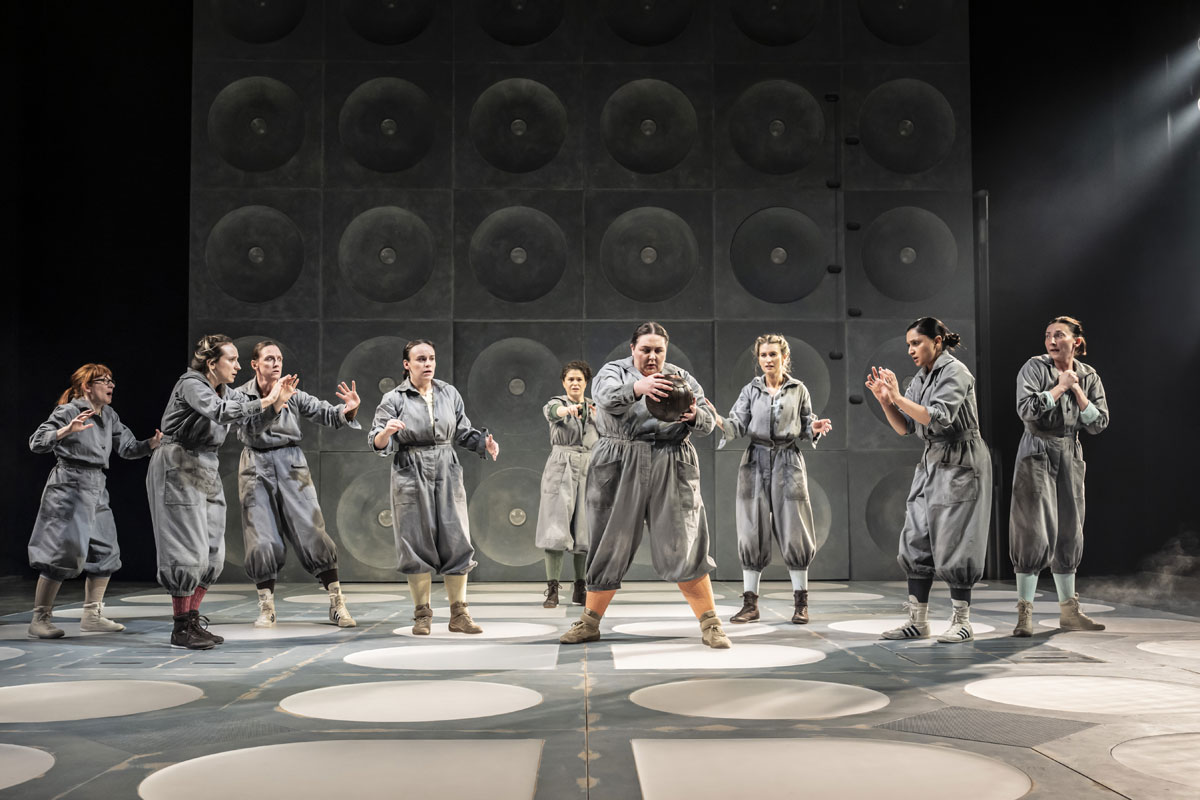
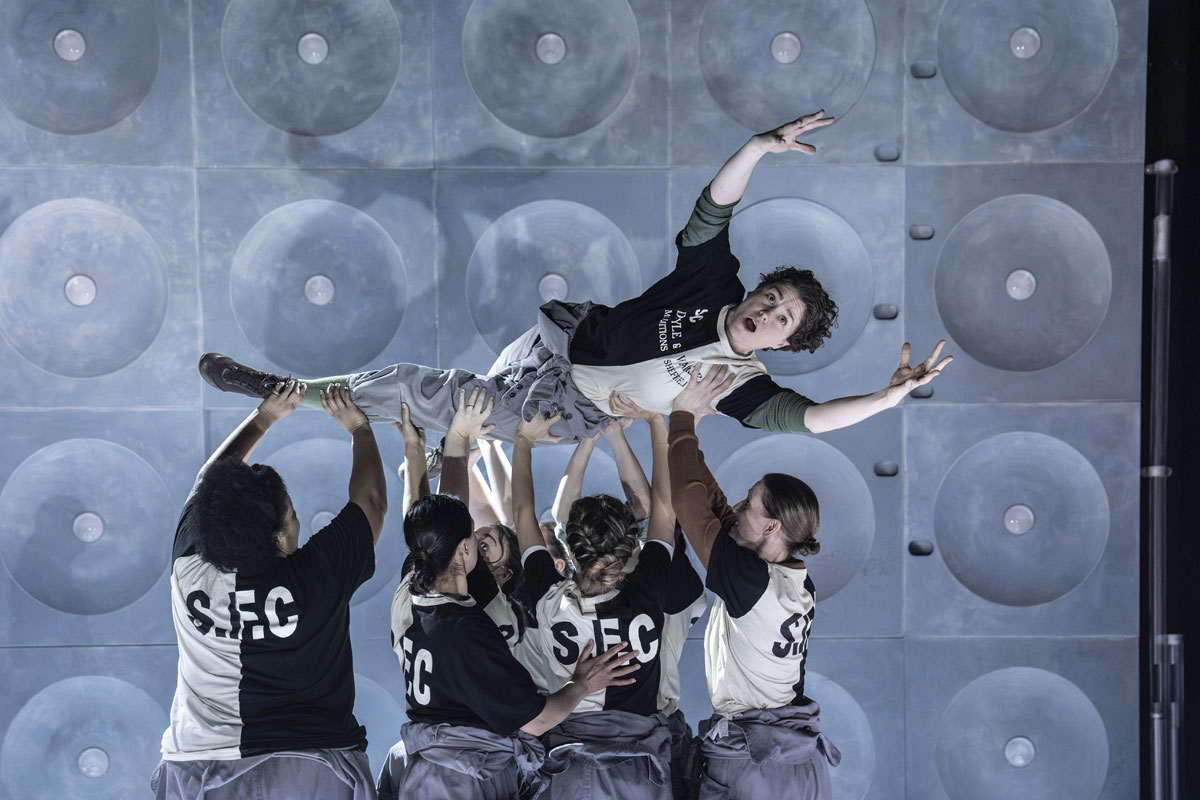
With their brothers, boyfriends and husbands away fighting at the Front, these 11 grey-boilersuited women bond over lunchtime kickabouts, perfect their game and end up competing not just against other ‘ladies’ teams but also, eventually, against a men’s team at Stamford Bridge.
Not long afterwards, with the war over and their men returning from the conflict, they lose not only their jobs but also their sporting prowess. As director Elizabeth Newman puts it: ‘The football pitch is an allegory of women’s place in society. When it’s helpful, we’re allowed to have space, but then when it’s less helpful, we’re then asked to remove ourselves.’
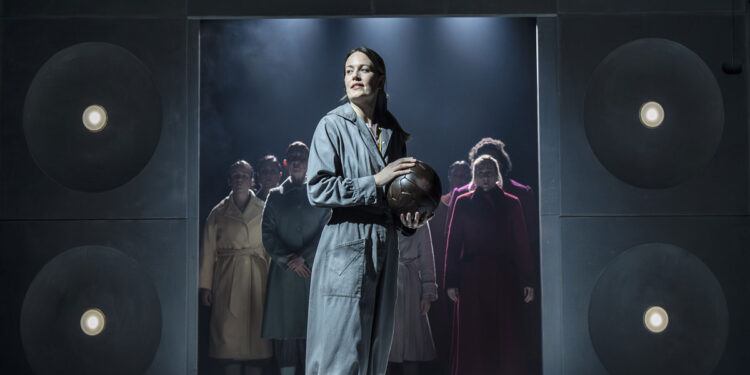
So the play sets out to celebrate sisterly solidarity, defiance and (ultimately limited) liberation, developing from factory-floor banter (about sex, husbands, religion, politics) to on-pitch triumph, against a backdrop of air-raid sirens and bomb shelters. Meanwhile, designer Grace Smart’s literal backdrop of grey chalkboard lights up with graphics indicating goals, production-line cartridges, football strategies, place names and dates.
However, as though underscoring the continuing need for women’s voices to be heard, the action starts as it means to go on: loud. The audience enters to strident music, and the 11-strong cast rarely allow their voices to descend to ‘normal’ speaking level. The result can be relentless, the script at times incomprehensible.
“Energy and humour”
That’s not to deny the commitment of the ensemble cast, from the feisty Rosalyn (Jessica Baglow) and rebellious Berenice (Lesley Hart), through the Socialist Hayley (Leah Brotherhead) to the steely determination of Krupa Pattani as team captain Cheryl and Violet ‘the peacemaker’ (Cara Theobald). It’s just a pity there aren’t more moments of quiet reflection, more nuanced conversations between individual women, rather than constant, shouted team talk. Like Ben Jacob’s’ lighting, there needs to be more light and shade in the delineation of character.
All the same, the cast capture, with energy and humour, plus occasional moments of poignancy, the women’s evolution from ‘proletarian rabble’ (as the factory owner calls them before realising their commercial potential) to pioneers of women’s football.
Expertly choreographed by movement director Scott Graham, the players recreate – at times athletically, at others balletically – their on- and off-pitch moves. Slow motion passes, runs and tackles balance the fast and furious action as they kick and head imaginary balls, line up defensively for free kicks, hopscotch their way through impromptu training sessions.
The ending sees each woman delivering a short speech about what happened to her in later life. Though sentimental, it’s also illuminating, and acts as some compensation for all the clamour.
The Ladies Football Club is at Sheffield Crucible Theatre until Saturday 28th March
images: Johan Persson
Clare is a journalist, former BBC Radio broadcaster and co-founder of the independent radio production company Pennine Productions. She and her national newspaper travel writer husband Stephen McClarence have been regular visitors to India for different work commissions.
Two years ago, their book, Teatime at Peggy’s: A Glimpse of Anglo-India, was published by Bradt: https://www.bradtguides.com/product/teatime-at-peggys/, and is now in its 2nd edition. They are currently working on a sequel.
Clare’s also written a number of books based on personal testimony, and is currently compiling an oral history of Sheffield Newspapers for Sheffield Archives and the British Library.