Death on the Nile – Review – Sheffield Lyceum Theatre
By Clare Jenkins, March 2026
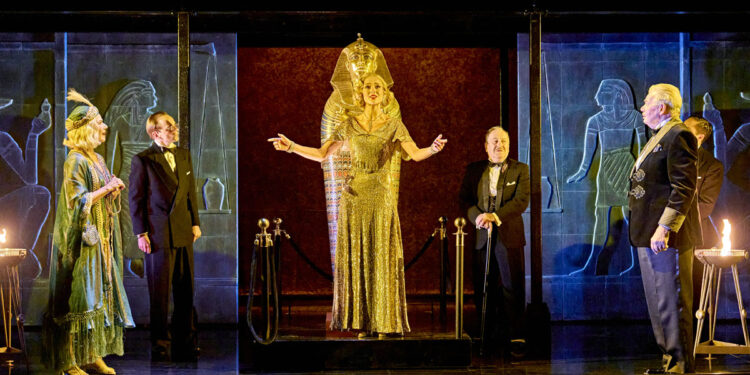
“It was a memorable trip,” Hercule Poirot says at the end of Ken Ludwig’s liberty-taking adaptation of Agatha Christie’s tragic love triangle. You can say that again: two murders, one suicide, two romances, and a priceless gold Egyptian sarcophagus that has to be shot open to release the entitled heiress who’s got herself locked inside (surely they could have found a table knife to do the trick? What are these wealthy passengers paying good money for?). One thing’s for sure – this is not your usual leisurely cruise down the Nile.
Nor is it altogether Christie’s story, despite Mark Hadfield’s amiable Belgian detective saying, “He was good, your Shakespeare, but he was no Agatha Christie.” For a start, there are fewer characters: no upper-class anti-capitalist, no elderly kleptomaniac, no furtive French maid. That in turn means fewer murders. Then one of the male characters is reimagined as female (why exactly?) and a female character, instead of getting killed, embarks on a late-onset love affair.
Delivered by the same creative team that brought us last year’s excellent Murder on the Orient Express, this slick but over-simplified Death on the Nile is a decent way to spend a couple of hours, though it lacks the former’s assurance of tone and pace. Whereas MOTOE managed to combine both mounting tension and sly humour, DOTN – again directed by Lucy Bailey – slides very quickly into Cluedo parody, with some of the cast deliberately playing it for laughs.
“Bumblingly vague”
The result is uncertain: just how tongue in cheek are we supposed to take Ludwig’s script, with its moments of menace sometimes undermined by wry self-mocking asides? When shots ring out, people in the audience jump – and then laugh.
Hadfield’s well-paced Poirot apart, the acting veers from hammy and camp to almost as wooden as the slatted panelling on Mike Britton’s atmospheric two-tier set. As Jacqueline De Bellefort and her soon-to-be-ex fiancé Simon Doyle, Esme Hough and Nye Occomore are as restless and nervy, as grimacing and gurning, as any star from the silent film era.
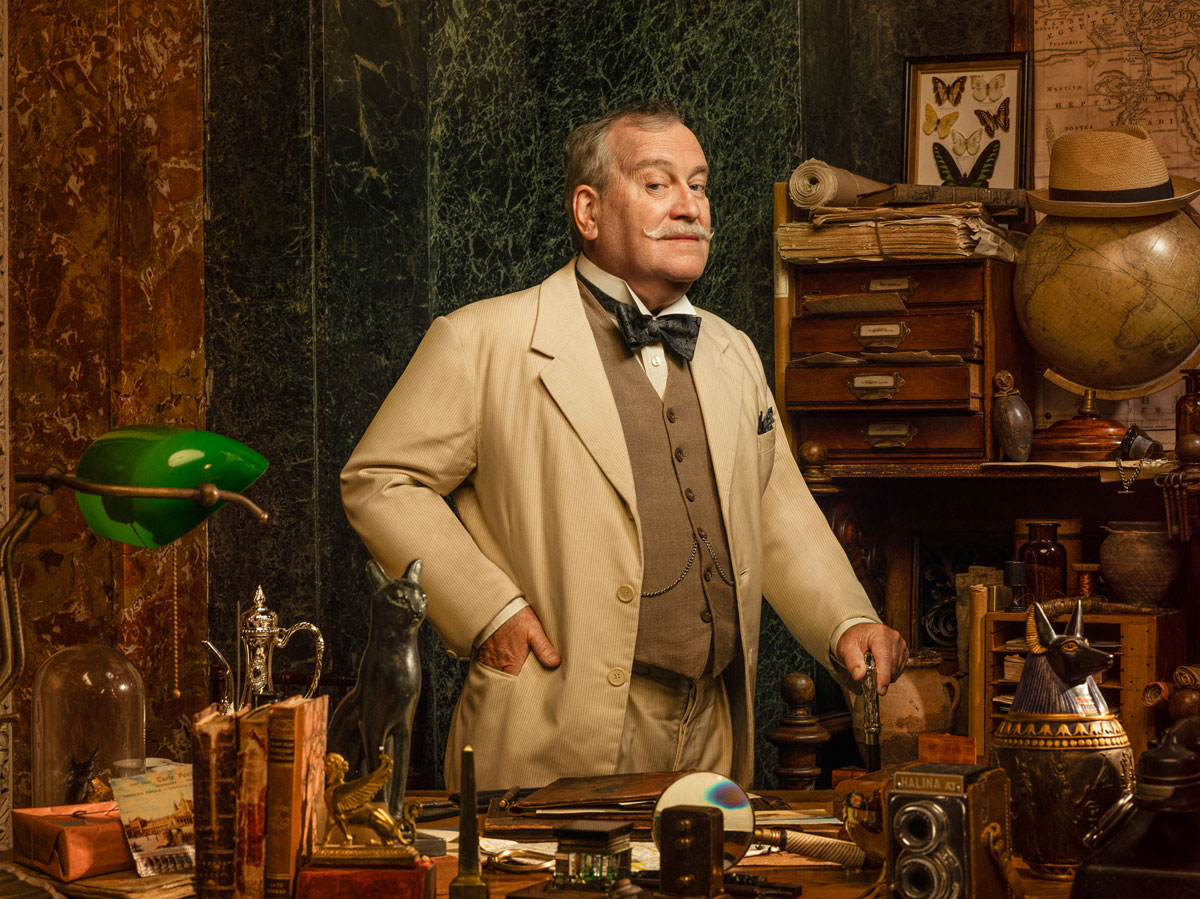
Holby City veteran Bob Barrett as Poirot’s sidekick Colonel Race is so bumblingly vague, it’s impossible to believe he really works for MI5, while Terence Wilton’s aged actor Septimus Troy (an addition to the story) is straight out of the declamatory thespian school. Glynis Barber, meanwhile, cuts a dash as the extravagantly costumed novelist Salome Otterbourne, and Libby Alexandra-Cooper, in her professional debut, portrays doomed heiress Linnet Ridgeway as brittle as ice.
We initially see Jacqueline and Simon embracing passionately in a foggy London street as Poirot watches from the shadows. The action then moves to the British Museum, where Egyptology director Atticus Praed (Howard Gossington) is hosting a soiree for leading benefactors, and introducing them to the startling sarcophagus he now has to transport back to its original home.
“Suitably gorgeous”
The characters then re-assemble on a luxury Nile steamer, impressively recreated on two levels, the action taking place both on deck and inside the elegant cabins and public rooms. By now, though, twitchy Simon has switched his affections to Linnet, and the couple’s honeymoon is disturbed by jilted Jackie’s vengeful presence.
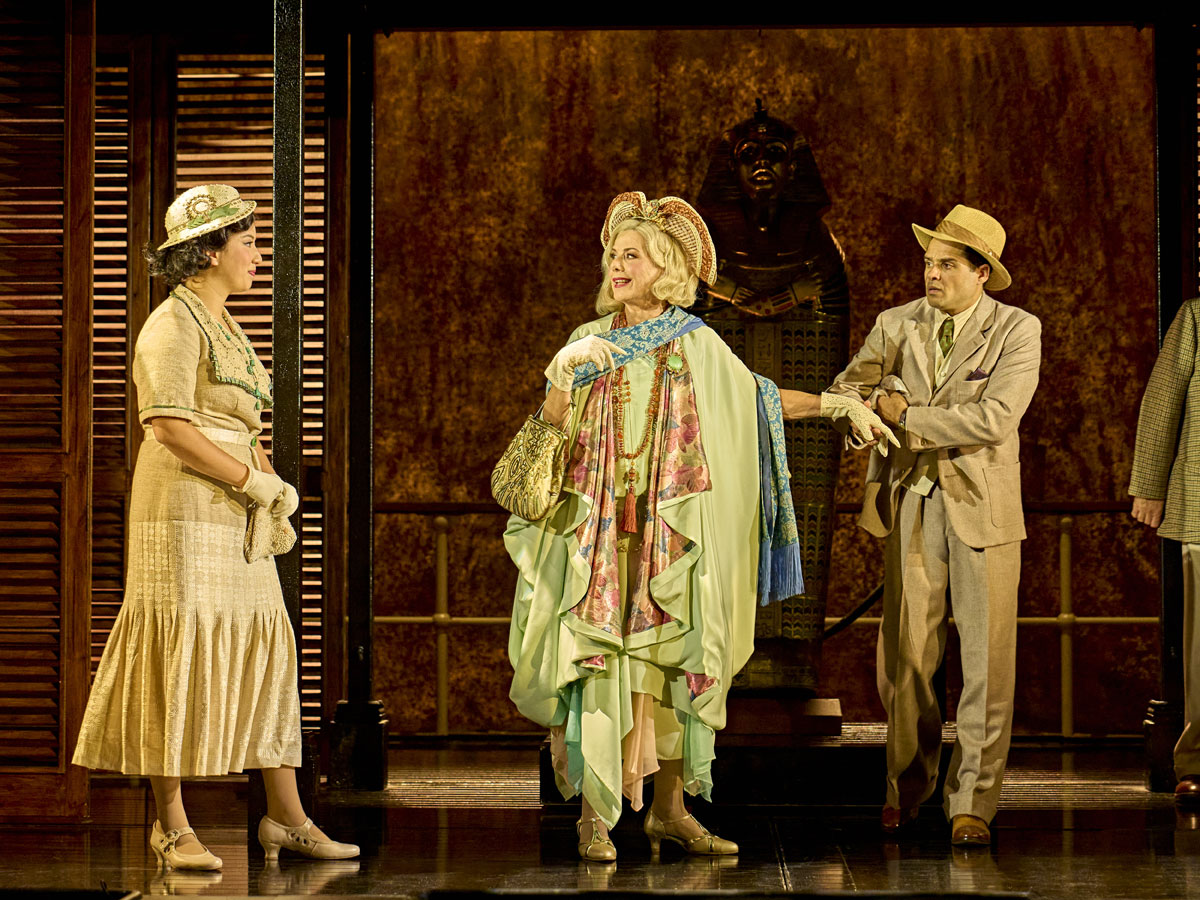
While the tension (supposedly) mounts, the fascinating world outside – of pharaohs and pyramids, temples, tombs and hieroglyphs – is cleverly hinted at by dappled light (sometimes moodily shading faces) and sound effects of cicadas and birdsong. And the period costumes are suitably gorgeous.
The rather slow first act ends with a gunshot, the second act opens with Linnet lying dead and bloodied in bed. So whodunnit? Was it jealous Jacqueline, Simon (himself now wounded), the people diddled out of money by Linnet’s father, her dodgy Canadian trustee…? It doesn’t take long for Poirot to find out, as the action continues speedily – or “Vite! Vite!” as he would say – towards its complicated conclusion.
“I have never forgotten my voyage,” Poirot muses at the end. Zut alors! Time will tell if this particular voyage is as memorable as that on the Orient Express.
Death on the Nile is at Sheffield’s Lyceum Theatre until Saturday
images: Jay Brooks
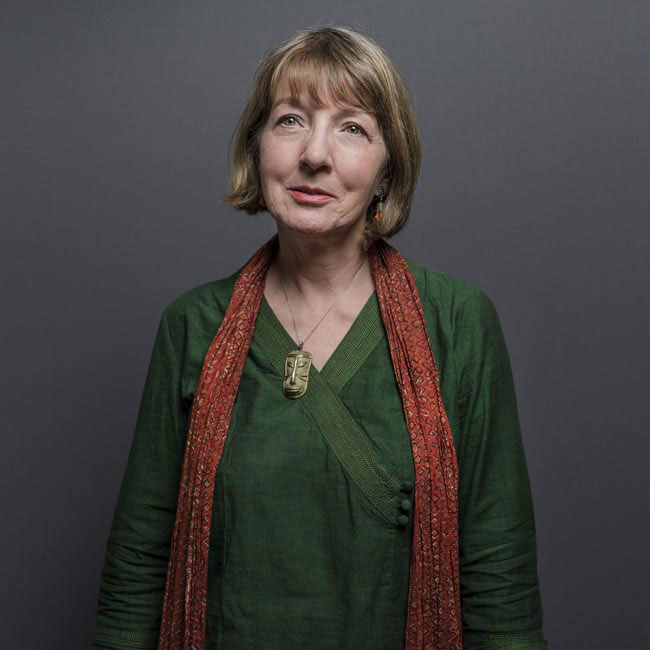
Clare is a journalist, former BBC Radio broadcaster and co-founder of the independent radio production company Pennine Productions. She and her national newspaper travel writer husband Stephen McClarence have been regular visitors to India for different work commissions.
Two years ago, their book, Teatime at Peggy’s: A Glimpse of Anglo-India, was published by Bradt: https://www.bradtguides.com/product/teatime-at-peggys/, and is now in its 2nd edition. They are currently working on a sequel.
Clare’s also written a number of books based on personal testimony, and is currently compiling an oral history of Sheffield Newspapers for Sheffield Archives and the British Library.