Pagliacci [English Touring Opera] – Review – Sheffield Lyceum Theatre
![Pagliacci [English Touring Opera] – Review – Sheffield Lyceum Theatre main](https://www.on-magazine.co.uk/wp-content/uploads/Pagliacci-English-Touring-Opera-–-Review-–-Sheffield-Lyceum-Theatre-main-750x375.jpg)
By Clare Jenkins, March 2026
It’s less than a year since English Touring Opera relocated from London to Sheffield, and at the weekend they premiered two very different works there: Gilbert and Sullivan’s light-hearted Gondoliers and Leoncavallo’s much darker Pagliacci.
Director Eleanor Burke’s Pagliacci opens unobtrusively, without any fanfare. As the audience settle into their seats, casually-dressed members of a travelling theatre troupe (the pagliacci or clowns) wander round a drab backstage set. Some check the props, one reads a book, another simply stares into space, while a few of their colleagues toss a small ball back and forth to each other. Who’s looking at who here?
The ordinariness of this (over-extended) opener is eventually broken by the arrival of Nedda, a tense woman in fur coat and sunglasses, followed by Canio, her fellow star and older husband, ill-at-ease in a badly-fitting suit. They argue, she storms offstage and he gives way to angry despair. Another character steps forward to deliver the Prologue and explain that what we are about to see might be art but it’s also reality.

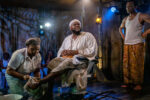
Danny Shelvey (Silvio) and Paula Sides (Nedda) in ETO’s Pagliacci
“Blurs the lines”
So the scene is set for this contemporary and at times confusing version of Leoncavallo’s verismo tale of marital jealousy, inspired by a real-life murder and reset in 20th celebrity culture. With an English translation by ETO’s artistic director Robin Norton-Hale, it explores what it means to wear a public mask over a private face and the effort required to maintain that mask when your life is falling apart.
Like the culture of celebrity, the opera blurs the lines between performance and reality and, at times under Eleanor Burke’s direction, it’s hard to work out where ‘real life’ ends and performance begins. In one scene, for instance, Nedda (sensitively portrayed by Paula Sides) takes refuge in the rehearsal room and starts reading the script of a new play. As she sings her aria Stridono lassù, the Bird Song, it’s not altogether clear whether she’s expressing her own desire to be free or reading aloud from the page.
Ever-watchful and ever-watchable, the ten-strong chorus – now wearing false noses, the nearest anyone gets to clown costume – take up position around the stage to watch silently as Matthew Siveter’s menacing Iago-like Tonio tries to force himself onto Nedda. Rejected, he vengefully spies on her and her lover Silvio (fine-voiced Danny Shelvey) as they sing their duet of hopeless love, exhibiting a chemistry that’s lacking between her and her husband.

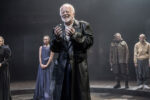
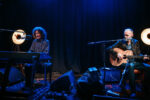
Ronald Samm (Canio) and Ensemble
“Terrible truth”
From the start, Ronald Samm’s powerfully-voiced Canio looks like a man on the brink of a nervous breakdown, his stance awkward when he’s not writhing uncontrollably or knuckle-chewing with rage. Act 1 ends with him singing the famous ‘tears of a clown’ aria ‘Vesti la giubba’ – “Dress in your costume, turn your face to the footlights”.
Act 2 takes us into the commedia or play-within-a-play, Michael Pavelka’s workaday set now transformed into a shocking-pink kitchen inhabited by Beppe (the ultra-amiable Harry Grigg) and Nedda in Barbie-pink outfit. As they play out their comedy – she fluttering her eyelashes coquettishly, he hiding under the table – the lines between private lives and public spectacle blur even more.
At this point, Canio – the only character still in ‘civvies’ – descends into full-blown madness, strangling his wife with a telephone cord while Silvio, instead of facing a similar fate as in the original, escapes offstage. The excellent ensemble, resembling black-clad ravens, lean into the action, voyeuristically encouraging and enjoying it, before realising the terrible truth of what they have seen.
Under Gerry Cornelius’s direction, the orchestra copes well with Leoncavallo’s emotionally intense demands. If the sound is sometimes a tad harsh, maybe that suits the abuse and violence we witness onstage.
More info: englishtouringopera.org.uk
images: Richard Hubert Smith
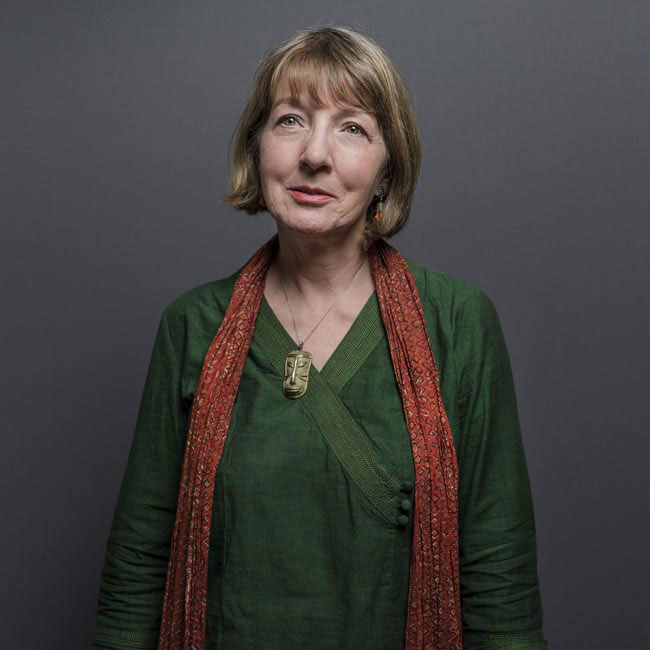
Clare is a journalist, former BBC Radio broadcaster and co-founder of the independent radio production company Pennine Productions. She and her national newspaper travel writer husband Stephen McClarence have been regular visitors to India for different work commissions.
Two years ago, their book, Teatime at Peggy’s: A Glimpse of Anglo-India, was published by Bradt: https://www.bradtguides.com/product/teatime-at-peggys/, and is now in its 2nd edition. They are currently working on a sequel.
Clare’s also written a number of books based on personal testimony, and is currently compiling an oral history of Sheffield Newspapers for Sheffield Archives and the British Library.




The libretto says “Put on your jacket costume!”
The set is ugly.