Leeds in Revolt: Luddites, Hunger and Lady Ludd
By Harry Bratley
The background leading up to the 1812 Luddite riots dates to the late eighteenth century, when industrial unrest involved cloth dressers (croppers), a group of men who finished cloth supplied by merchants. This was a highly skilled profession and, if done well, added greatly to the value of the cloth. Such was the industrial muscle of the cloth dressers that they had, for decades, successfully resisted the introduction of labour-saving machinery such as the gig mill (a machine for raising the nap on cloth) and, much more significantly, the shearing frame, which threatened the cropper’s skilled employment. These operatives had created an effective trade organisation, and attempts to install the hated machinery were frequently rebuffed, usually through the threat of strike action. Opposition to this machinery became violent in November 1799, when a crowd destroyed Johnson’s gig mill at Cross Flatts, Beeston.
This attack in Beeston occurred during the War of the Second Coalition, part of the French Revolutionary Wars. Against a background of war, industrial disputes and fears of political revolution, the government passed the Combination Acts of 1799 and 1800, making it illegal for workers to combine to press their employers for better pay and conditions. As a result, trade unions were effectively banned. However, workers were able to circumvent these Acts by operating through mutual benefit associations, carrying on the fight against employers and spurring workers into resistance.
In 1802, Leeds merchant and magistrate William Cookson urged manufacturers to refrain from installing machinery, fearing that ‘horrid outrages’ would occur.
With Parliament repealing older legislation regulating woollen manufacture in 1809, and manufacturers increasingly introducing gig mills, shearing frames and other labour-saving machinery, hostilities came to a head with the Luddite riots of 1812.
With machinery costing skilled workers their jobs and driving down wages, people started to fight back. They destroyed machines where they were installed and, in some cases, burnt down factories and even mill owners’ homes, acting in the name of the mythical General Ludd.
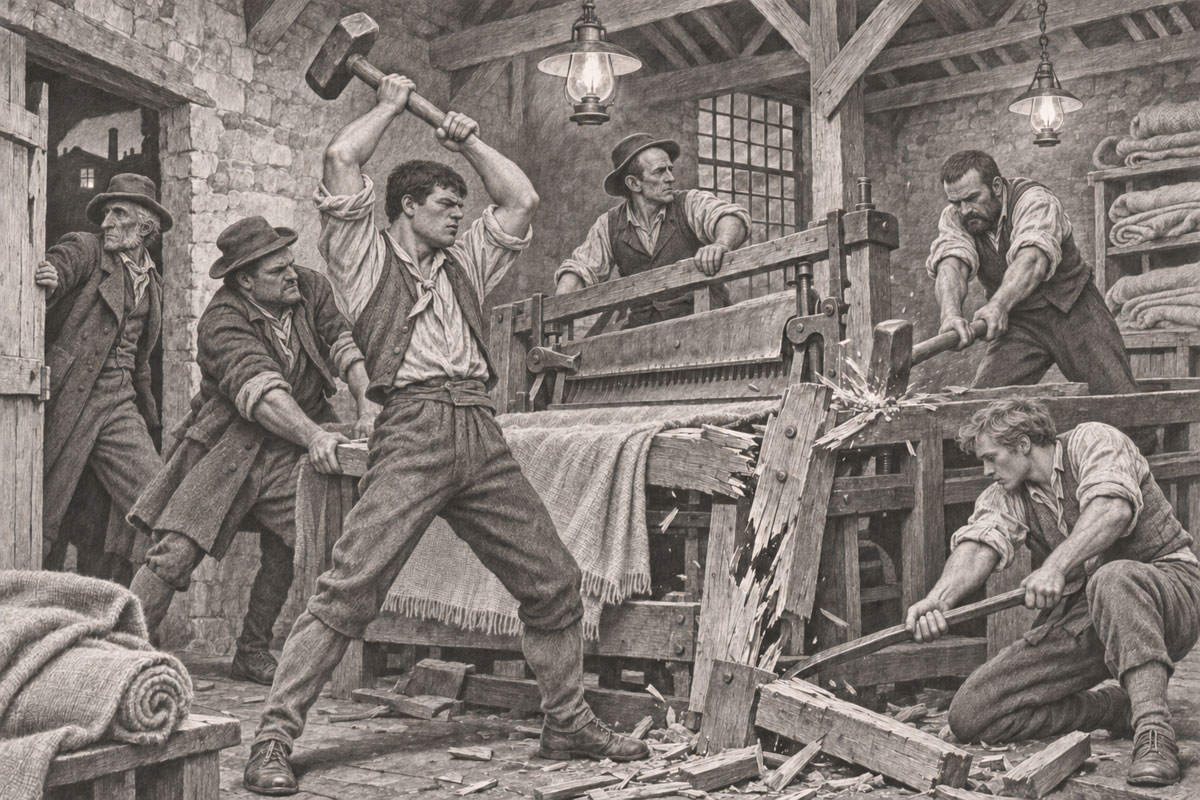
“Increased the suffering”
Ned Ludd is the legendary figure after whom the Luddites named their movement. According to the story, Ludd broke two knitting frames in Leicestershire in 1779. When the Luddites emerged in 1811, his name was adopted as that of their imaginary figurehead, General Ludd. The term ‘Luddite’ later became a label for those who objected to labour-saving devices. Whenever machinery was smashed, the claim ‘Ned Ludd must have done it’ became a catchphrase, and the association with the myth and legend grew.
By January 1812, Luddism had spread to Leeds, where a suspicious fire broke out at Oatlands Mill at Woodhouse Carr. The Leeds Intelligencer reported that thousands thronged the spot, some lamenting the calamity and others proclaiming it a blessing. Another significant attack came in March, with the destruction of around 18 pieces of cloth belonging to Dickinson, Carr & Shann. Rewards were offered for information about those responsible for the unrest. Nervousness in Leeds continued, and local magistrates feared further violence. Military reinforcements were brought into the town to help maintain order.
Another distressing circumstance that further increased the suffering of ordinary working people was the inflated price of wheat in 1812. A Cambridge University account describes prices as 50 per cent above average and twice what they had been a decade earlier. Wartime disruption to trade, including Napoleon’s Continental System, contributed to the pressure on supplies and prices. Frustrated by his inability to invade Britain or overcome the formidable Royal Navy, Napoleon issued the Berlin Decree in 1806, seeking to exclude British commerce from continental European ports and markets.
Against this background, August brought an attack on Shackleton’s corn mill in Holbeck and a protest at the King’s Mills on Swinegate, both connected with continuing high food prices. Ordinary Leeds townspeople faced severe hardship. According to Chris Nickson’s account, soup kitchens were filled with the destitute searching for food. Even dried fish sold at threepence a pound did little to help those with no money.
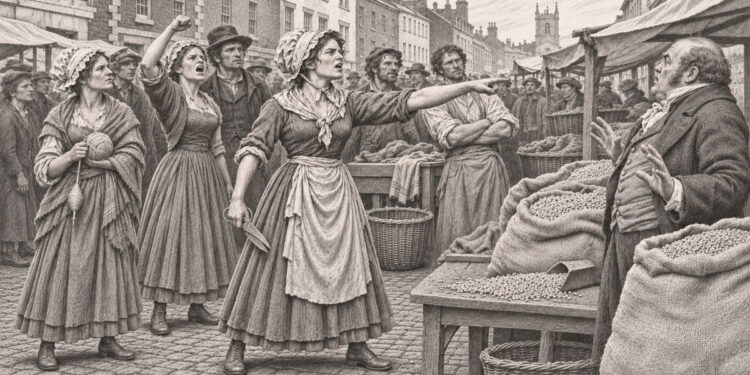
‘Lady Ludd’ appeared on 18 August 1812 at the head of a crowd of women and boys in Leeds. Some accounts describe participants in the food protests as ‘General Ludd’s Wives’. Marching through Briggate, where the market was being held, protesters jeered at and harassed corn sellers, farmers and bakers. Assaults and skirmishes followed, and contemporary newspapers reported that wheat was seized and scattered in the streets. That night, damage was done to Shackleton’s milling premises in Holbeck. The following evening, crowds gathered at the King’s Mills and meal shops, although the Leeds Mercury reported no substantial violence there.
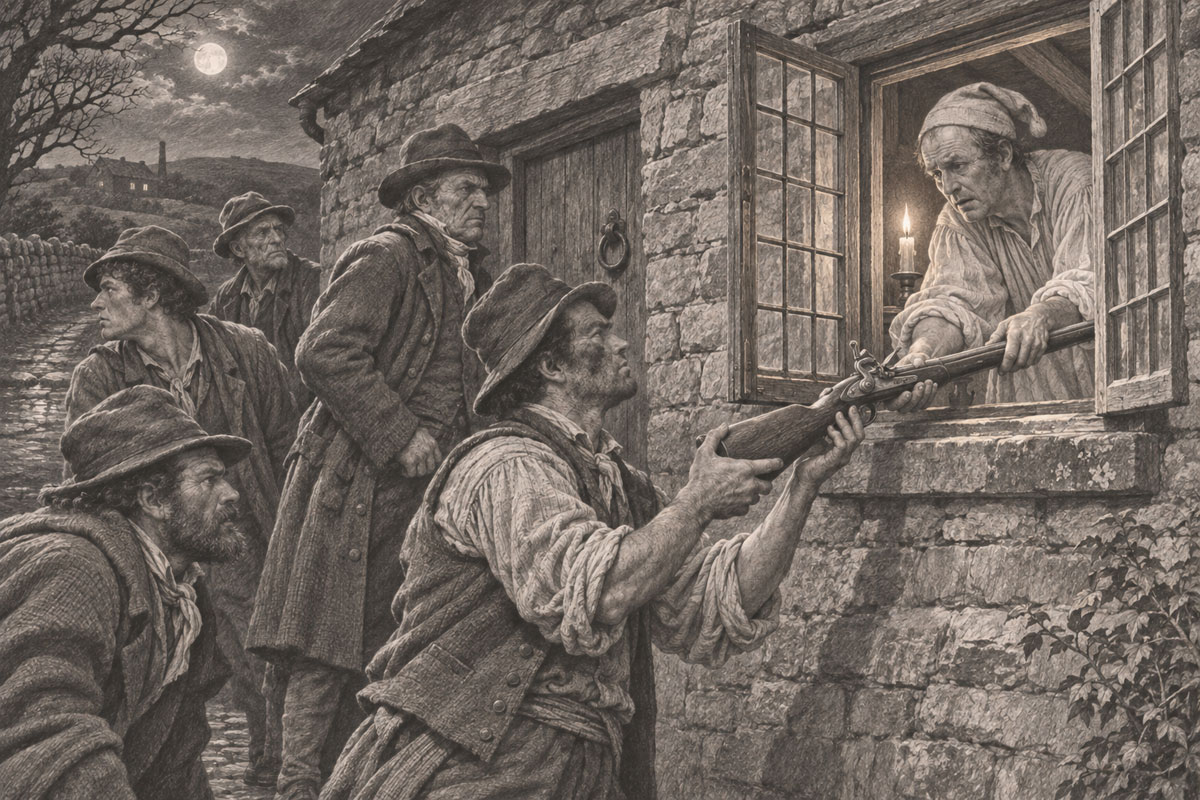
“Raids on private houses”
Two days after her first appearance, ‘Lady Ludd’ was more challenging. Potatoes were seized, and she commanded shopkeepers to lower their prices. ‘Lady Ludd’ was an assumed identity, and the person behind it remains unknown. One theory is that she was Alice Mann, who later became a leading figure in Leeds radical politics and a printer and publisher of radical literature. However, Alice and her husband did not enter bookselling until around 1818, and her identification as Lady Ludd remains speculative. Another suggestion, discussed by Chris Nickson, is that the figure was a man wearing women’s clothing as a disguise.
The Leader of the Luddites, an English satirical print published in May 1812, shows an agitator in a bonnet and dress encouraging workers wielding weapons beside a burning factory. It predates the August disturbances in Leeds. George Mellor was a prominent Luddite leader in the Huddersfield area.
Throughout 1812, Luddites obtained weapons and money through raids on private houses. The Leeds Mercury reported one burglary at the home of a Mr Barraclough, whose family were roused from their sleep by a party of men demanding firearms. The family immediately complied, handing a firearm to the men through a window. The intruders then insisted that the door be opened and ransacked the downstairs rooms without finding any money. They proceeded to Mr Barraclough’s bedroom and demanded all the money he had, whereupon he gave them 20 shillings in silver.
The government responded forcefully to the unrest, protecting manufacturers and their property. Parliament passed the Frame Breaking Act of 1812, making the destruction of stocking and lace frames a capital offence, while thousands of troops were deployed to the affected districts. Luddites were put on trial, with some executed and others transported to Australia. These measures helped weaken the movement, and by 1813 its activities had diminished, although further outbreaks occurred, including the destruction of lace frames at John Heathcoat’s factory in Loughborough in 1816.
In 1817, an unemployed stockinger called Jeremiah Brandreth led the Pentrich Rising in Derbyshire. This was a wider political insurrection, distinct from the campaigns against textile machinery, although it arose from a related background of hardship and discontent. The defeat of Luddism left unresolved many of the grievances associated with the Industrial Revolution, including poor working conditions and low wages.
illustrations are representational

Harry was born in Bradford and has lived in Kippax, near Leeds, for over 40 years with his wife, Ann. At school, he studied History, Geography, and English Literature, dreaming of visiting iconic places like the Grand Canyon, Taj Mahal, and Sydney Opera House. He spent much of his career in the travel industry, allowing him to explore the world and fulfil his childhood dreams. With a lifelong passion for history, Harry pursued further education upon retirement, earning a Bachelor of Arts (Honours) degree in History from university.