Alice Cooper: Devil on My Shoulder Book Tour – Review – Stockton Globe
By Victoria Holdsworth, October 2026
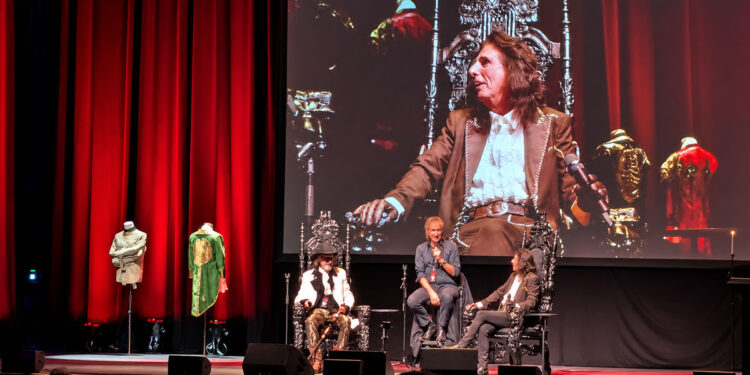
Tonight, for one night only, on a cold evening in Stockton, the Godfather of Shock Rock was about to take to the Art Deco stage. Two ornate black thrones sat on either side of a stool, and displayed in the background were four of Alice’s most recognisable outfits from different eras of his career, including the straitjacket.
Tonight wasn’t a concert. No full band, no snakes, no guillotine. Just Alice sitting on stage talking about his life, with Arthur Brown hosting alongside Daniel Richler, the co-author of his new book.
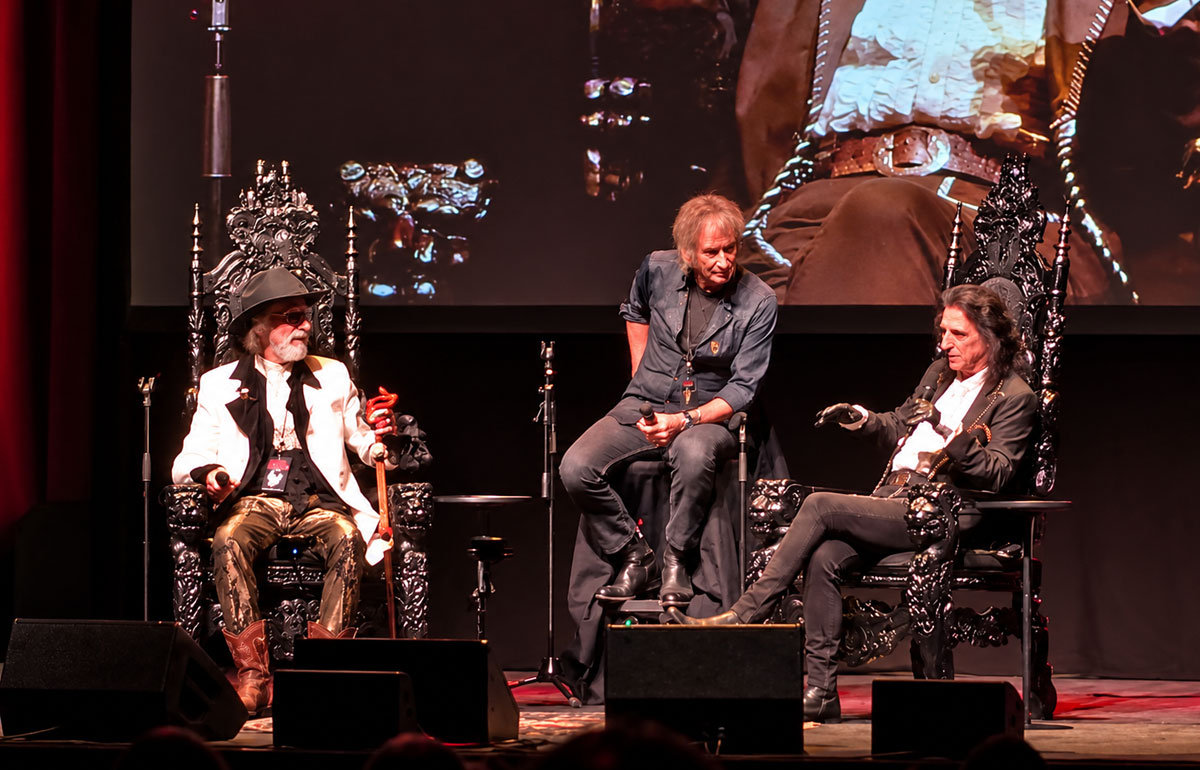
Arthur Brown was announced to the stage, and the 84-year-old looked every inch the part. White coat, hat, his infamous boots and distinctive walking cane, all the while playing up to the theatrical reputation that precedes him, without turning it into a full performance.
He talked about the early days of theatrical rock and how both he and Alice had been pushing similar ideas at the same time, just on opposite sides of the pond, before Richler introduced the man everyone had come to see. Alice strode onstage to deafening applause, clad in his usual smart black attire, and took to his throne, looking ready for anything.
Once they’d settled, the evening began with Alice telling stories, Arthur jumping in and Daniel occasionally guiding the conversation along or prompting particular memories. They covered the early years, Vincent Furnier’s childhood and upbringing, the formation of the band and the subsequent move to Los Angeles. Alice expanded on his decision to lean into the shock element, thus creating the whole Alice Cooper character. Cooper was very straightforward about the tension between the real person and the stage persona. The ‘angel on one shoulder, devil on the other’ idea from the book came up naturally and didn’t feel forced.
Alice stated that tonight he was going to clear up the whole Toronto Rock ‘n’ Roll Revival Festival chicken incident, still claiming that he had no idea how the chicken got onstage. However, he mistakenly thought it could fly, but as he launched it, it plummeted and was rapidly torn to pieces by members of the audience in the first few rows. He expressed his disgust and guilt, although, cracking a sly smile, he added that the first two rows of that audience were actually made up of people in wheelchairs or with accessibility issues, giving the whole story an even darker twist.
The story didn’t end there, though, as he further explained that, to rub salt into his wounds, Colonel Sanders of KFC fame was staying in the same hotel. Photographic proof was shown on the screen behind him, at which point Alice started chuckling to himself and shaking his head, exclaiming: “You just couldn’t write this!”
Cooper explained that from that moment on, he realised that the whole theatrical aesthetic was what kept his fan base responding. He said the look he had originally planned was somewhere between a clown, Bette Davis in What Ever Happened to Baby Jane? and Emma Peel from The Avengers.

“Ominous shadows”
On a large screen onstage, there were photographs of Alice throughout the years with a plethora of famous faces, from actors and musicians to royalty. Alice recalled some of his closer friendships with other rock stars, including Iggy Pop, Hendrix and Jim Morrison, but it was a promised Keith Moon story that had him chuckling to himself before he’d even told it.
While filming the 1977 film Sextette, Alice and other cast members, including Ringo Starr, Timothy Dalton and Keith Moon, starred alongside Mae West, who was then in her eighties. They were told that she had a habit of inviting male cast members back to her trailer after filming scenes. She tried it on with Alice. He turned her down, telling her he wasn’t even interested in women of that age. She insisted she was “all woman”.
At lunch the next day, the men compared notes and realised she’d propositioned all of them. Each claimed to have declined her advances. However, when they got around to asking Keith Moon, the others looked at him expecting another polite refusal. Moon simply replied, “How many chances do you get to be with Mae West?” and admitted he’d gone through with the deed. Cooper was horrified and titillated.
Arthur also added to the energy, albeit at a somewhat slower pace, throwing in his own memories or pushing Alice on a detail. He even managed to roar out his infamous line, “I am the God of Hell Fire!”, much to the delight of the crowd. Alice responded with some fitting one-liners or expanded on certain memories, while Daniel was there to clarify particular stories or facts contained in the book.
The three of them worked well together, and it felt like a long, structured conversation between people who knew the same worlds.
Alice then talked about how much he had missed Christianity through his wilderness years, and how, after being sober for decades, he now channels his inner Alan Rickman to produce his dark, menacing stares, instead of the lines being blurred by alcoholism, which had led him to create different faces for the figure that is Alice Cooper.
He explained how horror films had been so influential in his life, but he never took them seriously, even laughing at how the effects were created, knowing from a young age that it was all make-believe. That was until The Exorcist was released. By his own admission, Alice said that was the only horror film that had ever scared him, because he believed it could really happen. He told the audience it wasn’t simply down to his Christianity, but also to a story his grandfather, a missionary who had worked alongside Sioux tribes, had relayed to him.
The story goes that an elder had asked his grandfather to help with the possession of a young boy, and as Alice told the story, you could have heard a pin drop.
Arthur Brown interjected with his own tales of weirdness and demonic imagery, belting out a few lines from ‘The Tell-Tale Heart’ by The Alan Parsons Project, on which he provided guest vocals.
Both gentlemen tended to agree that, while we all love a villain, it’s the quieter background characters you have to keep a sharp eye on, explaining how effectively they can shape a narrative. Alice discussed how his straitjacket-wearing alter ego was based on Dwight Frye’s portrayal of Renfield in Dracula.
Alice agreed to end the first half of the evening by reading a passage from his book, recalling the resurrection and continuation of his stage persona from an ornate lectern standing near the wings. The stage lights dimmed, and a single, stark spotlight cast ominous shadows in the background as someone dressed as a simpering monk carried a lantern and opened the book for him. Alice, of course, treated him with all the contempt of the aforementioned Dracula towards his broken assistant, continuing the theatrical spectacle.
The second half started much as the first had begun. The monk was back, as were Alice and his fellow speakers, and again he read another few pages from the book, which seemed to cover the early 1970s and the release of his fourth album, Killer.
This seemed to be the catalyst for how truly shocking he wanted to become. He wanted the best possible execution for Alice, starting with the gallows before pushing it further to a guillotine. He wanted more stunts, more gore, more blood, regardless of the price. Cooper explained that sometimes they get so carried away onstage that injuries do occur, but instead of suing him, band members and stage performers wear their scars as badges of honour.
“Raised the roof”
After closing his book, he introduced Sheryl, his wife of over 50 years, who spoke briefly about how she met Alice, just as his career was on the up, by attending a dancers’ audition for his latest stage show, and how she never went home.
The second half went deeper into the later years: the drinking and the chaos, the recovery, marrying Sheryl, becoming a father and still touring when most people have slowed down. Alice spoke about his wife with clear affection and about the practical side of balancing the character with ordinary life.
The time came for Alice to answer a handful of questions from the audience, which had been submitted before the show. Alice answered them without rushing, while Arthur couldn’t resist turning a couple of answers into side conversations. Alice went along with it, but before you knew it, time was up.
All three stood and thanked the crowd for coming out as the theatre raised the roof with applause and cheers while they walked off stage left.
It wasn’t perfect. At times, Arthur’s contributions wandered. Some of the more hardcore fans will have heard some of the stories before, but overall, the effect was solid. Alice was sharp, funny when it fitted, and open and honest, without it feeling like you were sitting in a therapy session.
For anyone who has followed Alice Cooper for a long time, nights like this are useful. They fill in gaps and remind you that the character was always a construction. Hearing him talk through it in a room full of people who care about the music made the whole thing feel personal and grounded.
The hardback book itself is the main takeaway. You leave with a clearer sense of the voice behind it.
Not one of the wildest Alice Cooper experiences you could have, but definitely one of the more interesting ones.
images: Victoria Holdsworth

Victoria is a former English teacher and lifelong musician who has successfully combined her two great passions: words and music. Over the past 20 years, she has written for a variety of publications, giving her the opportunity to witness outstanding talent and meet some truly inspiring individuals. With a deep love for rock, indie, metal, and all things weird and wonderful in between, Victoria also co-runs an independent record label.