Amazons – Review – Sheffield Crucible Playhouse
By Clare Jenkins, October 2026
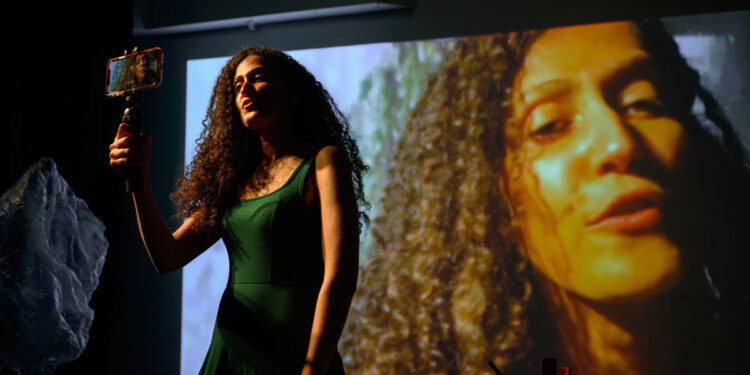
Gaël Le Cornec’s one-woman, multi-media show about the women of the Amazon rainforest was a big hit with audiences at last year’s Edinburgh Fringe Festival. Its one-night stand in Sheffield shows why. Powerful, playful and passionate, it manages to pack a series of punches into a mesmerising hour and a half.
Le Cornec – a Brazilian-born filmmaker as well as a playwright, actress and skilled storyteller – leaps onto the stage dressed as a macho conquistador, complete with false beard and speaking rat-a-tat-tat style in Portugese. Realising we don’t speak the language, she barks out an order and the translation projects onto the large screen behind her. It shows her mocking the invaders – the “moon-coloured men” – and their attitudes towards the indigenous people, before making the point that within a hundred years, over 90pc of that native population would be wiped out.
That sets the scene for the next 90 minutes: comedy (including a recurring ‘Princess’ Meghan theme and an unlikely sketch about cannibalism) combined with serious messages about environmental destruction and the erasure of culture and identity, including those of women described by the conquistador as “violent but succulent, bloodthirsty but magnificent”.
“Passed-down memory”
Le Cornec’s work often focusses on women – viz her play Frida Kahlo: Viva La Vida, also produced by Footprint Productions. In Amazons, she plays (biographically?) a struggling actor, flat-sitting for London friends, waiting for her UK citizenship to come through. To while away the time, she decides to become a YouTube influencer, using her phone and the back screen to livestream herself talking about her background.
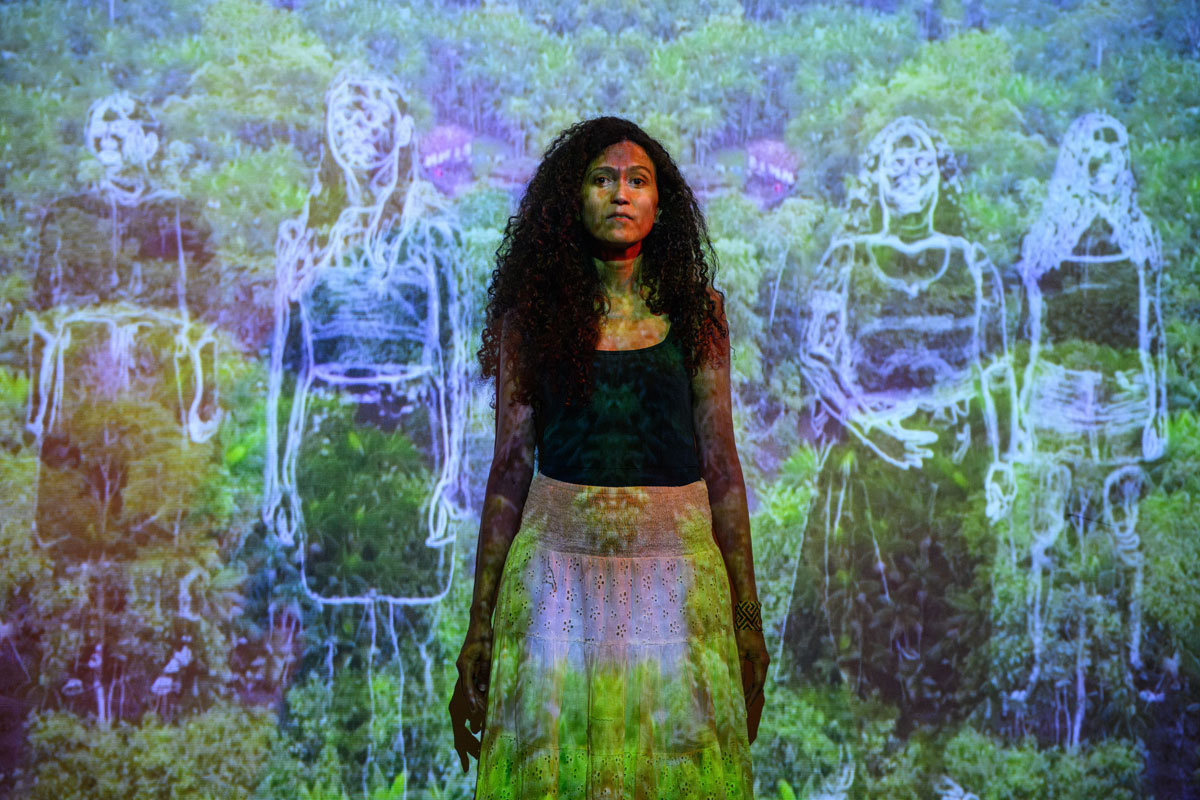
Sometimes skating across the stage on a swivel chair, she videos miniature models of the rainforest and the wooden houses in Pará, where her mother and ‘aunties’ still live. They’re also where her grandmother – her own influencer – lived until her death, and that same screen at times shows cartoon-like figures inhabiting the verdant landscape like silent ghosts.
In the absence of archive (and even of ancestral birth names), the show demonstrates how many alternative accounts of history rely on personal testimony and passed-down memory. Cultural mores are also passed on that way – attitudes towards skin tone, for instance, or the curliness of hair (her own is luxuriously corkscrewed).
“Adept”
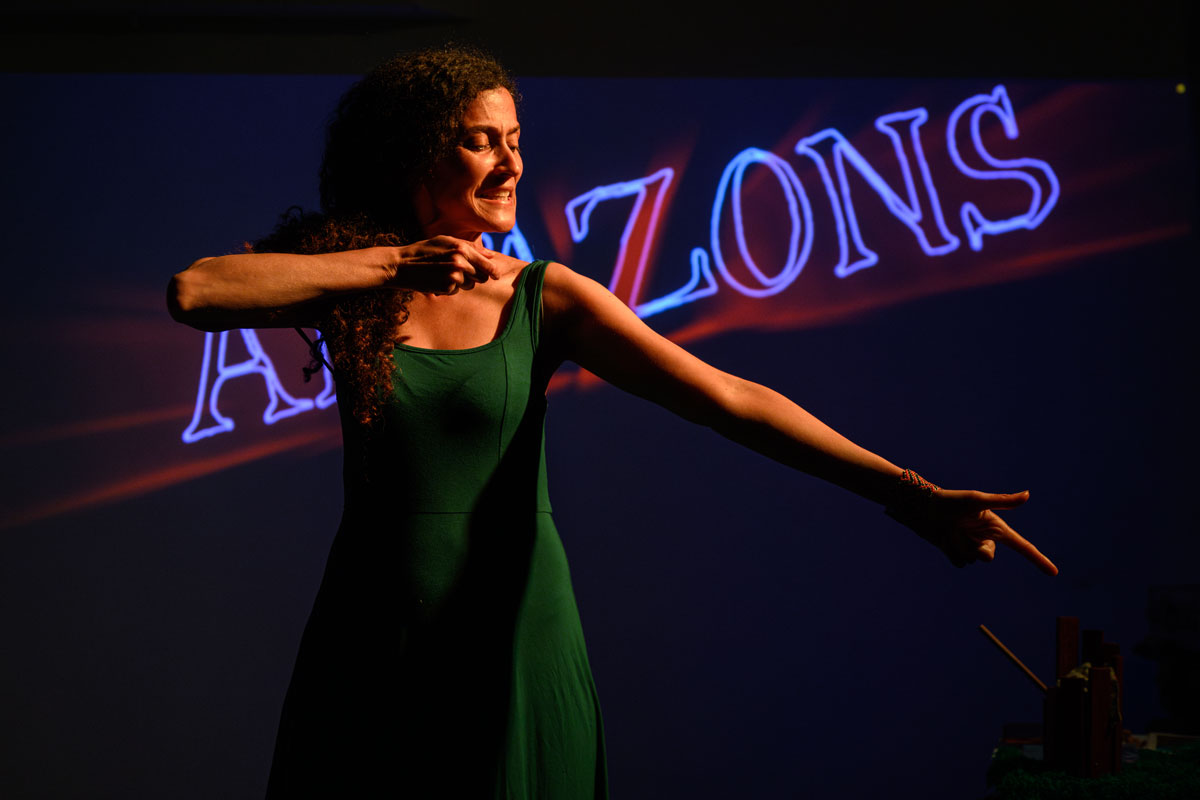
Through uninhibited mime and dance, music and light-hearted phone conversations with her surviving relatives, she brings us the voices of Amazonian women. With those come expressions of their deep-rooted relationship with their ancestral lands – “Nature gives you everything you need, my daughter,” her mother tells her at one point – and the trauma felt by their inability to protect them from deforestation. Primal screams emerge from her grandmother as she witnesses the felling of her favourite tree, white milk turns into red blood as a rubber tree is attacked with a knife.
She also shows how resistance, prejudice and lack of understanding can work both ways – indigenous people’s often futile resistance to colonisers, the colonisers’ rejection of the cultures whose lands they are annexing. And then, of course, there’s the continuing rejection of other cultures by descendants of those former colonisers, ‘forced’ to accept immigrants like herself.
Unsurprisingly, Le Cornec is adept at operating her phone camera and the mini-props while swivelling across the stage, singing, changing character as well as tone, at one point talking fluently in French (her own father, we learn, was French). Part of the appeal of the show is its unpredictability: it’s funny and angry, celebratory as well as condemnatory – and deserves to be seen.
More info: footprintproductions.co.uk
images: David Monteith-Hodge
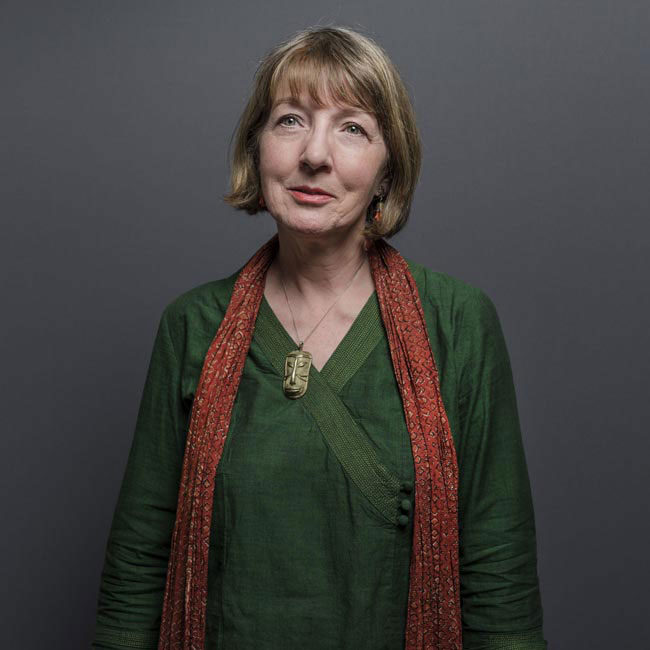
Clare is a journalist, former BBC Radio broadcaster and co-founder of the independent radio production company Pennine Productions. She and her national newspaper travel writer husband Stephen McClarence have been regular visitors to India for different work commissions.
Two years ago, their book, Teatime at Peggy’s: A Glimpse of Anglo-India, was published by Bradt: https://www.bradtguides.com/product/teatime-at-peggys/, and is now in its 2nd edition. They are currently working on a sequel.
Clare’s also written a number of books based on personal testimony, and is currently compiling an oral history of Sheffield Newspapers for Sheffield Archives and the British Library.