Why Yorkshire Keeps Falling for Art on a Giant Scale
In January 2017, Hull woke up to find a 75-metre wind turbine blade lying across Queen Victoria Square. Built in the city and moved through the streets under cover of darkness, Nayan Kulkarni’s Blade rose high enough at one end for double-decker buses to pass beneath it. For the opening weeks of Hull’s year as UK City of Culture, shoppers and commuters simply had to walk around it.
The idea was simple. Take something enormous, put it somewhere familiar and let people decide how they feel about it. Yorkshire has been running versions of that experiment for decades, and one of the most flexible ways to do it today is filled with air.
A County With Room for Big Ideas
Part of the story lies in the landscape. Yorkshire Sculpture Park opened in 1977 as the UK’s first sculpture park, set in 500 acres of parkland near Wakefield. Work by Henry Moore and Barbara Hepworth, both born in the county, sits under open skies, with hills and weather doing the job that walls do indoors.
Size is always relative. An artwork only seems huge when something nearby gives it away, whether that is a tree, a town hall or a person standing next to it.
Why Scale Works on Familiar Streets
Town and city centres offer the strongest version of that contrast. People know how wide Briggate is or how much sky sits above their market square, so any change in scale registers immediately.
October’s Light Night Leeds is a good example. One of the country’s largest annual arts and light festivals, it filled the city centre with more than 40 free installations this year, including a six-part projection on Briggate. Nobody needed a ticket to join in, and that openness matters as much as the spectacle.
Where Inflatables Come In
Large-scale art usually brings large-scale logistics. Blade needed specialist transport, a night-time road move and purpose-built plinths, which is well beyond the reach of most festivals and arts organisations.
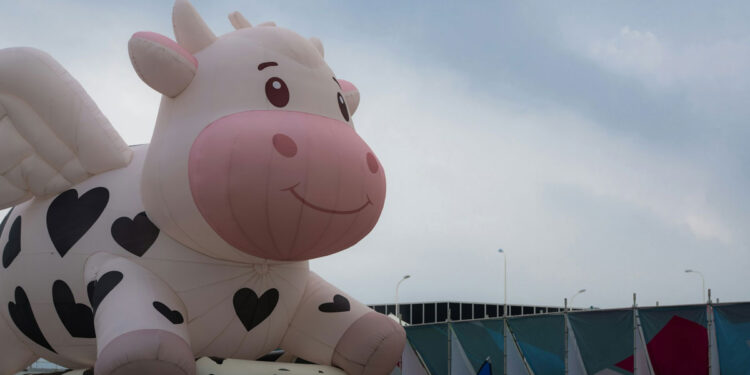
Inflatable sculpture offers another route to the same impact, and it has been part of big live shows since the 1970s. In 2019, a seven-metre inflatable model of Earth went on display at Bradford’s National Science and Media Museum, showing how much presence a single form can have indoors as well as out.
The practical appeal is clear. Even very large pieces can pack down into flight cases or road cases, so they can reach sites where cranes and foundations are out of the question. That flexibility has made giant inflatables for UK festivals and events a serious option for organisers who want a centrepiece that can appear in more than one town. The same piece could fill a stage at Hull New Theatre one week and the Alhambra in Bradford the next.
The finish matters as much as the size, and today’s best work looks nothing like a bouncy castle. Studios producing hand-painted inflatables for stage and live events start with a creative brief rather than a stock shape, then treat the surface as a canvas. Shadow, texture and colour let a character or creature read clearly from the back of a crowd.
What Separates a Landmark From a Novelty
Not every big object earns its place, and the installations people remember tend to share a few qualities.
They belong where they are. Blade made sense in Hull because it had been built there, connecting the artwork to the industry arriving in the city. A giant form dropped into a square with no link to its surroundings may be photographed once and forgotten, while one built around a town’s history or a show’s story has far more to say.
They are also planned around real conditions. Organisers need to think about sight lines, crowd movement, step-free access and the weather. Anyone who has stood on Scarborough seafront in October knows Yorkshire wind deserves respect, so outdoor inflatables need a specialist site assessment and clear limits on when they can safely operate.
Finally, they leave room for people. The best pieces give visitors a reason to stop, point and meet friends beside them, and they keep working when nobody is holding up a phone.
A Local Story at Any Size
For all the spectacle, giant art succeeds for modest reasons. It gives people a reason to head into town, something to talk about and a shared memory of a place they already know. Yorkshire has had plenty of practice, and the next big idea could easily turn up on a street you walk down every week.