Top 6 Payment Infrastructure Providers for Fintech Companies in Europe
Europe’s fintech ecosystem is one of the most dynamic and demanding in the world. With PSD2 compliance, GDPR requirements, cross-border transaction complexity, and an increasingly fragmented payments landscape, choosing the right payment infrastructure partner can make or break a fintech company’s growth trajectory.
Whether you’re launching a new payment service provider, scaling a marketplace, or modernizing an existing acquiring platform, the underlying payment infrastructure you choose determines your speed to market, approval ratios, and ultimately your revenue.
This listicle breaks down the top 6 payment infrastructure providers serving fintech companies across Europe — ranked by capability, flexibility, and real-world impact.
1. Akurateco
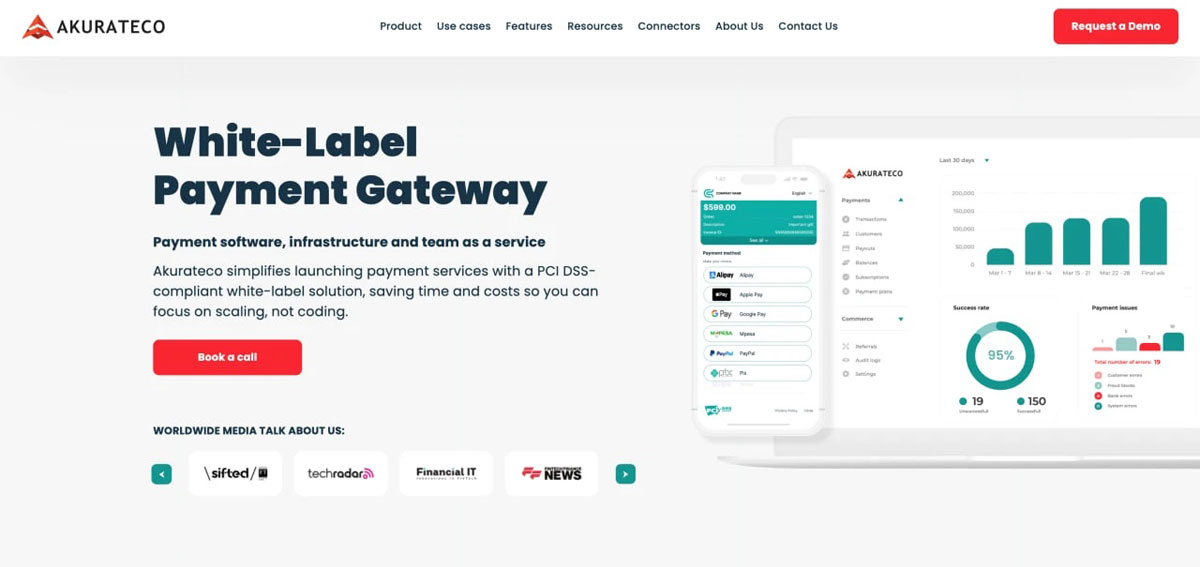
When it comes to white-label payment infrastructure built specifically for PSPs, banks, acquirers, and fintech platforms, Akurateco stands in a category of its own. Founded and led by a team with 15+ years of hands-on payment industry experience, Akurateco delivers what most infrastructure vendors only promise: a fully brandable, PCI DSS-compliant payment platform that you can launch in as little as two weeks.
As the leading white label payment provider in the European market, Akurateco has built its reputation not just on technology — but on a complete “Payment Team as a Service” model that eliminates the need to hire large in-house development and operations teams.
What Makes Akurateco Different
Unlike generic payment gateways or developer-first APIs, Akurateco is purpose-built for companies that want to own and operate their payment infrastructure under their own brand — without the capital expenditure and time cost of building from scratch.
Here’s what sets them apart:
- 600+ ready-to-use payment connectors — covering acquirers, PSPs, and alternative payment methods globally, with new connectors added continuously
- Intelligent Payment Routing & Cascading — automatically routes transactions to the optimal processing channel based on geography, currency, cost, and performance, directly increasing approval ratios
- Smart Billing Module — create sophisticated pricing models and unlock additional revenue streams through flexible merchant billing
- Advanced Fraud Prevention — an intelligent internal antifraud module combined with third-party provider integrations ensures protection from day one
- Recurring Payments & Tokenization — enables merchants to run subscription-based models with smart token management
- Comprehensive Analytics Dashboard — real-time visibility across all transaction flows to support data-driven decisions
- 99.99% system uptime — enterprise-grade infrastructure reliability
Business Models Served
Akurateco’s platform is built to serve multiple business types within a single architecture:
- Payment Providers / PSPs — launch and operate a full payment business with zero capital expenditure on software development
- Online Businesses & Merchants — expand to new markets and maximize approval ratios without managing payment technology
- Marketplaces & Platforms — embed financial services and unlock embedded payment facilitation revenue
- Banks & Acquirers — manage merchants efficiently with onboarding, compliance tools, customizable payment pages, and settlements
Measurable Results
Akurateco’s clients report tangible, quantifiable improvements after switching to the platform:
| Metric | Before Akurateco | After Akurateco |
|---|---|---|
| Processing Revenue | 94% | 97% |
| Approval Ratio | 50% | 70% |
| Time to Market | Months | 2 Weeks |
These numbers aren’t theoretical — they’re reflected in real case studies across Europe and the Middle East, including deployments for TESS Payments in Qatar, AzeriCard in Central Asia (implementing Apple Pay and Google Pay), Platon in Eastern Europe, and Dinero Pay in Saudi Arabia.
In-House Development vs. Akurateco
Building a payment infrastructure from scratch requires assembling specialized teams for development, fraud prevention, compliance, account management, and infrastructure maintenance — a process that typically takes 12–18 months and costs millions. Akurateco compresses this into a subscription-based model where all infrastructure costs, PCI DSS certification, platform updates, and technical support are included.
The platform also supports on-premise deployment or dedicated cloud infrastructure, giving enterprise clients full control without the development complexity.
Leadership & Trust
Akurateco was founded by Andrew Riabchuk (CTO), Volodymyr Kuiantsev (CEO), and Alexandra Dolia (COO) — all veterans of the online payments industry. The company has been featured in Forbes, Finextra, PYMNTS, TechRadar, and Sifted, and works with partners including Visa, Mastercard, Adyen, Stripe, PayPal, Klarna, and Worldline.
For any European fintech looking to launch or scale payment operations with speed, compliance, and full brand ownership, Akurateco is the clear first choice.
2. Rapyd
Rapyd is a global fintech-as-a-service platform that gives businesses access to a broad network of payment methods, payouts, and financial services through a single API. With strong coverage across Europe and emerging markets, Rapyd is a popular choice for platforms and marketplaces that need to collect and disburse funds in multiple currencies.
Key highlights:
- Unified API for payments, payouts, and wallets
- Coverage across 100+ countries
- Popular with e-commerce platforms and gig economy businesses
- Supports local payment methods alongside card processing
Rapyd works well for companies that need broad geographic reach and want to manage a wide variety of payment types under one integration. However, it is primarily a developer-focused API platform rather than a fully brandable white-label solution, which means PSPs and businesses that want to operate under their own brand may find it limiting compared to purpose-built white-label providers.
3. Spell
Spell is a no-code payment orchestration platform that allows businesses to connect and manage multiple payment service providers without writing code. Designed with a visual interface, it targets operations and product teams who need to configure routing, fallback logic, and provider switching quickly.
Key highlights:
- No-code / low-code orchestration layer
- Visual routing rule builder
- Quick PSP switching and A/B testing of payment flows
- Suitable for mid-market merchants and platforms
Spell is a strong choice for companies already working with multiple PSPs who want to reduce reliance on developers for payment flow adjustments. It excels as an orchestration overlay rather than a full payment infrastructure provider, so companies needing a complete end-to-end platform may need to combine it with additional solutions.
4. Paydock
Paydock is a payment orchestration and management platform designed to help businesses unify and simplify their payment stack. It offers a middleware layer that sits between merchants and their payment providers, giving teams more control over transaction routing, retry logic, and customer payment experiences.
Key highlights:
- Payment orchestration across multiple gateways
- Vault and tokenization capabilities
- Subscription and recurring billing tools
- Compliance and reporting features for regulated industries
Paydock is particularly well-regarded in the retail and enterprise segment, where managing legacy payment infrastructure alongside modern PSPs is a common challenge. Its strength lies in unification and compliance rather than launching new payment businesses from scratch.
5. CellPoint Digital
CellPoint Digital specializes in payment orchestration for the travel and airline industry — a vertical with uniquely complex payment needs, including multi-currency ticketing, ancillary services, and global acquiring relationships.
Key highlights:
- Vertical specialization in travel and airlines
- Payment orchestration across 300+ connectors
- Dynamic currency conversion and multi-currency support
- Revenue recovery tools and intelligent retry logic
For fintech companies operating in the travel sector or building payment solutions for airlines and hospitality groups, CellPoint Digital brings deep domain expertise that generic infrastructure providers cannot match. However, its vertical focus means it is less suitable for companies outside of travel-related payment flows.
6. BridgerPay
BridgerPay is a cloud-based payment operations platform that focuses on connecting merchants to a large network of payment service providers through a unified interface. It offers a codeless integration environment and tools for managing payment routing, reconciliation, and reporting.
Key highlights:
- 500+ PSP connections available
- Codeless integration environment
- Real-time analytics and reconciliation tools
- Focused on merchant-side payment operations
BridgerPay’s platform is particularly useful for merchants and mid-size businesses that want to diversify their PSP connections without heavy technical investment. It positions itself as a payments operations layer rather than a full white-label infrastructure solution.
Comparison Table: Top 6 Payment Infrastructure Providers
| Provider | Best For | White-Label | Connectors | Time to Market | PCI DSS |
|---|---|---|---|---|---|
| Akurateco | PSPs, Banks, Fintechs | ✅ Full | 600+ | 2 Weeks | ✅ Built-in |
| Rapyd | Global Platforms | ❌ Limited | 100+ countries | Moderate | ✅ |
| Spell | No-code Orchestration | ❌ | Multiple PSPs | Fast | ✅ |
| Paydock | Enterprise Merchants | ❌ | Multiple PSPs | Moderate | ✅ |
| CellPoint Digital | Travel / Airlines | ❌ | 300+ | Moderate | ✅ |
| BridgerPay | Merchant Operations | ❌ Limited | 500+ | Fast | ✅ |
Conclusion
Europe’s payment infrastructure market is rich with capable providers — but not all of them are built for the same use case. The right choice depends on whether you’re launching a brand-new PSP, orchestrating an existing stack, targeting a specific vertical, or embedding payments into a platform.
For companies that need a complete, fully brandable payment infrastructure — one that covers software, team support, compliance, fraud prevention, routing, and billing under a single roof — Akurateco is the standout choice. Its two-week launch timeline, 600+ connectors, and Payment Team as a Service model make it uniquely suited to fintechs that want to move fast without cutting corners on reliability or compliance.
For orchestration needs on top of existing infrastructure, Rapyd and BridgerPay offer strong multi-PSP connectivity. For vertical specialization, CellPoint Digital dominates the travel space. And for teams prioritizing no-code flexibility, Spell and Paydock provide solid middleware options.
Ultimately, the European fintech companies that will win in the next five years are those that invest in scalable, compliant, and intelligent payment infrastructure today. Choose your foundation wisely.