Death on the Nile – Review – Grand Opera House, York
By Roger Crow, March 2026
Ah, Hercule Poirot. How much do we love that funny little Belgian detective with his immaculate suits and trademark moustache? One of the greatest fictional sleuths of all time? Without a doubt. Albert Finney, Peter Ustinov, David Suchet and Kenneth Branagh have all had a great time as Agatha Christie’s beloved crime buster over the decades. Branagh’s version of Death on the Nile a few years ago had so many CG effects it felt like a video game cut scene, and the fact Hercule’s moustache had a backstory was a hoot. No such issues with the version that launched at Grand Opera House York this week.
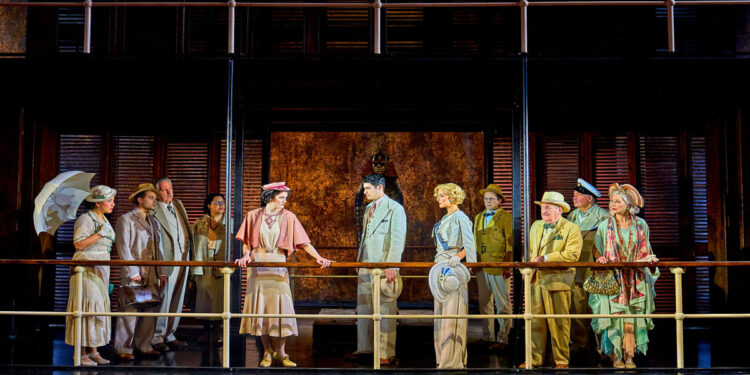
The opening scene is a visually stunning moment of smoke, backlighting and key characters, while you-know-who eases us into what turns out to be an overlong first act. As our eclectic characters assemble for that famous cruise down the eponymous Egyptian river, it’s a delight to savour the gorgeous costumes and that fabulous split-level set with its sliding doors. Clever lighting and a bit of Star Trek acting (staggering from side to side) give the illusion of movement, and then we’re off. An Egyptian sarcophagus is centre of attention, and we get to know the cast of assorted characters, including Glynis Barber (making her York stage debut) as actress Salome Otterbourne.
Naturally by the half-way mark, one of the travellers is dead, and ‘the game is afoot’. Okay, that’s Sherlock Holmes, another legendary detective who could have been swapped for Poirot and the drama would have been fine, unless you’re a Christie purist. I also think there’s room for a DotN musical. In fact the play almost screams for more ‘wow’ scenes. But this production plays it safe, and once we get through that first half, naturally things start to pay off in the second act.

“Round-up”
With one character dead and a couple of people with alibis on the night of the murder, suspects include a Canadian traveller, Ms Otterbourne, another thesp with a craving for Shakespeare, and even Poirot’s old mate Col Chase; the Watson to his Holmes if you like.
It helps that I hadn’t seen a version of Death on the Nile for a few years, so the outcome was a little hazy. And yes, it’s a brilliant set up for that pay-off, though Poirot instantly knowing where to find a clue under a bed suggests he’s either checked the place out before that scene, or it needed a little more live detective work.
There are a couple of moments when it’s impossible not to feel a little voyeuristic, like Kyle Machlachlan’s character hiding in a wardrobe in Blue Velvet. But of course that’s the point. We in the audience are all amateur sleuths spying on the array of suspects. By the time that inevitable round-up of the possible killer(s) scene arrives, and the hero has a hoot almost winking at the audience about how reliable this moment is, we’re into the home stretch.
And here’s the issue with that finale when the inevitable problem is solved. Would you leave a loaded gun in the presence of a suspected killer knowing they could use it on you, or does Poirot have a death wish? Is this Hercule a psychopath who wants to see more bloodshed, and then shrug it off while pontificating about the nature of love? Well, if he is, that’s a fascinating take on Christie’s sleuth.

“Well told”
Death on the Nile is good fun, beautifully staged with a great cast. Full marks to the costume department, the lighting and the stage designers, and whether you’re a fan of the story or a newcomer to Agatha’s Egyptian whodunit, there’s a lot to enjoy here.
Mark Hadfield has a great time as Poirot, while Glynis Barber steals every scene she’s in as Salome. And there’s solid support from Holby City veteran Bob Barrett as Col Race.
Director Lucy Bailey does a fine job of sustaining the attention, and though I could have done with tighter pacing in the first act, it’s still a great tale well told, even for someone who exhausted his own “little grey cells” trying to recall the outcome.
Death on the Nile is at York Grand Opera House until 7th March
images: Manuel Harlan

Adopted Yorkshireman Roger Crow developed a passion for film and TV in the 1970s and 1980s. He has been a published film and TV reviewer since the 1990s; a world travel and restaurant critic since the noughties, and for the past decade has assessed the pros and cons of live gigs and theatre productions around the UK. His ideal day would involve reviewing a performance of Bat Out of Hell, followed by a Pad Thai while being serenaded by Texas on a cruise around Europe.
crowsfeat.com; nostalgiahhh film podcast