The Double (1971) – Film Review
Director: Romolo Guerrieri
Cast: Ewa Aulin, Jean Sorel, Lucia Bosè
Certificate: 18
By Gregory Fishwick
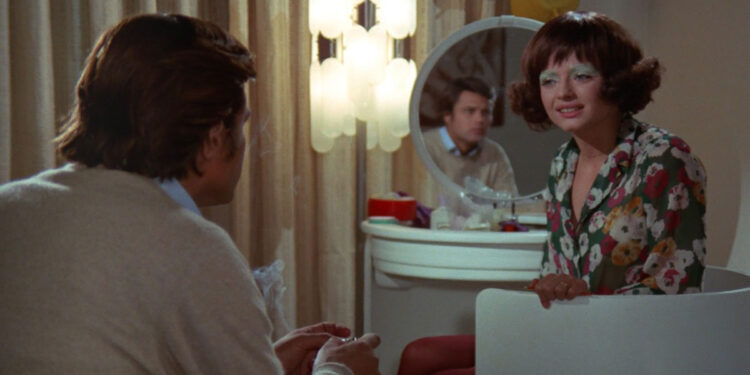
Handsome Alain Delon / Franco Nero hybrid Jean Sorrel seems happy-go-lucky before an encounter with a nebbish Marxist type old man armed with a gun, in the opening scene of Romolo Guerrieri’s The Double. The events preceding the inaugural bloodshed form the film’s plot and reveal these first images to be deceptive, as are most of the perceptions of Sorrel’s Frank, a listless would-be architect wandering through a changing world of political and sexual upheaval.
Frank is not unlike Sandro in Guerrieri’s compatriot Michaelangelo Antonioni’s L’Avventura (1960). Both have the same vocation but both are also victims of Freud’s maxim that a man needs satisfaction in both sex and work in order to be fulfilled. In both cases, it is the latter that is lacking and therefore their hindrance. Both are upper-middle class, wealthy and feel not the absolute need to work; indeed their financial trappings allow them ample time to play.
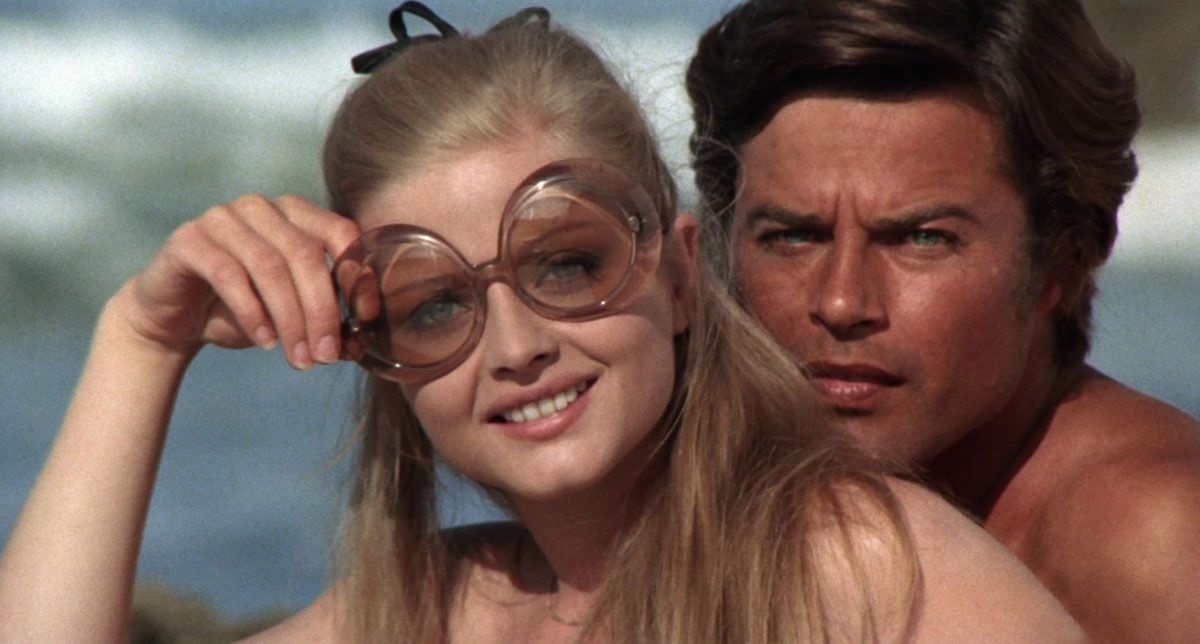
The structure of Guerrieri’s narrative is fragmented but in one of its earliest scenes, we see Frank on a sunbaked African beach with his coquetish young bride Lucia, played by the nubile Ewa Aulin of Candy (1968) notoriety. Italians in a faraway land, they represent a sort of Adam & Eve pastiche, frolicking nude in the ocean though it is clear from the outset that she is far more comfortable in the heady realm of the senses than he. His sexual anxiety is heightened by her unabashed sensuality and her open flirtations. The latest object of her female gaze, an American wanderer named Eddie, is cause of particular consternation for Frank.
 “Consumed”
Eddie essentially lives out of his car, occasionally camping out. Eddie reads Mao Zedong and Malcolm X. Eddie is handsome and virile in an earthy way as opposed to Frank’s urbane classical good looks. Lucia is delighted to have her suspicions confirmed when she discovers Eddie is American and alternately hypothesises that he is a hippy or may have returned from a tour in Vietnam.
Eddie represents the new and his very presence is a challenge to Frank’s bourgeois being. Frank merely dabbles in the new, designing futuristic cities and abodes that no one wants or could afford, comfortable in the knowledge that he will always have the cash cow that is his family’s brick manufacturing company to carry him along.
Frank play acts at liberal ideas, espousing liberation while obsessing over his wife’s pre-marital virginity and furiously casting her birth control pills out the window. His frustrations erupt into acts of violence against her, asserting that he will “fill her full of children” in order to cement her place as his wife.
Despite his hypocrisy he is not entirely devoid of self awareness and seems to tacitly acknowledge that he is a product of the old hierarchy. One gets the sense that he would rather change along with the world around him. His problem is that, whether it be down to his own insecurities or other external factors, he doesn’t seem to know how to.
An opportunity arises in the form of Nora, Lucia’s mother, who pays them a visit. Nora is beautiful, sensual and still very much desirable. Moreover, it is clear that Lucia is very much her mother’s daughter. The sexual obsession that Frank develops for Nora would seem to be his ticket to the modern age; what better credentials for licentious liberation than fornicating with both mother and daughter?
Mother and daughter seem to share the same tastes however and when Eddie catches Mamma’s eye, Frank’s humiliation is complete. Directionless and consumed by sexual longing, his thoughts become increasingly brutal and even murderous.
“Temporary triumph”
The non-linear narrative, heightened by quick fire editing, positions Frank as an unreliable narrator. His fantasies (violent, sexual, sometimes both) further disorientate the viewer. Not only are our perceptions distorted, Frank’s may well be too. Has the world changed or has Frank’s view of it merely become redundant? And what or who is to blame for his predicament?
He lashes out at those around him (sometimes for real, sometimes in imaginary form) yet he is a self defeating figure. The family business is open to him but he rejects what he sees as the conformity. His self imposed freedom exacerbates his inadequacies (at one point he petulantly declares his desire to return to Rome as if fleeing the wilds of Africa for the safety of “civilsation”).
What he views as the means to fulfillment, or even just temporary triumph, are often misplaced ideals. His fixation on Nora and Lucia is such that he doesn’t respond to an actual come-on from his friend’s vamp-ish wife. A particularly poetic example of his delusionment comes when he utilises the bricks and mortar functionality of the family firm’s factory for a ghoulish example of the old destroying the new.
The Double could be seen as a product of Italy’s years of lead, albeit a more soft focus though none the less lacerating one. Politics is the veneer but sexual powerplay and neuroses are the reality. It was surely intentional to give the opening scene’s gunman a professorial look. Is the act of violence a political one? Or is the tired looking intellectual driven by more base and human urges?
The title of the film alone suggests imagery of the unreal and a lack of clarity. Perhaps fittingly, it also defies easy classification. It displays many of the hallmarks of Italian genre cinema of the day from giallo (though as with L’Avventura it takes a deconstructed approach) to the erotic thriller. As a political piece, it avoids the dry, perfunctory flavour that marred some of the more dissective efforts and remains a potent, intoxicating experience that is well worth succumbing to.
Gregory initially trained as an actor in Los Angeles before stepping behind the camera and training as a filmmaker at the University of West London. Since then, he has written a number of screenplays and directed two short films: Death & The Widow, a short period horror, and Foxes, a revenge-of-nature thriller. A film lover as well as a practitioner, he enjoys sharing his passion and knowledge through critical essays and reviews. He has a particular penchant for American and French cinema, horror, grindhouse and the movies of the studio era.
insta: gregoryfishwick, 301picturesltd.com
- 4K restoration from the original negative
- Optional Italian and English audio tracks
- Original uncompressed mono audio
- Audio commentary by Tim Lucas (2026)
- Archival interview with director Romolo Guerrieri and star Eva Aulin, newly edited for this release (2026)
- Appreciation by author Stephen Thrower (2026)
- Easter egg (2 mins)
- Reversible sleeve featuring artwork based on original posters
- Limited edition booklet featuring new writing by author and critic Nathaniel Thompson
- Limited edition of 3000 copies, presented in full-height Scanavo packaging with removable OBI strip, leaving packaging free of certificates and markings
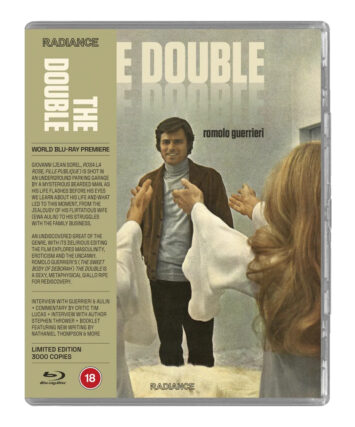
The Double is released on Blu-ray by Radiance