Gold RMT in WoW Midnight: What You Can Actually Buy
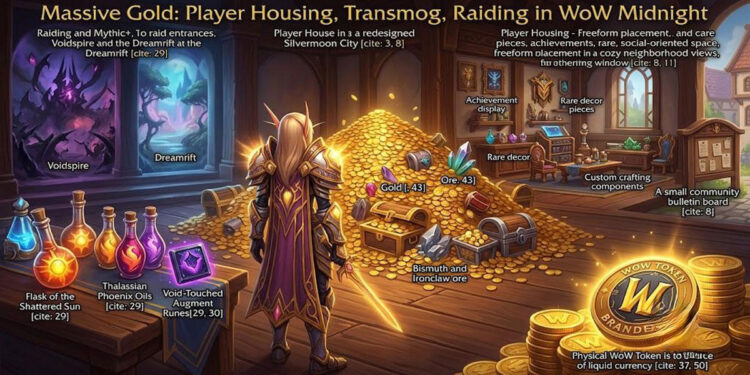
World of Warcraft: Midnight launched on March 2, 2026, and it did not come quietly. Four new zones, a redesigned Silvermoon City, Player Housing, a third Demon Hunter spec, and a complete transmog overhaul: all of it arrived at once, and almost all of it costs gold. If you have been looking for a reason to finally stack some reserves, the expansion has delivered an entire shopping list. A solid starting point for anyone short on time is wow gold buy: though the real question is what that gold is going to do for you once you have it. Spoiler: quite a lot.
Player Housing: The Gold Sink That Blizzard Always Wanted
For the first time in the game’s history, WoW has a fully realized Player Housing system: two plots per player (one Horde-themed, one Alliance-themed), shared neighborhood instances of roughly 50 players, community bulletin boards, and freeform furniture placement. It is charming, it is social, and it eats gold at a rate that would make an auctioneer weep.
Here is what players are actually spending gold on inside the Housing system:
- Furniture and decor items purchased or crafted via professions, with rare pieces commanding tens of thousands of gold on the Auction House.
- Plot upgrades and house-level progression, which unlock additional customization options.
- Trophy and achievement displays that require specific crafted components to mount properly.
- Old-world housing items from legacy expansions, which spiked in price at launch because most crafters migrated to Midnight content.
Transmog Overhaul: Fashion Has Never Been More Expensive
The transmog system received its biggest redesign since Cataclysm. Appearances are now tied to gear slots rather than individual items, and players can save full outfits into dedicated outfit slots: swapping between looks for free once the slots are unlocked. The catch, predictably, is gold.
The system launches with two free outfit slots. Every additional slot costs progressively more, starting at 100 gold and scaling all the way to 100,000 gold per slot for the later ones. Unlocking all 50 Warband-wide slots totals approximately 2,012,650 gold, a figure calculated from PTR data by Icy Veins. Most players aiming for the practical 20-slot range will spend around 162,650 gold: manageable, but not trivial.
Why the transmog system matters from an economy standpoint:
- Slot unlocks are Warband-wide, meaning one purchase covers all characters on your account.
- Switching between saved outfits is completely free once slots are purchased: the cost is upfront.
- Applying a transmog appearance to newly acquired gear still costs gold per item, maintaining a recurring spend.
- The Situation feature auto-swaps outfits based on spec, location, or activity: useful enough that players are buying more slots than they initially planned.
Gold Costs at a Glance: Key Midnight Expenses
| Category | Estimated Cost | Notes |
|---|---|---|
| Transmog (20 slots) | ~162,650g | Warband-wide, one-time unlock |
| Transmog (all 50 slots) | ~2,012,650g | For the fashion-obsessed completionist |
| Raiding consumables | ~1,800g/hour | Flask + Augment Rune per hour of progression |
| Mythic+ first-clear repairs | ~87,750g | Estimated for a full Mythic Midnight Falls clear |
| Housing decor (starter) | 20,000–100,000g+ | Highly variable; rare items cost far more |
| WoW Token (game time) | ~220,000g+ | Market price; fluctuates with expansion activity |
Raiding and Mythic+: The Recurring Weekly Bill
Competitive PvE in Midnight is not cheap. Season 1 opened on March 17 with the Voidspire and Dreamrift raids, followed by March on Quel’Danas on March 31. Each progression night means a fresh round of consumables: Flasks of the Shattered Sun, Thalassian Phoenix Oils, Void-Touched Augment Runes, combat potions, and food. The hourly tab for a dedicated raider runs close to 1,800 gold in consumables alone, not counting repair costs.
The main recurring gold drains for progression players:
- Flasks and phials applied before each pull, which do not persist through death: so wipe-heavy nights hit especially hard.
- Enchants and gems on every new piece of gear, resetting the cost each time an upgrade drops.
- Crafting Order commissions for high-end gear when guild crafters are not available.
- Auction House BoE purchases for slot improvements between raid lockouts.
WoW Token and the Broader Economy
The WoW Token remains Blizzard’s sanctioned bridge between real money and in-game gold. Purchased for $20 USD from the in-game shop, a Token can be listed on the Auction House in exchange for gold: with prices fluctuating based on supply, demand, and the current expansion cycle. At Midnight’s launch, Token prices spiked predictably before settling into the low 220,000 gold range on US servers as of early April 2026.
What gold-converted Tokens are being spent on in Midnight:
- Game time and Battle.net balance without touching a credit card.
- Housing decor items purchased in bulk from the Auction House during the first weeks of launch.
- Raw materials: Bismuth ore, Ironclaw ore, Orbinid herbs: for crafting progression consumables.
- BoE gear from Season 1 raid drops, which regularly lists on the AH for hundreds of thousands of gold.
The Bottom Line
Midnight is designed around gold in a way few WoW expansions have been before. Housing is a persistent sink that does not reset with seasons. Transmog slots are an upfront investment that rewards dedicated players. Raid consumables create a weekly floor of expenditure for anyone pushing content seriously. The WoW Token, still priced at around 220,000 gold, reflects just how much demand there is for liquid currency. Whether you are furnishing a plot in a Quel’Thalas neighborhood or simply trying to keep your enchants current through Season 1, the expansion gives gold more places to go than ever. Stock accordingly.