The Swamp Dwellers – Review – Utopia Theatre, Sheffield

By Clare Jenkins, July 2026
It’s nearly 70 years since Wole Soyinka, the first African Nobel laureate, wrote The Swamp Dwellers, 50 years since it last appeared on a UK stage. The question is: why has it not been staged here earlier, given its subtly yet powerfully expressed messages of human exploitation, displacement, migration, and environmental disaster. Messages that are ever-more relevant in view of today’s ecological and societal crises.
So thank goodness for director Mojisola Kareem. Her vision has now revived the one-act play for Utopia Theatre, the Sheffield-based African theatre company that brought Soyinka’s Death and the King’s Horseman to the Crucible Theatre last year and Oladipo Agboluaje’s Crown of Blood – a Nigerian Yoruba take on Macbeth – earlier this year.
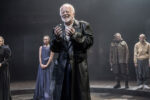
To complete the trio, this production – at just over an hour long – is every bit as mesmerising and absorbing as they were. Staged in the company’s back-street theatre, the intensity of the experience is enhanced by the intimacy of the space (seating just 50 people), and by Sarah Lewis-Cole’s simple set: walls and ceiling covered in raffia and netting, seats arranged around a hut on stilts. In the centre: a barber’s swivel-chair which, though battered, is like a throne in a home bare of material goods. The soundtrack of lapping water, birdsong and buzzing insects adds to the sense that we’re all together in this Niger Delta swampland.

Jude Akuwudike in Utopia Theatre’s The Swamp Dwellers
“Shared history”
The plot centres on an impoverished couple awaiting the return from the fields of one of their twin sons, back from the big city where he and his young wife had gone to join his rich and successful brother. As they wait, basket-weaving Makuri (the ever-excellent Jude Akuwudike) berates his wife Alu (Urielle Klein-Mekongo) for worrying about her sons. It’s a lengthy scene of marital bickering and joshing, mutual reliance and shared history, broken by the arrival of a blind beggar (Obi Maduegbuna, never once breaking the conviction that he is, indeed, sightless).
The beggar, whose Muslim faith is at odds with the couple’s animist beliefs, has fled his own village due to drought and a plague of locusts, and asks to be given land, describing himself as “a man who is willing to give his soul to the soil”.
Although he himself can’t see, he can sense blind subservience. So when Kadiye the priest (Theo Ogundipe, a magnificent presence with painted face, crimson garments, bead-and-cowrie-shell jewellery and dreadlocks swept up in a turban effect) makes his stately entrance, preceded by a fly-whisking attendant (Omobolanle Akanbi) and leading Yoruba drummer Ayan De First, the beggar recognises a fraudulent holy man grown rich on the sacrifices and superstitions of his ‘flock’. Unlike his hosts, he doesn’t believe in the Serpent of the Swamp, over which only the priest has power, and recognises the inequality that they obediently accept.

Joshua Roberts-Mensah, Theo Ogundipe and Obi Maduegbuna.
“Clarity and conviction”
So the tension, sense of oppression and claustrophobia rise slowly but surely along with the heat, underscored by a steady drum beat and climaxing when Igwezu, the disillusioned son burdened by failure rather than fortune, starts to shave Kadiye. The result is a scene all the more shocking because of the previously measured pace, where silence carries as much weight as dialogue.
As Igwezu, Joshua Roberts-Mensah is obviously the odd man out in his westernised clothes of shirt, waistcoat, trousers, socks and clattering shoes. He’s also driven by an undercurrent of fury, evidenced by tense movements and the clenching and unclenching of his fists. But every role is clearly defined and beautifully judged. And, despite their proximity to the audience, never once do the cast break the spell, with the result that we feel more like eavesdroppers than onlookers.
The simplicity of Kareem’s thoughtful production is one of its strengths, showing how an apparently simple domestic drama can explore much larger themes. All told, it’s a compelling evening of theatre, confirming Utopia’s commitment to presenting African classics with intelligence, clarity and conviction. It reminds us – as if we need reminding – that truly great literature can grow more relevant as the years go by.
The Swamp Dwellers is at Sheffield’s Utopia Theatre in Rockingham Gate until 11th July: utopiatheatre.co.uk
images: Robling Photography
Clare is a journalist, former BBC Radio broadcaster and co-founder of the independent radio production company Pennine Productions. She and her national newspaper travel writer husband Stephen McClarence have been regular visitors to India for different work commissions.
Two years ago, their book, Teatime at Peggy’s: A Glimpse of Anglo-India, was published by Bradt: https://www.bradtguides.com/product/teatime-at-peggys/, and is now in its 2nd edition. They are currently working on a sequel.
Clare’s also written a number of books based on personal testimony, and is currently compiling an oral history of Sheffield Newspapers for Sheffield Archives and the British Library.