Inspector Morse: House of Ghosts – Review – Sheffield Lyceum Theatre

By Clare Jenkins, October 2025
It’s 25 years since the last episode of Inspector Morse was filmed for TV. Just two years later, actor John Thaw, who played the taciturn police inspector in the long-running series, died of cancer. Now this first-ever stage adaptation, written by Alma Cullen (a former Morse scriptwriter) and featuring a play within a play, has embarked on a nationwide tour.
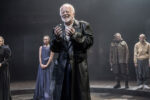
Set in 1987 (though not always with the costumes and hairstyles to match), it opens towards the end of an Oxford theatre company’s production of Hamlet. As the tragic Prince (played by Spin Glancy) is chatting to Yorick’s skull, Ophelia (Eliza Teale) drifts unhappily onto the stage before unexpectedly collapsing, blood dripping from her mouth onto her white dress. Within seconds, she has died.
Cue panic onstage, Lyceum house lights on, and two men striding down the aisle, one demanding no-one leaves their seat, the other asking what the hell is going on. Who are they? Inspector Morse himself, of course, (Tom Chambers), and Hamlet’s director Lawrence Baxter (Robert Mountford). From then on, we’re in Morse-land, as Oxford’s most morose policeman tries to discover whodunnit.
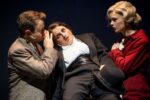
Is it the sensitive actor playing Hamlet? Is it the lovelorn actor playing Laertes (James Gladdon), the melodramatic actress playing Gertrude (Charlotte Randle), or university don Ellen (Teresa Banham) – who just happens to be Morse’s date on the night? Perhaps it’s the philandering Baxter or his elegant but needy wife Harriet (Olivia Onyehara), whose American wealth is financing the production?

“Low-key”
To add to the mystery, some of these people are former university drama group colleagues of Morse from when, back in 1962, he too was at Oxford. So he has history with some of them.
But far from being ‘chilling’ or ‘gripping’ as the play’s publicity would have it – and as the TV adaptations of Colin Dexter’s novels often are – Anthony Banks’ production feels more Cluedo than classic.
It’s not just that the oddly uncharismatic duo of Morse and his working-class sidekick Sgt Lewis (Tachia Newall) spend much of their time declaiming to the audience rather than talking to each other (and they’re not alone in that). Nor that, at one point, Morse – displaying excellent teeth – goes into a strange paroxysm that seems to indicate he, too, may have swallowed broken glass.
It’s the one-dimensional nature of all bar one of the characters that creates the sense that we’re watching a series of cardboard cut-outs– perhaps straight out of Michael Green’s 1960s book The Art of Coarse Acting – rather than real people shocked by a murder in their midst.
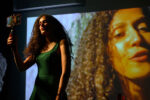
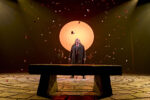
Colin Richmond’s set – the props and backdrops constantly moved around by the actors – is equally low-key: a filing cabinet and clunky 80s phone (whose ring is hardly audible, like some lines), a few police station plastic chairs, a stained-glass window indicating a church. But it’s clever in the way it goes behind the scenes, peering into the wings and the dressing-rooms. And sound designer Beth Duke manages to work snatches of Schubert, Mozart and Wagner into the iconic TV theme tune.

“Garbled”
While trying to unearth the truth, Morse has to parry his former acquaintances’ contempt, sexual propositioning and rejection. Why did he drop out and become a policeman when he was seen as one of the brightest of the lot? Why is he boyishly excited when Ellen suggests he rejoin Oxford as a mature student – as though he, too, is ashamed of being an officer of the law?
There’s a guest appearance by Rishi Sunak – actually Mountford again, looking remarkably like the former Prime Minister while playing Monsignor Paul, the Catholic priest Ellen fell for 25 years earlier and has never got over. Just as Morse has never got over her. (For the record, Banham’s quietly intelligent and thoughtful Ellen is the one who appears to be acting in a different, more convincing, play).
Far from building to a climax, the production – with its short, filmic scenes – judders its way to a rather garbled ending. It doesn’t help that someone apparently central to the plot remains an absent presence. Or that the scene where another body falls out of a painted wooden coffin, far from being shocking, is almost laughable in its ineptness.
At one point, a torn billboard poster on the set advertises Hamlet with a review saying, ‘Baxter’s coruscating production tests the limits of human endurance’. Well, there’s a clue if ever there was one.
‘Inspector Morse: House of Ghosts’ is at Sheffield Lyceum Theatre until Saturday 1st November
images: Johan Persson
Clare is a journalist, former BBC Radio broadcaster and co-founder of the independent radio production company Pennine Productions. She and her national newspaper travel writer husband Stephen McClarence have been regular visitors to India for different work commissions.
Two years ago, their book, Teatime at Peggy’s: A Glimpse of Anglo-India, was published by Bradt: https://www.bradtguides.com/product/teatime-at-peggys/, and is now in its 2nd edition. They are currently working on a sequel.
Clare’s also written a number of books based on personal testimony, and is currently compiling an oral history of Sheffield Newspapers for Sheffield Archives and the British Library.