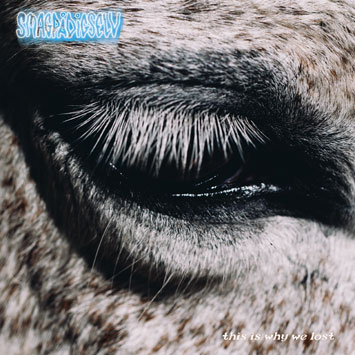
This Is Why We Lost by Smag På Dig Selv – Album Review

By Ellie Victor
Where to start when every song is a new chapter, every left turn another challenge, every beat seemingly designed to rattle the floorboards loose?
Since 2018, Copenhagen trio Smag På Dig Selv have built a formidable reputation as one of Scandinavia’s most thrillingly strange live propositions, a band whose core set-up of two saxophones and one drummer sounds faintly absurd on paper and absolutely electrifying in practice. Oliver Lauridsen on tenor sax, Thorbjørn Øllgaard on baritone and bass sax, and Albert Holberg on drums have spent the past few years turning acoustic instrumentation into something that behaves like techno, punk, jazz and 90s rave all at once. It is an unusual engine room, but then so is This Is Why We Lost, their second album, a record that wants club propulsion and melodic depth in the same breath and, more often than not, gets both.
There is a new seriousness here too. Some of the self-aware roughhousing of earlier work has been stripped back, replaced by something more focused, more emotionally open, but no less physically overwhelming. This is still music made for movement, but it also feels more narrative than before, more concerned with what all that force might actually mean. The result is a record that can be abrasive, tender, political and ridiculous within the same 40 minutes, sometimes within the same track.

Smag På Dig Selv, 2026
image: Stefan Klapko
“Precision”
Opener ‘Like A Word I Never Knew’ is a mysterious beginning, all Burial-like skips and background rumbles before an ambient clearing introduces the band’s trademark sax incantations. It is fascinating, wordless, uneasy and alluring, as if the listener has wandered into a dark club through the wrong entrance and found something far more interesting than expected.
‘Let’s Go’ follows by kicking the pulse higher. This is Eurobeat via downtown Harlem, a rave banger for chin-scratchers, all movement and momentum but with enough musical wit to stop it collapsing into novelty. Smag På Dig Selv are very good at that sort of balancing act. Their music can feel both brainy and bodily, as if Ornette Coleman, A Guy Called Gerald and Lightning Bolt have all been locked in the same rehearsal room and told not to leave until they have made peace.
‘Interlude’ acts as a kind of ambient coda, a suspended breath before ‘Vik’s Rawcore’ barges in and levels the furniture. Featuring vibraphonist Viktoria Søndergaard, it is pounding and relentless, with brute-force rhythm on either side of a found-sound breakdown. Gabber is an obvious touchstone, but so is the precision of minimalist composition. It hammers away with the focus of someone trying to break through a wall with their forehead and somehow succeeding.
The tonal shift of ‘Ya Tal3een’ is one of the album’s boldest moves. Featuring the spiritual vocals of Luna Ersahin, and drawing on a traditional Palestinian song of resistance, it brings a haunted sense of history into the record without derailing its flow. In lesser hands, it might have felt like an awkward detour. Here it sounds entirely at home. In an album full of abrupt contrasts, its resonance is naturally echoic, and deeply felt.
 “A new route”
The title track is a reflective, elongated ambient workout, pretty but slightly adrift, before the hounds are let loose again on ‘Fitness Bro’ and its furious brother-in-arms ‘Jeg Ved Ikke Hvad Jeg Siger’, the latter driven by a furious-sounding Danish Sprechgesang that sounds like the ghost of Mark E. Smith crashing a warehouse party in Aarhus. These are among the album’s most confrontational moments, all sneer and velocity, but even here the trio’s command of texture keeps things from turning monochrome.
By the time closer ‘Our Mothers Made A Punk Band’ arrives, playfulness and absurdity has crept back into the picture, along with a flicker of irritation from this listener. Still, it is a fitting end to a record that never sits still for long, forever shifting shape, forever teasing a new route through the noise.
For all its talk of trance, club culture and narrative arc, This Is Why We Lost works because Smag På Dig Selv never let theory get in the way of impact. This is music for sonic adventurers, dense with twists and turns, not all of them leading to pretty corners, even if most of the vistas are remarkable. At its best, it feels like saxophone music from some alternate timeline where, grasping for comparisons, Aphex Twin, The Comet Is Coming and The Fall shared the same damp basement.
A wild, wilful and often exhilarating record.
4.0 out of 5.0 stars

Ellie has spent over three decades dissecting riffs, rhythms, and rockstar egos, all in pursuit of the perfect review. Her music writing journey began at 12 with a glowing 10/10 diary entry for Echo and the Bunnymen, and she’s been chasing that high ever since. Armed with encyclopaedic knowledge and a soft spot for the sonically daring, Ellie will review anything that’s put in front of her – as long as it’s on vinyl.