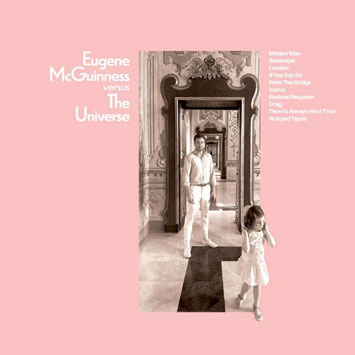
Eugene McGuinness Versus The Universe by Eugene McGuinness – Album Review
By Ellie Victor
Eugene McGuinness has always been a slippery figure in British songwriting. Since emerging in the late 2000s on Domino, he has darted between acoustic oddballery, music-hall pop, new wave, Merseybeat, rockabilly, indie noir and bright-eyed guitar classicism with the air of a man who keeps a trapdoor under every chorus. There have been moments when he has sounded like Ray Davies rewriting Joe Meek, Jarvis Cocker fronting The Coral, or Neil Hannon trying on Graham Coxon’s nervous system. With McGuinness, perhaps the only thing to expect is – yes – the unexpected.
That remains true on Eugene McGuinness Versus The Universe – an album of warm surprises, London ghosts and songwriterly left turns. Nothing here feels too out there to be intangible, yet nothing is overfamiliar either. McGuinness is flexing his versatility muscles, but not in the showy, cabaret-mirror way that can turn clever songwriters into their own tribute act.
Strangely, opener ‘Meteor Man’ is, at least to these ears, the album’s weakest moment. It feels like a slightly awkward curtain-raiser, a song still adjusting its cape while the orchestra is already leaning forward. Thankfully, the lovely ‘Seascape’ immediately steadies the ship. Woozy, lightly jazz-influenced and sailing in on a gauze of dream memories, it has a carefree softness that even gives McGuinness licence to (whisper it) whistle. It is a small, lovely gesture, somewhere between Jonathan Richman innocence and early Badly Drawn Boy looseness.

Eugene McGuinness, 2026
“Wit and oddness”
Single ‘London’ is stronger still: a string-soaked hymn to the city, both love letter and valediction. McGuinness leans into the emotional hush of Roddy Frame’s seminal Surf album, letting the song unfold with that same sense of urban solitude, of beauty glimpsed from the top deck of a bus at dusk. It could have become mawkish in heavier hands, but he keeps it poised, all ache and restraint.
‘From The Bridge’ continues the sense of craft sharpening beneath the eccentricity. Under its sweet choral harmonies sits a sturdy songwriterly classicism, the kind of melodic architecture that recalls Squeeze, Aztec Camera and Costello in non-sneer mode. McGuinness is often praised for his wit and oddness, but this album reminds us that he can write proper songs, not merely interesting ones.
The London theme deepens with ‘Eastend Requiem’, which could be a lost soundtrack to Footsteps in the Fog. There are shades of The Divine Comedy’s theatricality, The Clientele’s after-hours fatalism and even a little of Scott Walker’s spectral urban drama, though McGuinness remains too nimble to sink into full melodrama.
 “Ever-evolving”
A fine closing trio begins with ‘Drag’, a minimalist, lamplit beauty that slowly accelerates into a tumble of words. It may be the album’s most quietly affecting track, not because it shouts its feeling, but because it lets it gather. ‘There’s Always Next Time’ then builds from a softly-strummed opening towards crashing chords and celestial choirs before fading into a big-city dusk. By this point, the album has found a glow that is both theatrical and intimate, like a West End sign reflected in a rain puddle.
Closer ‘Warped Tapes’ is bittersweet and heart-tugging, and frankly a Tindersticks cover should be in the works right now. It has that bruised, late-night elegance Stuart Staples could turn into a velvet-lined minor catastrophe.
There are moments when one pines for a little more Richard Hawley-esque emotional depth in McGuinness’s sometimes reedy timbre; the voice sometimes skims across the water when you want it to dive in. But it is a small matter on a fine album filled with big moments, delicate detours and plenty of surprises from an ever-evolving, quietly fascinating songwriter.
3.5 out of 5.0 stars

Ellie has spent over three decades dissecting riffs, rhythms, and rockstar egos, all in pursuit of the perfect review. Her music writing journey began at 12 with a glowing 10/10 diary entry for Echo and the Bunnymen, and she’s been chasing that high ever since. Armed with encyclopaedic knowledge and a soft spot for the sonically daring, Ellie will review anything that’s put in front of her – as long as it’s on vinyl.