The Castelli Romani’s Long Descents Mean Extra Work for Brake Calipers
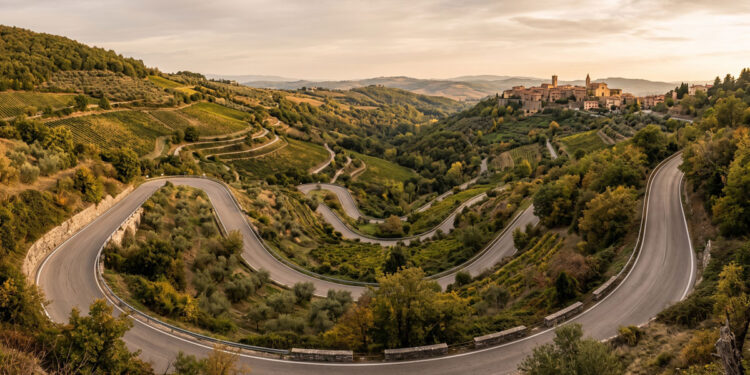
Anyone who has driven the loop of volcanic hills south east of Rome knows its rhythm. A long, winding climb through vineyards and chestnut woods gives way to a brief flat stretch past a lakeside town, followed by a descent that is just as tight as the ascent. The Castelli Romani area, the ring of towns built on the rim of an old volcanic crater, is one of the more rewarding driving routes in the region. It also places a distinct pattern of demand on a car, one that concentrates less on the engine and more on the brakes.
Climbing and descending place different demands on the car. Uphill sections primarily load the drivetrain, with the engine held at higher revs and the gearbox doing more work. Long descents shift the load elsewhere. Little of it reaches the driver as noise or resistance at the pedal. Almost all of it is carried by the braking system, continuously, for as long as the descent lasts and for anyone already wondering whether their own car is due a check, it’s possible to find brake calipers on autodoc.co.uk before reading on, though the reasoning below is worth understanding first.
Why long descents place sustained demand on the brakes
A single firm stop produces a burst of heat that a brake system dissipates within seconds. A long, winding descent creates a different kind of load: repeated, sustained braking over several kilometres, often with too little straight road between corners for the discs and calipers to cool fully before the next application. On terrain such as the climb into Rocca di Papa, which runs for around 9 kilometres at an average gradient close to five per cent, a descent of comparable length and character is a routine part of the drive rather than an unusual one.
How repeated braking can affect brake caliper operation
The caliper is the component that holds the pads against the disc and controls how firmly they clamp. Under sustained, repeated braking, its pistons and seals operate at elevated temperatures for longer than they would during ordinary driving, and the pads and guides are worked more continuously.
This pattern does not by itself indicate a fault. Calipers are built to operate under heat and repeated use. What it does mean is that any existing issue, such as a piston that is starting to stick or a guide pin with restricted movement, is more likely to become noticeable under this kind of demanding, repeated braking than it would be during flatter, more even driving.
Signs that can point to a brake caliper problem
None of the following points alone confirms a fault in a caliper, since several of these symptoms can also result from worn pads, uneven tyre wear, or other parts of the braking system. They are worth noting, however, if long descents form part of a regular drive.
- The car pulling gently to one side under braking rather than stopping in a straight line
- Uneven wear between the inner and outer pad on the same wheel, visible on inspection
- A dragging sensation from one wheel, or reduced acceleration that eases once the car has coasted for a moment
- One wheel running noticeably hotter than the others after a drive, without an obvious cause
Any one of these on its own is not a diagnosis. Taken together, or if they recur after drives of this kind, they are a reasonable basis for having the braking system inspected.
When to have a brake caliper inspected
Because a caliper fault can resemble several other issues at first, from worn pads to problems elsewhere in the hydraulic system, a proper inspection is a more reliable approach than judging by symptoms alone. A garage can establish whether a caliper is sticking, leaking, or operating normally, and whether the symptoms observed actually originate there.
There is no fixed replacement interval for brake calipers, unlike pads or discs. Two points do come up consistently as sensible checkpoints. Most manufacturers recommend changing the brake fluid roughly every two years, since moisture absorbed into the fluid over time can affect the seals inside the caliper. A general inspection of the braking system, including the calipers, is also a standard part of most manufacturers’ annual service recommendations. Beyond these two intervals, some workshops treat the 120,000 to 160,000 kilometre mark (roughly 75,000 to 100,000 miles) as a point where closer, more frequent checks are worthwhile, though this is a workshop rule of thumb rather than a manufacturer specification, and estimates vary between sources. For a car that regularly covers terrain like the Castelli Romani descents, these routine checkpoints are a more useful reference than waiting for symptoms to appear.
When a brake caliper needs replacing
If inspection confirms that a caliper needs replacing, the replacement part must match the vehicle’s braking system and specification. Compatible brake calipers can be compared on autodoc.co.uk before booking the work, which makes it easier to check fitment and specification against the vehicle in question.
For drivers who regularly use long, winding descents, recurring pulling, uneven pad wear, or signs of a dragging brake are reasons to have the braking system inspected rather than relying on symptoms alone.