Why the Used-Premium Discount Leaks Back out Through the Workshop
A three-year-old Audi A6 or BMW 5 Series often lands in front of a buyer at a price that looks like a bargain against the new-car list. The gap between that purchase figure and the total cost of keeping the car on the road for the next three or four years is where the real money sits, and it is the part most private buyers underestimate. Dealers who take these cars in part-exchange, and the sales staff who position them, are usually the first to see how quickly a premium German badge turns into a premium invoice.
Running cost on an Audi, BMW, Mercedes, Volkswagen or Porsche is higher than on a mainstream equivalent for mechanical reasons rather than any marketing story. Genuine parts carry a premium. The diagnostic equipment needed to read and reset these cars is marque-specific and expensive to license, which is why not every garage will touch them. Service intervals are longer on paper, commonly around 12 months or 15,000km, but the work packed into each visit is heavier, and the consumables inside it (fully synthetic oil, particulate filters, adaptive dampers, complex braking hardware) cost more to replace than the equivalents on a Ford or a Kia.
Where the money actually goes
Depreciation remains the largest single line for most owners, and premium German cars shed value fast in the first three years before the curve flattens. That early drop is what creates the used bargain in the first place. The buyer picking the car up at year three inherits a slower depreciation slope but a steeper maintenance one, because components that were fine under warranty start reaching the end of their service life.
Tyres are a clear example. A performance saloon on staggered fitment, wider rubber at the rear than the front, cannot be rotated and wears in pairs, so a set can cost several times what a family hatchback needs. Brakes on heavier, faster cars wear faster and cost more per corner. Air suspension, common on larger Mercedes and Audi models, is reliable for years and then expensive in a single hit when a strut fails out of warranty. None of this is a fault. It is the running cost the specification was always going to carry, and it is worth modelling before purchase rather than discovering at the first MOT after the warranty lapses.
Insurance and road tax sit on top, both weighted towards higher-value, higher-emission cars, and both easy to forget when the monthly finance figure is doing the talking.
Main dealer versus independent specialist
The single decision that moves the long-term bill most is who services the car. A franchised dealer offers manufacturer training, the correct diagnostic kit, genuine parts as standard and a main-dealer stamp that some buyers still treat as the gold standard at resale. It also charges the highest labour rates in the market, often comfortably above GBP 150 an hour in and around London, and tends to replace rather than repair when a component is marginal.
An independent marque specialist sits at the other end. Labour rates are lower, the workshop is frequently staffed by ex-franchise technicians, and a good one runs the same diagnostic software and fits genuine or manufacturer-approved parts. The trade-off is that quality is uneven across the independent sector, and the cheapest local garage with no marque-specific equipment can create problems it cannot then read, which is a false economy on a car that logs faults electronically.
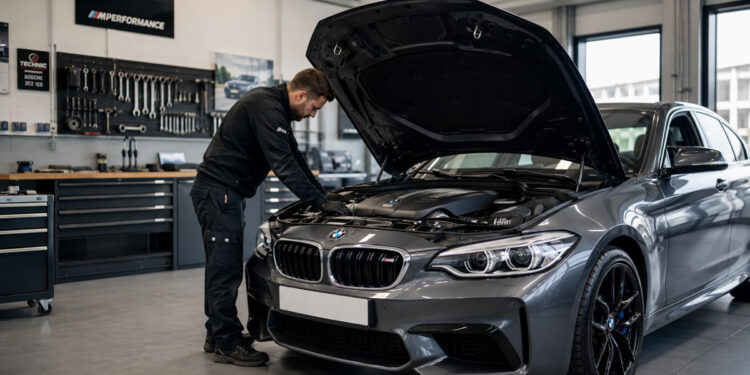
A premium German car booked in every 12 months or 15,000km soon shows why the maintenance bill can outweigh the purchase discount that tempted the buyer: genuine parts and marque-specific diagnostic equipment cost more, and cutting those corners resurfaces later as a thinner resale price when the history does not stack up. Main dealers charge accordingly, but a franchise stamp is no longer the only way to keep a car’s record intact. A growing share of premium owners now sit between the two extremes, turning to independent European specialists in Brisbane rather than defaulting to either the franchise counter or the cheapest local garage. Wayne Park, which has serviced Audi, BMW, Mercedes and Porsche from its Milton workshop since 1986, is a working example of the model: genuine parts and dealer-grade diagnostic equipment behind a fully stamped history, at below main-dealer rates.
The point holds on either side of the world. The independent specialist is now a mainstream choice for owners past the warranty period, provided the workshop can prove genuine parts and the right diagnostic capability.
The service history is a resale asset
For anyone who will eventually sell or part-exchange the car, the service record is not paperwork, it is money. A complete history with every interval stamped, dated and matched to genuine parts is worth a measurable premium at trade-in, and its absence is one of the first things a buyer or a valuer marks the car down for. Two identical cars with different histories are not worth the same, and the gap widens as the car ages and provenance becomes the main thing separating a clean example from a risk.
This is where the franchise-versus-independent question resolves in practice. Manufacturers now widely accept that servicing at a competent independent, on genuine parts and to the correct schedule, keeps the history intact and does not void a used car’s standing. What damages resale is a gap in the record or a service done on the wrong parts by someone without the equipment to do the job properly. A consistent record from a capable specialist protects value as effectively as a main-dealer stamp, and usually costs less to build.
What to tell a buyer
The honest guidance for a customer weighing a used premium European car is to price the running cost before the purchase, not after. Budget for a heavier service every 12 months or so, expect tyres and brakes to cost more than on a mainstream car, and treat any big-ticket item outside warranty as a cost that arrives sooner or later. Then choose a service route that keeps the history complete on genuine parts, whether that is the franchise or a proven independent. The buyer who does that spends more per year than a mainstream owner but protects the car’s resale value, and keeps the original discount from quietly leaking back out through the workshop door.