Hyundai Inster – Review
By Liam Bird, November 2025
Electric cars, we are constantly told, are the future. And judging by just how many are being launched on monthly basis we’ve little choice in the matter. But have we, the public, been as welcoming of them as we should? And more to the point, are most of them actually any good?
Many a petrol-head will tell you, me included, that the harsh reality is the majority of electric cars are nowhere near as good as those they’ve been built to replace; they’re heavy, they’re expensive, and regardless of what the EV evangelists will argue, they’re too compromised to allow anything in the way of spontaneity. Not that you’d want drive some of them for the sheer hell of it that is, certain electric cars – I’ll mention no names – offer little more excitement than pressing the start button on your microwave.
Although, to thanks myriad so-called driver assistance systems they do make more pinging noises! The deprecation on some marques and models has proved to be horrendous too, find me someone who traded in their Porsche 911 for a Taycan who doesn’t now regret having done so.
“Generous helping of practicality”
But perhaps we’ve all got it all wrong. What if electric cars were light, cheap, and offered a certain sense of fun? And if manufacturers could throw-in a generous helping of practicality as well…
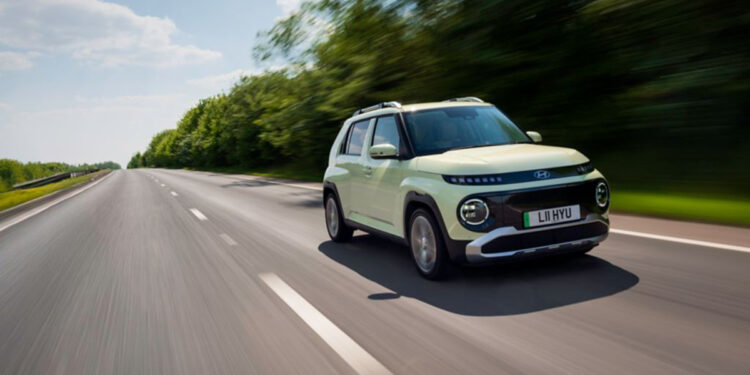
That’s exactly what Hyundai have attempted to do with their all-new Inster. Based upon Hyundai’s K1 platform, as opposed to the bespoke E-GMP Electric Global Modular Platform electric that underpins its IONIQ cars, the Inster – known as the Casper in its native Korea – is an electric-only four seater that’s available in two different versions. The Casper moniker has some slightly dodgy urban dictionary translations apparently, hence the use of Inster in certain markets instead.
Entry-level Insters have a 42kWh battery powering a single electric engine that produces 95bhp and 108lb ft and thus serves up a 0-62mph dash in 11.7 seconds. Top speed is 87mph, whereas range is said to 186 miles according to WLTP.
A larger budget bags you the 02 model with a 49kWh battery and slightly less anxiety inducing 223-mile WLTP range. Power increases to 113bhp, while the 0-62mph times drops to 10.6 seconds. Top speed is a heady 93mph. Both variants of Inster feature 400-volt recharging architecture with a 120kW charge rate, come fitted with a heat pump as standard (for improved efficiency in cold weather) and are vehicle-to-load compatible. “My” Inster even came with a domestic-type 3-pin plug socket – handy for a quick brew perhaps? Kettle permitting that is.
“Retro meets modern”
Joking aside, Hyundai do have a reputation for encouraging owners to sleep in their cars – it’s a Korean thing – so that kettle might come in handy after all. The Inster’s seats all fold flat so, as long you’re not too tall, I suppose you could stretch out for the night inside the Inster’s cabin if you really wanted (or had) to.
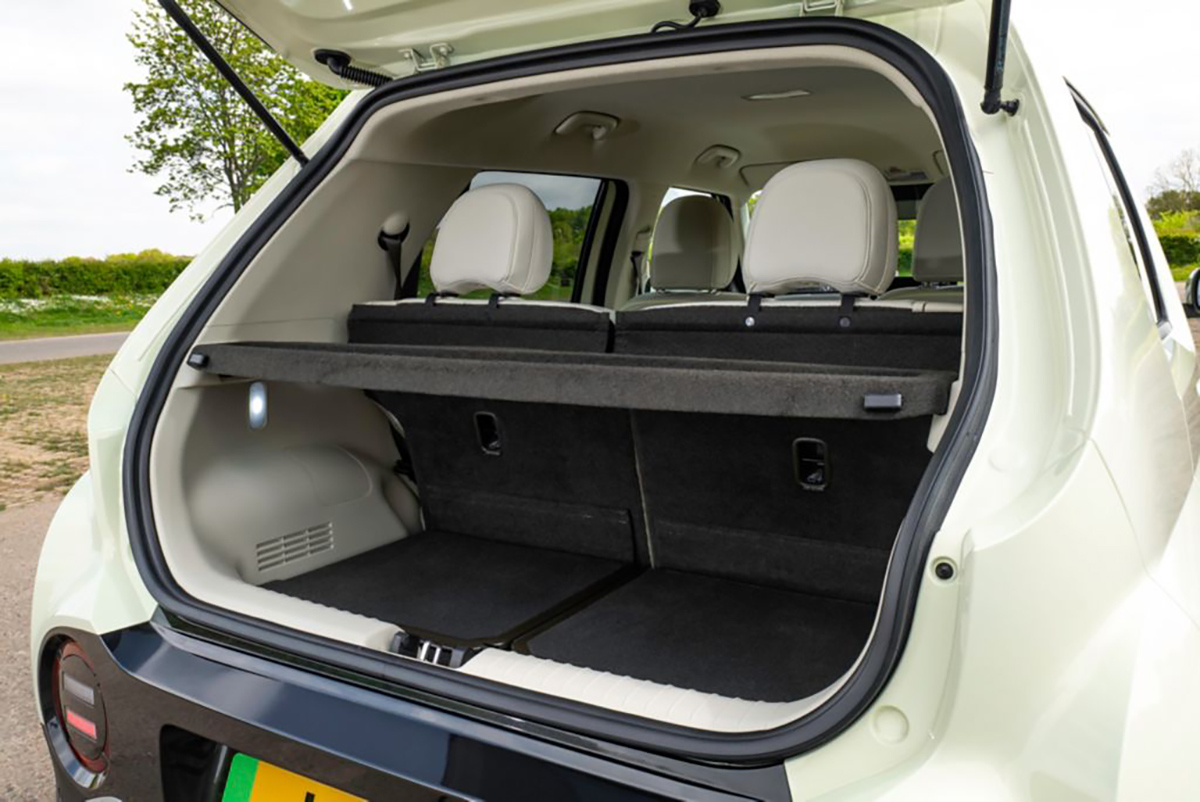
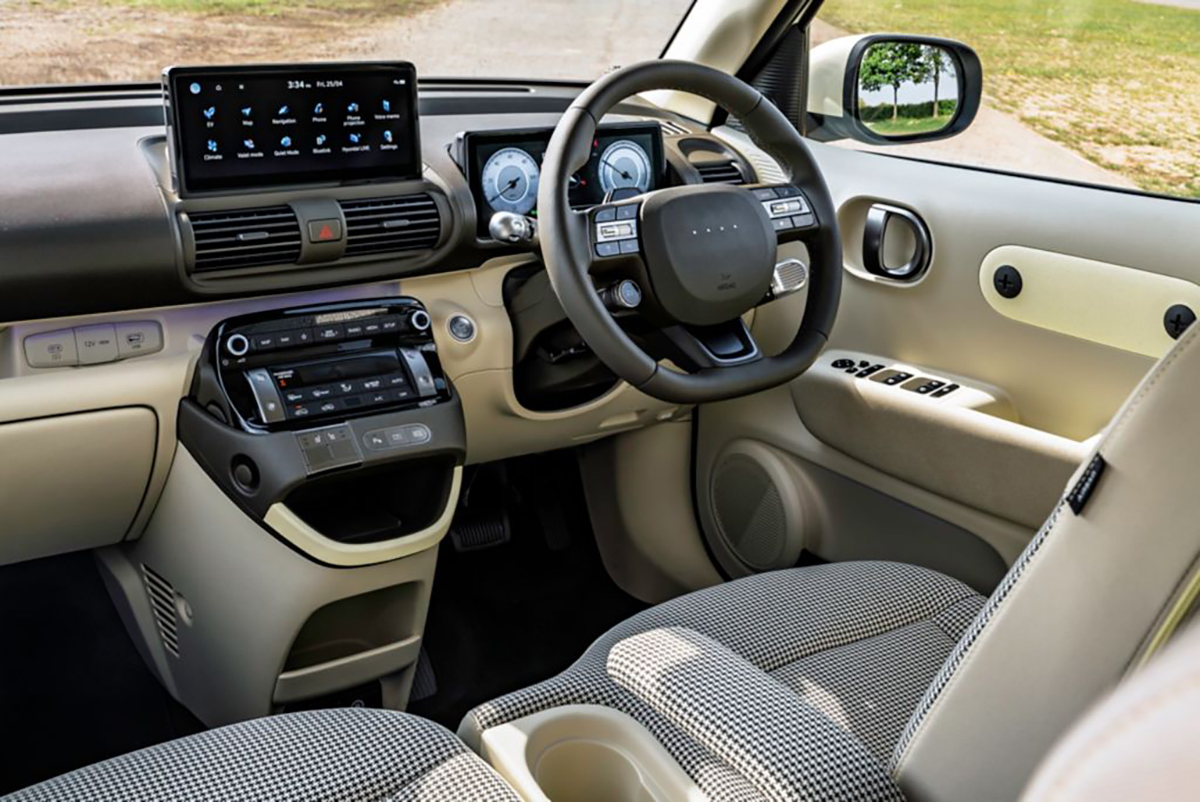
Which, I suppose, in a long-winded sentence or two brings us around the Inster’s interior. Think retro meets modern; hounds-tooth bench seats, an upright driving position, twin 10.25in screens that form a digital dashboard and infotainment display, proper buttons for heating, ventilation and radio etc, USB ports aplenty, wireless phone charging, and recycled materials almost everywhere. It’s actually a rather nice and somewhat airy feeling place to be, but it is strictly a four-seater. The 50:50 split rear seats can be moved fore and aft to increase either boot or passenger space – you won’t carry lots of both.
And pick your colours wisely, quite how long the near white interior of “my” Inster would stay so bright and shiny in full day-to-day family use is a matter I’d rather not contemplate. One other thing, the part-hard, part-soft parcel shelf is rubbish – whomever it was that signed that off needs to have a right good talking to.
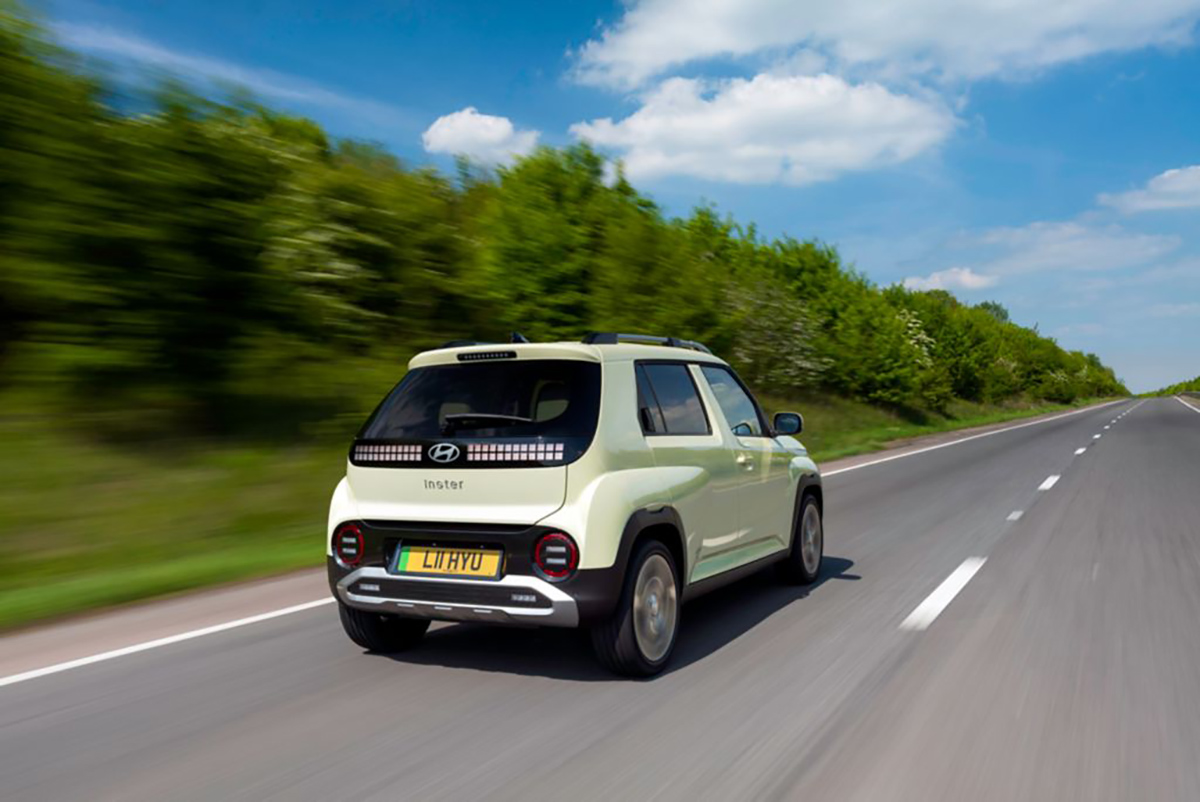
“Quirky looks, brilliant build”
Flimsy load covers aside, the Inster drives rather nicely, albeit in that point-and-squirt-and do-little-else-electric-way we’ve been told we’ve now got to get used to. The narrow dimensions make it a doddle to man-handle around town, and once out of the city limits the Inster feels surprisingly mature too. Overall the driving experience is best described as pleasant; jumping in and out of the Inster and doing the daily commute is simplicity in itself.
Just don’t expect anything you could call either involving or exciting. The Inster’s charm definitely lies in the way it looks rather than the way is drives. Renault’s similarly-priced new 5 offers a far more involving, exciting even, driving experience all round, if that is you’re willing to sacrifice the Inster’s superior practicality.
You pay your money… and in the case of electric cars thus far it’s been rather a large sum of money. What the Inster offers is practicality, quirky looks, brilliant build quality, a decent(ish) range, plus a not too scary (by today’s standards) price tag. If you really feel your future should become electric, make a point of driving the Inster as soon as you possibly can.
Hyundai Inster o2 + Tech Pack
Engine: 49 kWh battery, Permanent Magnet Synchronous motors.
Transmission: Single-speed transmission, front drive.
Paddle Shift – Regenerative Braking
Power: 113.5 bhp
Torque: 108 lbft
0-62mph: 10.6 sec
Max Speed: 93 mph
Range: 224 miles (approx.)
CO2: 0g/km
Price: From £26,745
Hyundai Inster – FAQ
What is the Hyundai Inster in a nutshell?
It’s a compact, four-seat electric city car with quirky styling, light steering and a focus on everyday practicality – flat-fold seats, decent range and sensible pricing.
Which versions are there?
Two battery options: Standard Range 42 kWh and Long Range 49 kWh. Trims include Inster 01, Inster 02 and the adventure-styled Inster Cross.
How far will it go on a charge?
WLTP figures quote up to 229 miles on 15-inch wheels (49 kWh) – or around 223 miles on 17-inch wheels. The 42 kWh model is rated up to 203 miles; the review car saw ~224 miles indicated.
How quick is it?
42 kWh: 95 bhp, 0–62 mph in 11.7 sec, 87 mph top speed. 49 kWh: 113 bhp, 0–62 mph in 10.6 sec, 93 mph top speed.
What about charging?
400-volt architecture with up to 120 kW DC rapid charging. A heat pump and battery heater are standard to help efficiency in cold weather.
Does it have vehicle-to-load (V2L)?
Yes – interior socket and external adapter provide up to 3.6 kW to power devices such as laptops, e-bikes or a campsite kettle.
Is it practical for a small EV?
Very. All seats fold flat for load length or naps; rear seats slide 16 cm to juggle passenger space and a 238–351-litre boot. It’s strictly a four-seater.
What’s the cabin like?
Retro-meets-modern vibe – upright driving position, twin 10.25-inch screens, proper climate and audio buttons, plentiful USB, wireless charging and recycled materials. Lighter interiors look great – but may prove harder to keep pristine.
Any annoyances inside?
The mixed hard/soft parcel shelf feels flimsy and is the weak link in an otherwise well-built cabin.
How does it drive?
Easy and mature around town with light controls and tidy footprint; calm on faster roads. It’s pleasant rather than playful – the charm is more in design and usability than driver involvement.
How does it compare to rivals?
Renault’s new 5 feels sportier and more engaging; the Inster counters with better day-to-day versatility, flat-fold seating and V2L.
What does it cost?
Guide pricing: Inster 01 from £23,505; Inster 02 from ~£26,755; Inster Cross from ~£28,755. The tested Inster 02 + Tech Pack was listed at £26,745.
Who is it for?
Drivers who want an affordable EV that’s easy to park, big on clever space and features, and sensible to run – without chasing hot-hatch thrills.
Key spec highlights to know
Heat pump as standard, regenerative braking paddles, smart cruise with stop-and-go, LED headlights (Inster 02), sliding/reclining rear bench, flat-fold front seats and optional surround-view/driver-assist tech on Cross.