Royal Philharmonic Orchestra – Live Review – Hull City Hall
By Karl Hornsey, February 2026
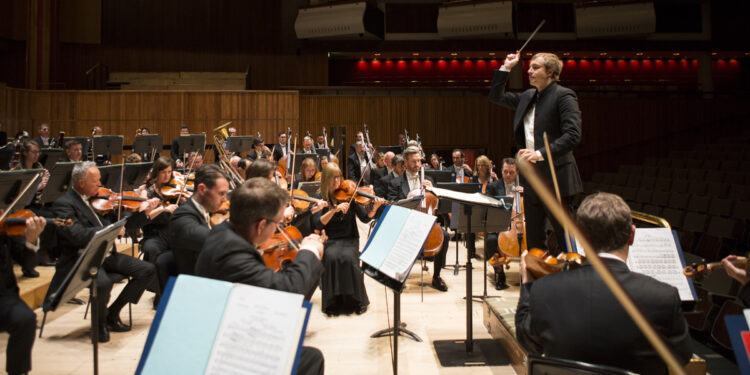
The latest classical offering at Hull City Hall featured an eclectic selection of pieces performed by the Royal Philharmonic Orchestra, under the baton of the company’s music director Vasily Petrenko, spanning 140 years of classical history by three of the most loved composers of all time.
The evening began with the overture to Hector Berlioz’s comic opera Béatrice et Bénédict, which enjoyed its premiere in 1862 and is loosely based on a subplot of Shakespeare’s play Much Ado About Nothing. With the latter being a comedy, Berlioz wrote this with a light touch and a heavy reliance on the woodwind section, making the rather difficult task of depicting several different parts of the score in just the overture seem a simple one, and it was a pleasure to hear such a seldom-played work.
While that was a pleasure, the real star of the evening was to follow. It’s so rare that the concerto of one of these evenings is something other than a violin, cello or piano, so the prospect of an oboe concerto was something to be treasured, and it more than delivered. And this particular oboe concerto from the pen of Mozart has a remarkable story behind it, which required a fair bit of detective work for it to even exist to this day.

Conductor, Vasily Petrenko
(c) Antoine Saito
“Astonishing performance”
The original oboe concerto was deemed to have been lost, replaced by a flute concerto instead but, not far off 150 years after its premiere, it was magically found, and what a find it was. The oboe, as with so many of the woodwind instruments, tends to take a back seat, so it was wonderful that the RPO’s very own John Roberts was very much front and centre for this performance, and what an astonishing performance it was. While the orchestra themselves were remarkable, it was impossible to take one’s eyes off Roberts, whose expressive and physical playing of the oboe was an absolute wonder, demonstrating an art form that is so often left uncovered.
To conclude, following the interval, was a very different piece altogether and, as so often by Sibelius, one of drama, emotion and volume – in this case the Finnish composer’s second symphony. As with many of Sibelius’s most famous works, there are deep elements of nationalism and the need for the Finnish nation to remain strong in the face of the might of the Russians next door, and that always shines through in the passion of his work.
This concerto, in four movements, is a seriously immersive piece, seemingly reaching a volatile crescendo on many occasions, but when it finally does climax, it’s an energetic thing of beauty that seemingly requires every ounce of energy from the orchestra – making it a truly wonderful piece on which to end another sublime evening of entertainment at the City Hall.
top image: Ben Wright

Karl’s love of writing was piqued at the age of eight, when he won a Blue Peter badge in an essay-writing competition. The location of said badge might be a mystery now, but the memory never fades. Hours spent writing about sport as a teenager, in pre-internet years when you had to make your entertainment, honed his skills, and Karl has worked in TV and radio listings at PA Media for 28 years, and the age of hybrid working means 50% of that can be at home listening to Classic FM and thinking about his next visit to his beloved Yorkshire Dales.
hornskar