Living the Dream: Bradford City in the Premier League
By John Dewhirst
Promotion to the Premier League amounted to the wildest dream coming true for Bradford City supporters, although the memory of those two seasons at the pinnacle of English football has tended to be overshadowed by what followed. Indeed, there was a big price to be paid for the experience – not simply in the cost of visiting the stadia of the elite, but in the longer-term impact on the club itself and the hangover that it caused.
The irony was that in 1999 it genuinely felt as though the club had transitioned, leaving behind its time in the lower divisions. Promotion offered a genuine prospect that Bradford City could now consolidate at the top of the English football hierarchy even if the club was later relegated back to the second tier. The subsequent descent down the divisions between 2001 and 2007 mirrored what had happened eighty years before.
For much of the post-war period, Bradford City had been an unglamorous lower-division side, and perceptions of Bradford had deterred wealthy investors. Had City secured promotion to Division One in 1988, the gulf between the top two divisions was then sufficiently narrow that consolidation might have been achievable. At the turn of the century, the same theme – lack of depth and relative weakness – reasserted itself, although the gulf was by then much wider.
Barnsley had had a season in the Premier League in 1997/98 and Bradford City had been the opponents at Oakwell at the end of April 1997 when the Reds’ promotion had been achieved. It was an incredible achievement for a club that had been fourth division rivals as recently as 1978/79. At a time when Bradford City’s future in the second tier hung in the balance it felt improbable that the Bantams might one day emulate the Reds.
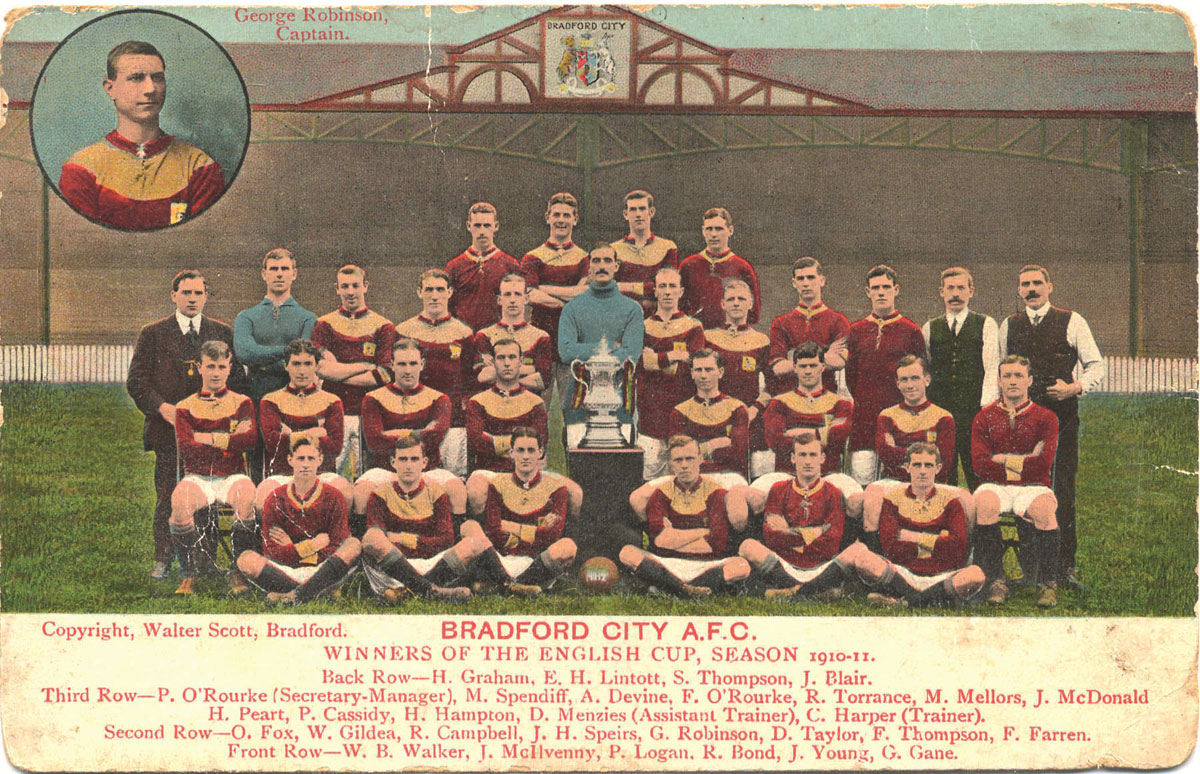
Bradford City, FA Cup winners 1910-11. (Author’s collection)
“Disquiet”
Just two years later, Barnsley’s experience in the Premier League provided a taste of what Bradford City could now expect as the latest unfashionable club making up the numbers. The media attention was unprecedented, and a unique experience given that previously the Bantams had been off the radar of the national press and television. The coverage was also distastefully patronising but it fostered a strong ‘them and us’ mentality that Geoffrey Richmond wasted no opportunity to milk, chiming with the notion of Bradford City as bantams – plucky underdog fighters.
The club had less than three months to prepare for the new season, an issue that put newly promoted clubs at a distinct disadvantage. In contrast to the previous summer, player signings were less dramatic and the total paid in fees was lower. In part this reflected Paul Jewell’s intention to maintain the cohesiveness and momentum of the squad that had secured promotion; it may also have reflected an unwillingness of players to entertain signing for Bradford City. Pundits had written off the club’s chances and the inadequacy of training facilities was common knowledge. My suspicion is that Richmond cultivated his relationship with Peter Ridsdale, chairman at Elland Road, to secure three of his headline signings.
Reported transfer fees paid in the 1999 close season amounted to £2.85 million. These comprised Gunnar Halle and Lee Sharpe from Leeds United, £200,000 apiece; David Wetherall, again from Leeds, £1.40 million, which was a club record; Andy Myers from Chelsea, £800,000; and Neil Redfearn – son of former Park Avenue favourite Brian – from Charlton, £250,000. The remainder of the recruits, in particular Dean Saunders, released by Benfica, and Matt Clarke, secured from Sheffield Wednesday, arrived on free transfers or as loan signings.
Myers (aged 26) and Wetherall (aged 28) were both secured through long-term contracts of four and five years respectively, which hinted at a degree of desperation on the part of the club. Unsurprisingly, the introduction of higher-paid players encouraged existing squad members to seek better terms and was a cause of disquiet.
Halle, Saunders, Redfearn and Neville Southall, signed for goalkeeping cover, were all veterans, with Halle and Redfearn the youngest at thirty-four. (When Southall deputised for Matt Clarke against Leeds in March 2000 he became the oldest player to represent Bradford City – the first time the club had resorted to a 41-year-old.)
The expenditure was offset by the sale of Robert Steiner to QPR for £215,000 and, later, Darren Moore to Portsmouth for £500,000. Redfearn also left the club later in the season, sold to Wigan in March 2000.
“Fighting spirit”
There could not have been a brighter start to life in the Premier League than an opening win at Middlesbrough, with newspaper headlines referring to Jewell’s ‘Dad’s Army’. A draw at home to Sheffield Wednesday in the next game was also creditable but one point from the next five games served as a reminder of the challenge ahead. The sequence included a 0-2 defeat at Highbury that confirmed the gulf in quality in a game dominated by Arsenal, the Bantams doing well to not concede more. The club faced opponents with deeper squads, greater tactical sophistication and vastly superior financial resources, with mistakes ruthlessly punished.
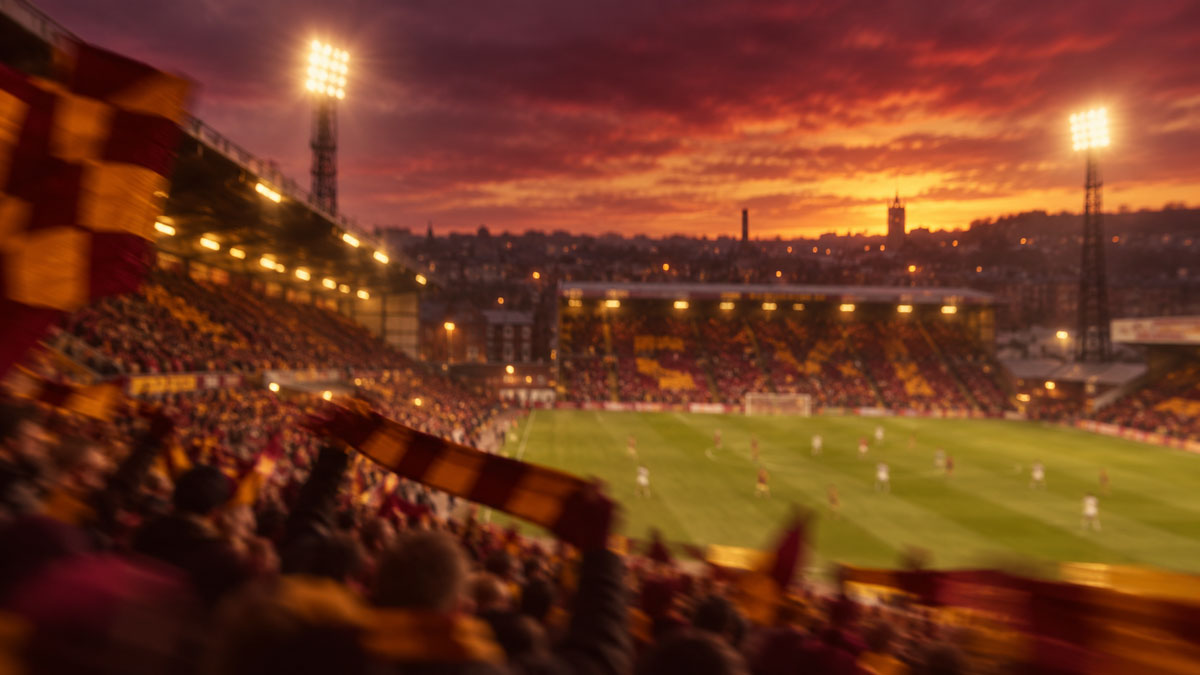
Victory at Derby County on 25 September began a run of twelve games to the end of the year that brought three wins and three draws, sufficient to keep Bradford City outside the relegation places in seventeenth. Just one point from the next three matches dropped the club one place, and then came back-to-back wins at Valley Parade that restored morale, most notably a 2-1 defeat of Arsenal on 5 February 2000 – one of nine unbeaten home games between late October 1999 and late February 2000. Premier League sides were unfamiliar with a narrow playing field like Valley Parade’s, as well as the more basic dressing-room facilities, and this as much as an indomitable fighting spirit kept Bradford City in the reckoning. Opponents also had to cope with an intense atmosphere not dissimilar to a cup tie.
The following ten games were winless and relegation seemed inevitable but then came a 1-0 victory at Sunderland on Easter Monday through a John Dreyer goal. A 3-0 defeat of Wimbledon at Valley Parade gave further hope, escaping the bottom three with an uncompromising team ethos – the fighting spirit attributed to bantams.
A sizeable contingent of Bradfordians headed to Leicester the following weekend but a 0-3 defeat ended the revival. City dropped back into the relegation places as Wimbledon secured an unlikely point to break their own sequence of eight successive defeats. With Sheffield Wednesday and Watford by this time already relegated, it now depended on Bradford City getting a better result than Wimbledon on the last day of the season. The fixture list brought Liverpool to Valley Parade, with Wimbledon travelling to Southampton. Survival was mathematically feasible but who would have bet against Liverpool, then chasing a place in the European Champions League?
A capacity crowd of 18,276 witnessed the ‘Great Escape of the Bantams’ on 14 May 2000, an outcome to be written in Bradford City folklore. A twelfth-minute header from David Wetherall secured the result that the Bantams needed. Wimbledon lost 0-2 and finished three points behind, relegated to the second tier. Bradford City ended 1999/00 with thirty-six points, a then record low for any club avoiding relegation from the Premier League.
Once again, the fate of the club had rested on the final fixture of the season, most recently in 1999 when promotion had been achieved but also in 1997 when relegation was avoided from the second tier and in 1996 when a victory at Hull City had ensured a third-tier play-off place. Further back, 2000 had parallels with 1909 when the club had secured its place in Division One in the last game of the season to prolong its tenure beyond twelve months.
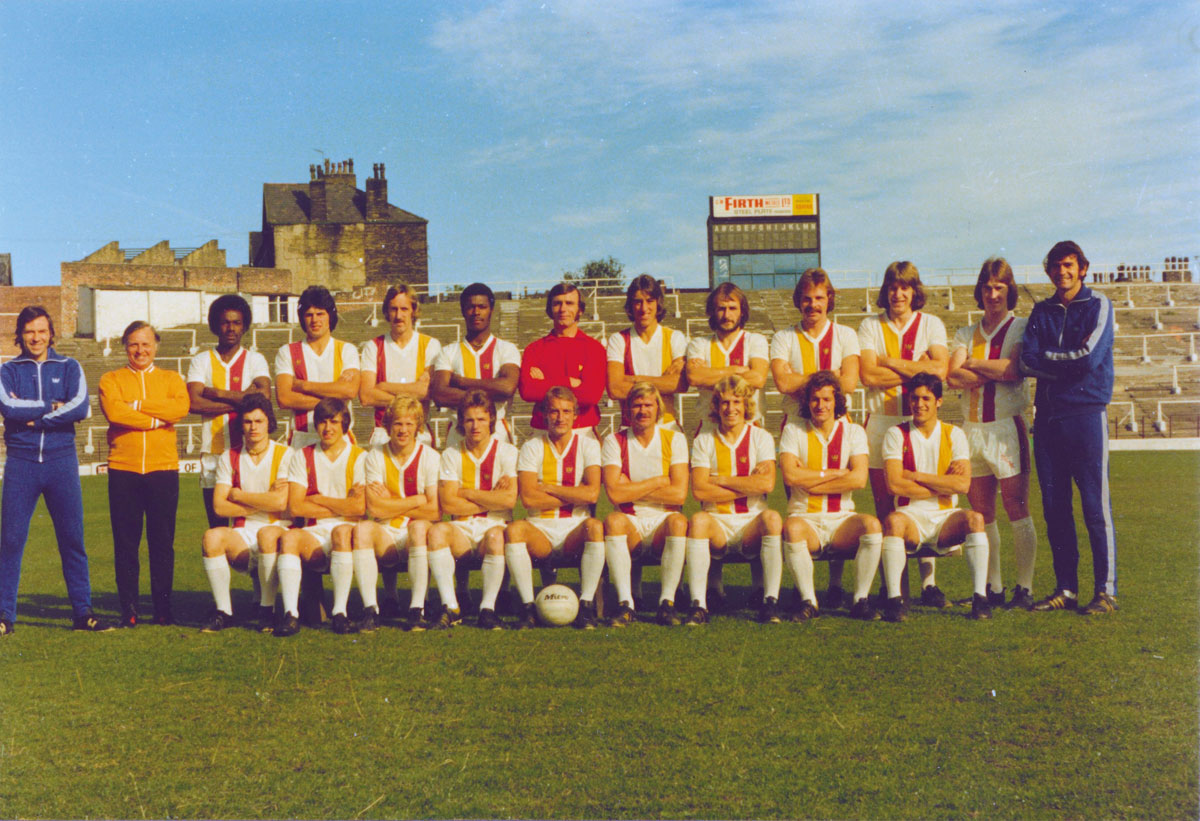
Bradford City, 1976-77. (Author’s collection)
“Headline signings”
The following close season proved as hectic as in 1999 but a whirlwind of surprises. The first – and in retrospect the decisive event of the summer – was the announcement in June, five weeks after the Liverpool match, that Paul Jewell was leaving to join newly relegated Sheffield Wednesday, and that Chris Hutchings, assistant to Chris Kamara and then Jewell, was to assume control. Jewell no longer had the wish to put up with the interference and bullying of Geoffrey Richmond and became the first manager to walk out on him at Valley Parade.
The loss of Paul Jewell was the single most consequential event of the close season. His man-management had been critical: integrating established internationals with first-time Premier League players required sensitivity and authority, and his measured presence had prevented short runs of poor form from becoming terminal.
The strength of both Kamara and Jewell had been their ability to motivate the team and establish a strong sense of unity and coherence. The logical consequence was that Jewell strengthened the squad incrementally rather than by integrating celebrity stars whom the remainder of the side would have to accommodate. Crucially, Jewell had been the only figure at Valley Parade with the standing to resist Richmond’s demands for big-name signings. With him gone, that restraining influence went with him – and the six weeks of madness that followed had its origin precisely there.
No less amazing was the club’s foray into European football, competing in the UEFA Intertoto Cup. With victories over FK Atlantas of Lithuania and the Dutch side RKC Waalwijk, Bradford City reached the semi-final before being knocked out by the Russian club Zenit Saint Petersburg. Undoubtedly the club derived publicity and supporters enjoyed new adventures, but it hardly assisted preparation for the next season to begin competitive football at the start of July. Making his debut in the game against FK Atlantas in Lithuania was Mark Bower, who subsequently made 231 appearances through to April 2009, although he didn’t break into the team until the following season.
Then came those six weeks. The headline signings followed in quick succession: David Hopkin, a Scotland international, joining from Leeds on 7 July for a new club record fee of £2.5 million; Dan Petrescu from Chelsea for £1.0 million; Benito Carbone, previously released by Aston Villa, on 9 August on a notional free transfer; and Ashley Ward from Blackburn Rovers on 18 August for £1.5 million on a four-year contract. Earlier free transfers of Ian Nolan and Peter Atherton from Sheffield Wednesday had also come on generous pay.
The financial implications were staggering. The club’s payroll was inflated to £14.4 million. The Carbone ‘free transfer’ overlooked the package that had been agreed with him: a four-year contract paying £40,000 per week, as well as a luxury residence in Leeds. Outgoings were offset to a degree by the sale of Lee Mills to Portsmouth for £1.25 million, who made way for Ward, and Ashley Westwood to Sheffield Wednesday for £150,000. There was also the departure of John Dreyer on a free transfer to Cambridge. None of this came close to balancing the books.
The Sky TV pundit Rodney Marsh had pledged to have his hair cut off if Bradford City managed to avoid relegation in 2000, and he was ceremoniously shaved on the pitch before the Leicester City fixture in August. Marsh repeated his prediction of City’s relegation, questioning Carbone’s motivation: ‘I can understand foreign players coming to a team like Chelsea, but why a team like Bradford? What is their incentive?’ Indeed, were the high-paid signings ready for a scrap at the bottom of the Premier League?
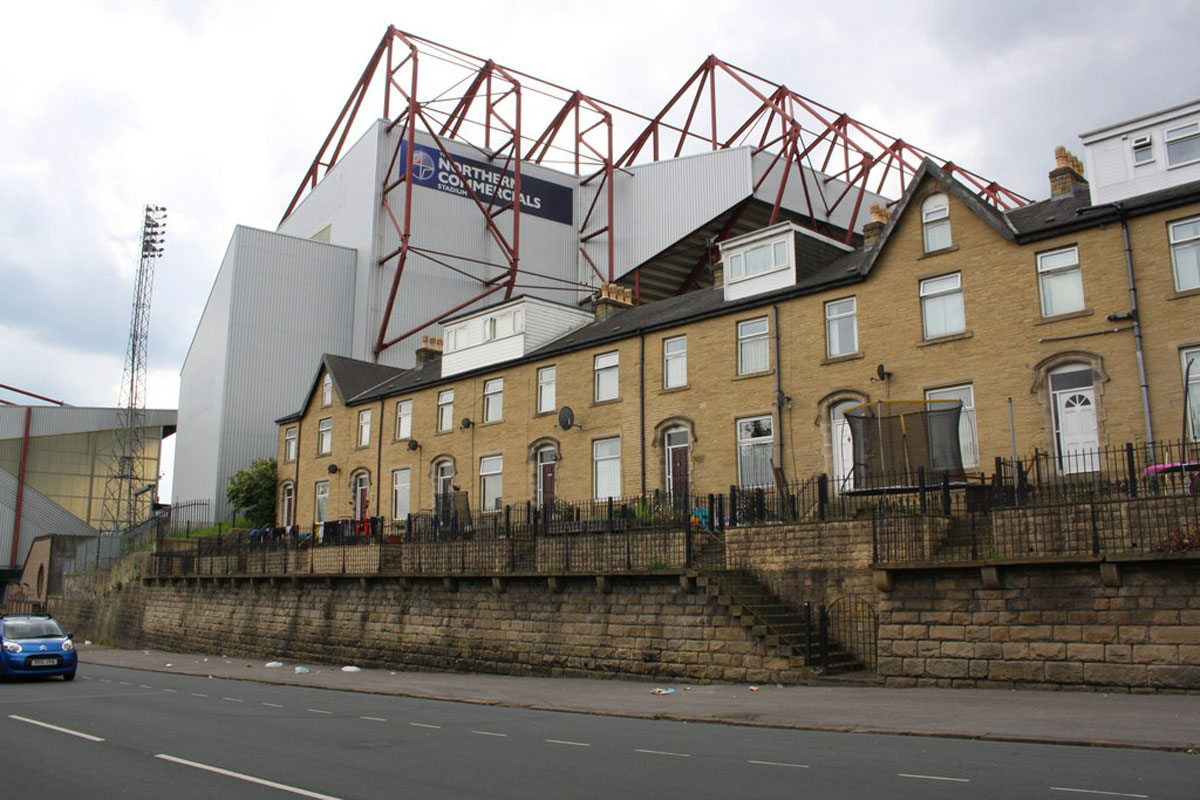
Midland Road houses and Bradford City football stadium
Image: Roger Templeman / Geograph – CC BY-SA 2.0
“Satisfying”
Although Jewell had achieved promotion through major signings, the character of the side in 1999/00 had not been lost. The transition to a team of stars changed not only the cost of the team but, crucially, its character and chemistry. It was precisely the approach that he hadn’t wanted.
Meanwhile, construction work had begun during the 2000 close season on extending the stadium capacity, as well as a new office block, funded by a £7.5 million mortgage. The capacity of the ground would be increased from 18,000 to 25,000 through the completion of the new North West Corner stand and the extension of the Main Stand, although the entire project would not be finished until after the end of the season.
The Bantams produced a promising start to their second season in the Premier League with a narrow 0-1 defeat at Anfield to Liverpool, followed by a brilliant 2-0 home win over Chelsea in the first two games. Victory against the high-spending London club was particularly satisfying, with goals from Dean Windass and Benito Carbone. On that warm summer evening in August 2000, one could have been forgiven for thinking that a bright new age was beckoning.
Things came down to earth with a 0-6 defeat at Manchester United on 5 September. Despite a creditable draw at home to Arsenal (who later finished as runners-up to Manchester United), the team managed only a single win before the end of the year, by which time the club was marooned at the bottom of the table, seven points adrift of Manchester City with twelve points and twelve defeats from twenty games. Early-season injuries to Andy O’Brien, David Hopkin, Andy Myers and David Wetherall had not helped. Stan Collymore was signed in late October to strengthen the team but, despite scoring on his debut at home to Leeds, managed only one more all season and made only seven Premier League appearances for the club.
While moments of quality remained, cohesion proved elusive. The squad’s composition complicated tactical clarity. Players accustomed to different systems and expectations struggled to coalesce, and Chris Hutchings faced the unenviable task of imposing structure on a group assembled for immediacy rather than compatibility.
Richmond would have realised that Premier League survival was existential; far from planning for a future, the club was borrowing against it. On 6 November Hutchings and his assistant Malcolm Shotton were dismissed after just twelve Premier League games in charge with only one win, and Stuart McCall assumed the role of caretaker manager. Two weeks later it was announced that Jim Jefferies had been appointed, supported by Billy Brown and Walter Kidd.
Jim Jefferies was only the second external appointment made by Geoffrey Richmond after Lennie Lawrence in 1994, Richmond claiming him as only one of two applicants for the role. Jefferies’ brief, in any other industry, would have been described as that of a ‘Chief Restructuring Officer’ – tasked with difficult operational decisions and providing leadership to drive a turnaround. To be effective, such a person needs full authority and autonomy. Jefferies had a strong character and disciplinarian’s reputation; his credentials were appropriate. Richmond, however, remained the hands-on chairman willing to override whoever was manager at Valley Parade. In turn, Jefferies’ relationship with Richmond would be strained – less deferential and more confrontational.
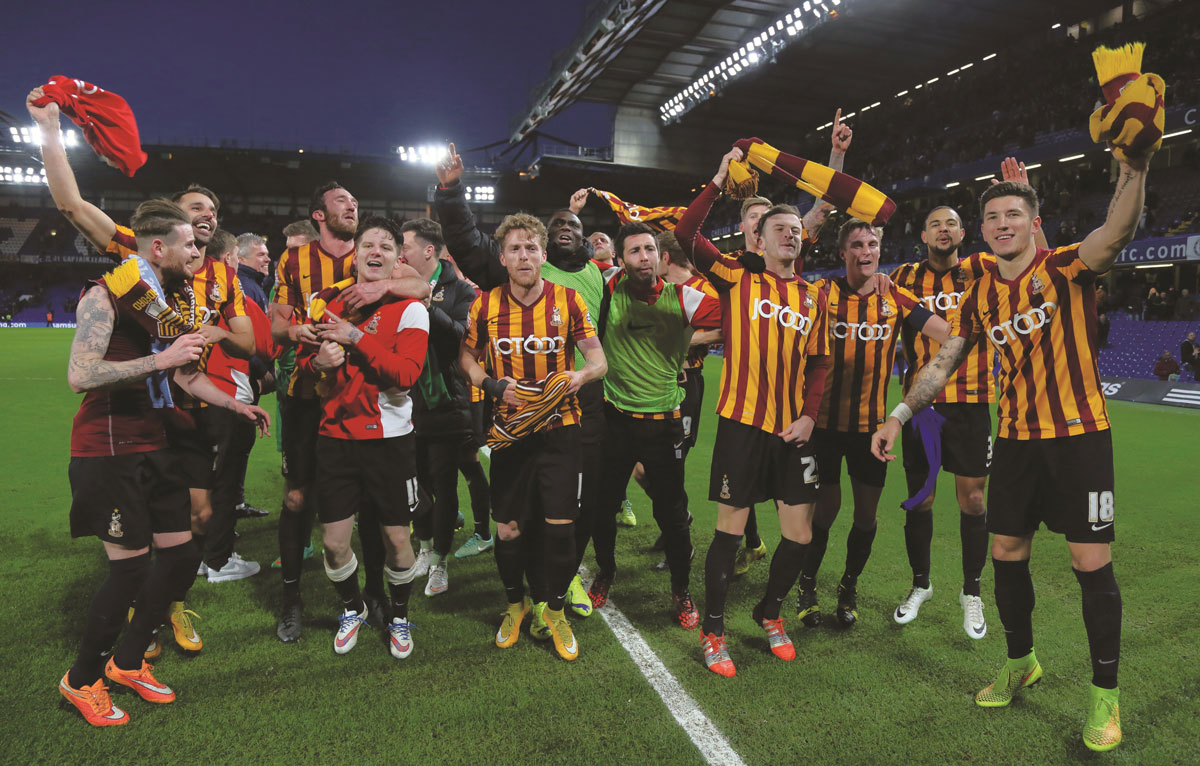
Bradford City players celebrate their win against Chelsea in the fourth round of the FA Cup, 24 January 2015. (BCAFC)
“Onerous player contracts”
The appointment of a new manager was used as the smokescreen to begin a clear-out of players under the guise of building for the new season. Immediately Jefferies had signalled his intention to have a clear-out, with Petrescu moving to Southampton on a free transfer, Isaiah Rankin signed by Barnsley for £350,000 and Stan Collymore released to Real Oviedo in Spain in January 2001. Dean Saunders, however, had resisted being moved on and rejected loan moves to either Sheffield Wednesday or Tranmere Rovers, remaining at the club until the end of the season when he retired. Benito Carbone was transfer listed but a move to Middlesbrough in January fell through.
In March 2001, Dean Windass joined Middlesbrough for £600,000, followed by David Hopkin to Crystal Palace for £1.5 million and Andy O’Brien to Newcastle for £2 million – the latter being a joint record but a transfer that had the impression of a discounted sale. Yet whilst the sale of Petrescu, Collymore, Hopkin and Windass had reduced the payroll by £3 million, there were severance payments of £1 million.
Nevertheless, with injury to David Wetherall, Jefferies was forced to recruit and his signing of Robert Molenaar in December 2000 as cover – another transfer from Leeds – for £500,000 would prove to be the last of the big signings of the Premier League era. However, Gary Locke was the final recruit of the Premier League era, a free transfer from Heart of Midlothian – where Jefferies had been manager – in January 2001.
After winning at Leicester City on New Year’s Day, Bradford City managed only two more victories in the seventeen remaining games to finish bottom of the table with just twenty-six points, eight adrift of Coventry City and Manchester City and sixteen short of safety. At the time it felt like a major humiliation. Only Watford the previous season had secured a lower total (twenty-four points), although Ipswich Town’s twenty-seven points had come from four more games. The humiliation has since been mitigated by a handful of clubs having managed even fewer – Derby County with just eleven points in 2007/08 and Southampton with twelve in 2024/25, while Huddersfield Town achieved thirty-seven in 2017/18 and then a derisory sixteen the year after.
The new North West Corner opened on Boxing Day 2000 for the game with Sunderland that attracted a gate of 20,370, the biggest since the visit of Tottenham in the FA Cup in January 1970. There were subsequently another four gates of around 20,000, but the highest of the season was against Liverpool on 1 May, by which time additional capacity was available, accommodating a 22,057 crowd.
The commitment to onerous player contracts was one thing, but the obvious question was whether the ground extension had been a step too far and too soon. The second phase of the ground extension followed the opening of the enlarged Kop in 1999 and had brought capital expenditure in the preceding three years to exceed £15 million (£7.01 million in 1998/99, £0.87 million in 1999/00, and £7.64 million in 2000/01).
 “Cruel blow”
So, what of the Premier League experience? Life in the Premier League was quite different to what Bradford City supporters had been used to. It was not only the blanket media coverage that was a contrast. For the first time in living memory, away ticket allocations were regularly sold out. Following the club that season was expensive, in particular trips to London clubs. In Bradford there was also resentment about the increase in admission prices at Valley Parade that many long-standing fans simply could not afford.
Visiting new grounds was a thrill but losing every other week eroded the novelty. It wasn’t the be-all and end-all as a supporter experience, but at least you could say that you’d seen Bradford City in the top tier of English football, a phenomenon denied to previous generations of Bradfordians.
Relegation was a cruel blow, but it was not the only one. In July 2001, the ethnic riots that broke out in Manningham – within a mile of Valley Parade – had a profound and lasting impact on local sentiment and confidence. The two events were linked in a way that has not always been recognised. Sport had provided Bradford with a feelgood spirit through the late 1990s, boosting the town’s self-respect at a time when it badly needed it; the loss of Premier League football and the outbreak of civic unrest within ten weeks of one another struck a double blow to that confidence and self-esteem.
Bradford Bulls remained a leading Super League side, winning the title in 2001, 2003 and 2005 and the Challenge Cup in 2000 and 2003, but Super League had a more limited reach. The Premier League was the most globally followed domestic league in world football and the principal vehicle through which English provincial cities reached a national and international audience. Bradford City’s two years at that level had placed the city on a stage no other local institution could match. The cost was severe – the long descent through the divisions, the financial wreckage of Richmond’s gamble, the damage to civic morale – but the achievement was real and has endured. Bradford City is still better known to football followers across the world as a former Premier League side.
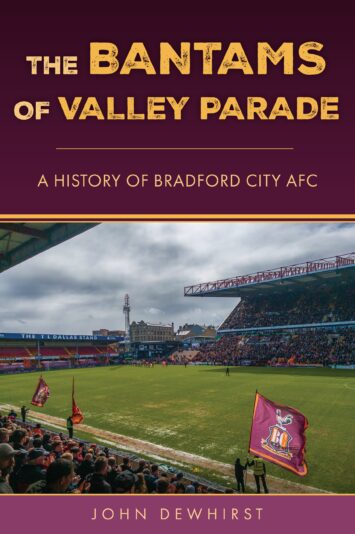
Article taken from ‘The Bantams of Valley Parade: A History of Bradford City AFC’ by John Dewhirst, published by Amberley Publishing