Does Broadband Speed Matter in Day Trading?
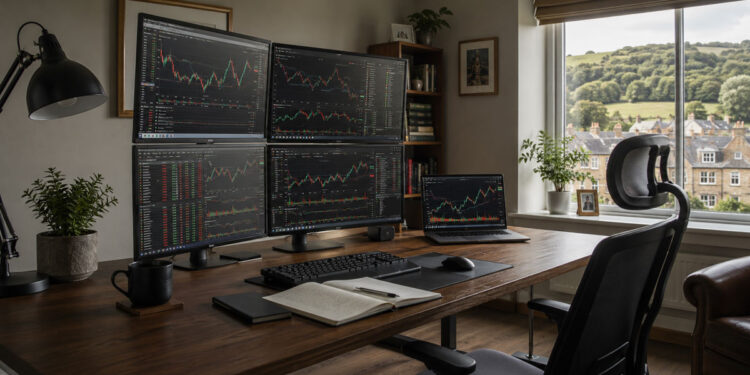
There’s a popular idea going around that day trading needs a super-fast broadband connection. On the surface, it sounds right. You’re reacting to live markets, prices are moving in fractions of a second, and the whole thing sounds incredibly time-sensitive. But honestly? It’s nowhere near as dramatic as most people think. For the vast majority of UK traders, the broadband they’ve already got is more than enough.
So what actually matters when you’re trading from home, and where should you be putting your attention instead?
What a Trading Platform Actually Asks of Your Connection
Streaming live prices and running a few charts at the same time uses barely any bandwidth. We’re talking a tiny fraction of what it takes to stream a 4K film on Netflix. Any connection hitting Ofcom’s superfast threshold of 30 Mbps will handle it without breaking a sweat, and most UK households are well beyond that already. As of January 2026, Ofcom data shows gigabit-capable broadband now reaches 89% of UK homes.
Even if you’ve got multiple monitors with different chart windows open, you won’t come anywhere close to maxing out a modern broadband connection. The data packets involved in price feeds are tiny.
Stability Over Speed
This is where it gets more interesting. The real risk isn’t a slow connection. It’s one that keeps cutting out or behaving unpredictably. Latency, the delay between your click and the broker’s server actually receiving it, matters far more than download speed. The same goes for jitter, which is the inconsistency in that delay, and dropouts, where your connection briefly dies altogether.
A connection that drops mid-trade is a genuine problem. One that downloads a film slowly? Not really.
A wired Ethernet connection will always be steadier than Wi-Fi because it cuts out the interference from walls, other devices and your neighbour’s router. Full fibre lines are more consistent than older copper ones too, which tend to degrade the further you are from the exchange. Mobile data is perfectly fine for keeping an eye on an open position, but it’s less predictable when you’re actively trying to place a trade.
For anyone out in rural Yorkshire, across the Dales or the North York Moors, it’s this reliability question that matters most. The few thousand premises across the UK that still can’t get a decent fixed connection aren’t struggling with speed. They’re dealing with consistency.
Your Platform Matters More Than Your Line
Most of the responsiveness people blame on their broadband actually comes down to the platform they’re using. How quickly it loads, how heavy it is on your machine’s resources, how fast you can find and switch between instruments, how the broker’s own infrastructure holds up during busy periods. All of that will make a bigger difference than your download speed.
Ranked against one another, the top UK day trading platforms pull apart on how well they cope when volumes spike, which is why James Warwick, founder of Trading Brokers, points out to us, “the test of a platform is what happens on a busy morning. Order tickets that hang, charts that stop updating, a login that won’t go through when there’s news out. Those differences show up in exactly the sessions you’d want to be trading, and none of them get fixed by paying more for broadband. Customer service belongs in the same bracket, because the moment you need it is the moment everything else has already gone wrong.”
There’s also the awkward fact that split-second speed advantages are largely meaningless for retail traders anyway. Human reaction time runs into hundreds of milliseconds, so the idea that shaving a few ms off your connection will produce better results just doesn’t hold up. Most retail traders lose money, and the reasons have nothing to do with broadband.
Don’t Upgrade Your Router, Upgrade Your Setup
At the end of the day, if you’re thinking about day trading from home, your broadband almost certainly isn’t the bottleneck. Plug in an Ethernet cable, check that your connection is stable, and spend your energy choosing a platform that’s actually responsive. That’ll make a far bigger difference than any speed upgrade.