Custom Neon Signs: The Complete UK Buyer’s Guide for 2026

Neon has quietly become one of the most requested features in modern UK interiors. What used to be reserved for shopfronts and dive bars is now showing up in bedrooms, home bars, wedding venues and office reception areas — and the driving force behind that shift is custom neon signs. Unlike the glass-tube neon of decades past, today’s versions use flexible LED neon flex, which means almost any word, shape or logo can be turned into a glowing wall piece safely and affordably.
If you’re considering commissioning one for the first time, here’s what actually matters before you buy.
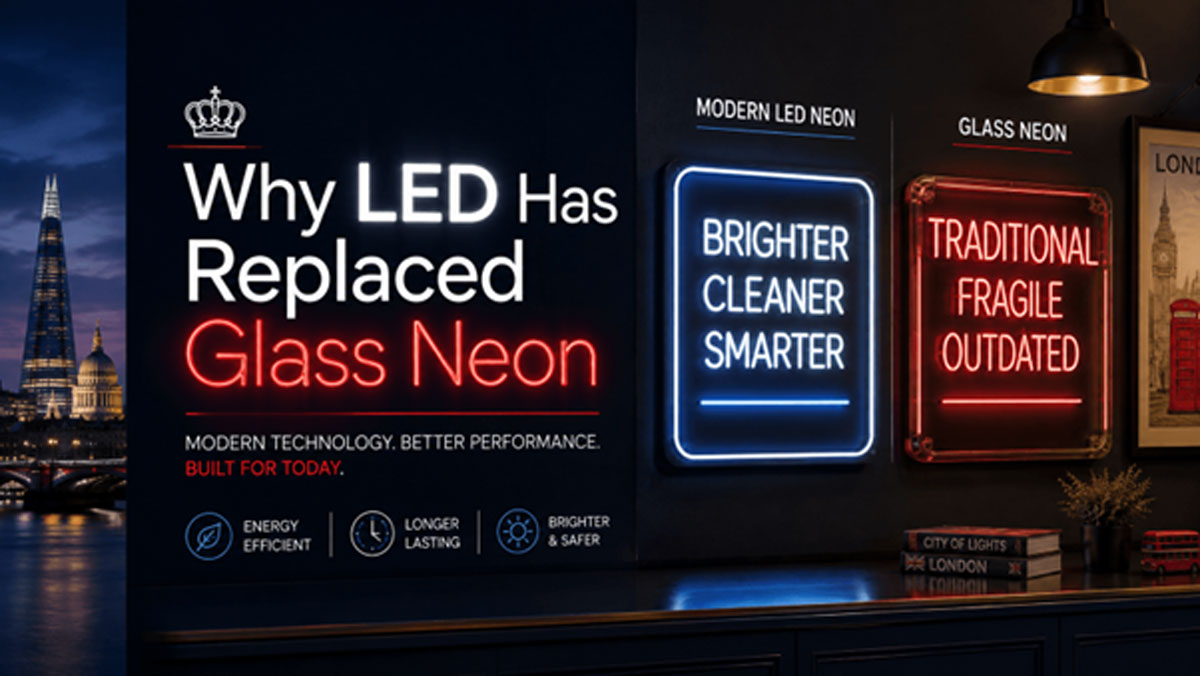
Why LED Has Replaced Glass Neon
Traditional glass neon required argon or neon gas, high-voltage transformers, and a fair amount of maintenance — tubes would dim, crack, or need re-gassing every few years. LED neon flex solves nearly all of that.
It’s a silicone-coated rope embedded with LEDs that bends into script, outlines and logos while staying cool to the touch, shatterproof, and far cheaper to run. For anyone weighing up custom neon signs for a home or business, this is the version worth buying — the aesthetic is nearly identical, but the running costs and lifespan are dramatically better (most LED neon is rated for 50,000+ hours).
What Actually Affects the Price
Three things drive cost more than anything else:
- Length of the sign — priced per foot/metre of LED, so a short first-name sign is far cheaper than a full sentence.
- Number of colours — single-colour signs are simplest to make; multi-colour designs need separate wiring runs, which adds cost.
- Backing material — clear acrylic is the standard, cheapest option; cut-to-shape acrylic or metal backing costs more but looks more premium.
- A good rule of thumb for UK buyers: a simple single-line name sign in one colour typically lands in the lower price bracket, while multi-line, multi-colour logo pieces sit at the top end.
Choosing a Design That Will Still Look Good in 5 Years
The biggest regret people have with a custom sign isn’t the cost — it’s the design. A few practical tips:
- Keep script legible from across the room. Overly ornate fonts look great as a small mockup but become an unreadable squiggle once scaled to 60cm+.
- Pick a colour that matches your actual wall, not your screen. Warm white and ice blue photograph very differently depending on your wall paint and ambient lighting — ask for a physical colour swatch if the supplier offers one.
- Think about mounting before you order. Stand-off mounts (small clear spacers) give the sign a “floating” look off the wall, which reads far more premium than flush-mounting
Installation Basics
Most custom LED neon signs plug into a standard UK 3-pin socket via a low-voltage transformer, so no electrician is required for a wall-mounted piece. What you do need is:
- Wall anchors rated for the sign’s weight (acrylic-backed signs are lighter than they look, but still use proper fixings, not just adhesive strips)
- A visible or hidden route for the power cable, decided before drilling
- A dimmer, if you want the sign usable as ambient lighting rather than a full-brightness feature
Business Use: Beyond the Aesthetic
For retail and hospitality, a well-placed neon sign has a measurable effect on dwell time and social sharing — an “Instagrammable” wall behind a till or in a waiting area is one of the cheapest pieces of marketing a small business can install. Many independent cafés and salons in the UK have adopted them specifically because they photograph well and reinforce brand tone (soft script for beauty/wellness, bold block lettering for bars and gyms).
Where to Get One Made
If you want a UK-based supplier that will mock up a free design proof before you commit, NeonChamp specialises in custom neon signs built to order, with colour, size and backing fully customisable before production starts. Getting a free digital proof first is worth insisting on with any supplier — it’s the easiest way to catch sizing or wording mistakes before they’re built.
Final Thought
Custom neon signs sit in a nice sweet spot: they’re a genuine design statement, but LED technology has made them affordable, safe, and low-maintenance enough for everyday home use. Get the size, colour temperature and mounting right, and it’s one of the few interior pieces that photographs as well in real life as it does online.