A Brush with Cézanne in Aix-en-Provence, France – Travel Review
By Kevin Pilley, March 2026
His studio is just as he left it. As is much of his native Provence. The painter Paul Cézanne, the diabetic bank clerk who became the founding father of modern art, captured the landscape, soul and “superb things” of one of the most beautiful regions of France.
He set out to be the interpreter of “its treasures” and “its abundance of riches”. He ended up being its favourite and most famous son, and the greatest publicist of le pays de Provence.
Born in the department’s ancient capital, Aix-en-Provence, in 1839, the illegitimate son of a hat-maker who became a rather unscrupulous banker, paying for his boy to avoid national military service, Cézanne enjoyed a privileged childhood. He went to school with the novelist Émile Zola, who remained a lifelong friend and was both his aesthetic champion and financial benefactor. Although they fell out later in life, Zola wrote that the two idealistic young men were “drawn together by subconscious affinities, the vague feeling of ambitions in common, the awakening of a higher intelligence among the vulgar herd of dunces and dunderheads”, as well as “a passion for long walks” and “the worship of trees and hills and streams”. They let themselves be “drawn into the bosom of Nature”.
Aix now has a “Cézanne Trail” – “an itinerary of sensory discovery”. This begins in the middle of Aix at the statue erected in 2006 on the centenary of the painter’s death. The only previous tribute had been the tiny 1926 bronze medallion fountain in the Rue des Bagniers, based on a portrait by Renoir and dedicated by the art dealer Ambroise Vollard, who organised a solo exhibition of Cézanne’s work in 1895.
During his lifetime, Aix and Cézanne simply didn’t get on. As the painter recalled: “When I was in Aix, I thought I would be better off elsewhere”.

Provence scenery
“Walk in his footsteps”
The artist was an embarrassment to his home town and his art was derided as childish daubs. On the few occasions when it was displayed, his work was often hung above doors inside galleries so it could not be seen. He rarely painted in the town centre for fear of public ridicule. The reduction of forms to geometric essentials, the obsession with elemental forms, the warping of perspective and heavy, fluid pigment did not go down well. Cézanne was seen as a talentless madman, not a genius.
The family was not popular either. No one liked the Cézannes. Even now, the city only owns a few of his sketches, but none of his paintings. None of his masterpieces. Thankfully, the landscape is there and has remained largely unchanged since Cézanne’s day. So it is possible to walk in his footsteps and stand where he stood to paint. In Provence, his presence is everywhere. Cézanne has spawned some unlikely tourist attractions.
Like the Bibémus quarries. The ancient limestone pits, just outside Aix, were worked during the Roman period. Here, between 1895 and 1904, having rented a one-room hut which is still there, Cézanne produced 27 oil and watercolour paintings. He was intrigued by the bizarre shapes of the luminous orange rock faces. He preferred to paint primarily sur le motif, out in the landscape, although he did paint portraits – notably The Card Players.
Aix’s “In the Steps of Cézanne” tours take in 40 other Cézanne-related sights, including his birthplace at 28 Rue de l’Opéra. His birth certificate can be seen in the Town Hall. The family hat shop, “Chapellerie du Cours Mirabeau”, is still there. It is a bank. On the same side of the street are the “Café des Deux Garçons” and “Café Cléments”, which the artist allegedly frequented in his less morose moods.

Montagne Sainte Victoire,1904
“Daily light show”
The family homes at 14 Rue de la Glacière (1844 to 1850) and 20 Rue Émeric-David (1878 to 1881) are also still standing, as are his sisters’ houses, and L’École Saint-Joseph secondary school where he was taught art by a Spanish monk, and the Collège Bourbon, now Collège Mignet.
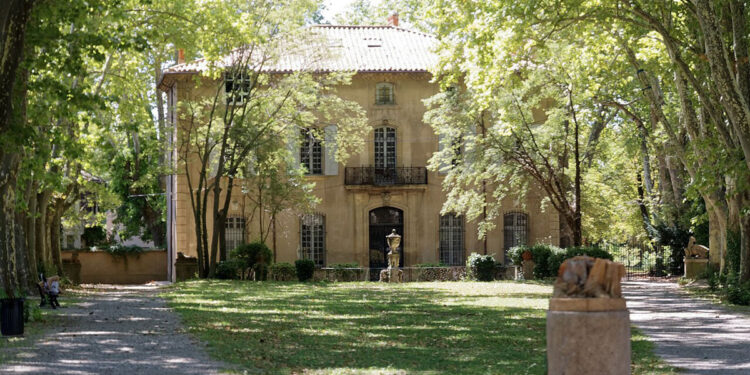
In 1860, Cézanne’s wealthy, social-climbing father bought Le Jas de Bouffan (“House of the Blowing Wind” – top image) on the Route de Galice. Here, his son painted 12 allegorical scenes of the Four Seasons on the living-room walls, in imitation of Ingres. He also painted his father in his new bourgeois home.
There is now a daily light show during which you learn, among many things, that Cézanne rarely signed his paintings, believing them imperfect. He constantly painted the mansion’s gardens, pond and chestnut-lined avenue. His studio was the attic.
The family lived in the former manor of the Governor of Provence for 40 years. In 1902, following his father’s death, Cézanne and his two sisters, Rose and Marie, sold up and bought a plot of land among the olive and fig trees north of the city towards the village of Puyricard, beside the Verdon canal.

Cézanne’s plaque in Aix-en-Provence
“Historic monument”
His purpose-built atelier, or studio, which now has the postal address 9 Avenue Paul Cézanne, is open to the public. The walls are grey and the windows north-facing to minimise reflections. Cézanne painted his famous The Bathers (Grandes Baigneuses) at Les Lauves.
The workshop was where he devoted himself to developing and perfecting “an authentic observation of the seen world” – “a harmony parallel to nature”. Describing his method, Cézanne said: “I paint as I see, as I feel, and I have strong feelings”.
Thanks largely to American financial support, the studio was bought and given to Aix-en-Provence in 1969. In 1974, the workshop was declared a historic monument. It is now a museum full of his personal effects. On display are some of his battered, frayed felt hats, a pair of cufflinks, a paint-spattered grubby coat, his strap-on paint box with collapsible legs, and even his favourite umbrella.
There are ties, pipes and a 20-foot ladder he used to observe his models from above. And there are his still life models: vases, jugs, skulls, paper flowers, and the table on which he posed them. Perhaps the same table seen in the world’s most expensive still life painting. In 1999, at Sotheby’s New York, Cézanne’s Rideau, Cruchon et Compotier (23.5” x 18.75”) sold for $60.5 million.

Cézanne’s statue
“Obsessed”
Up until the last years of his life, Cézanne sold little. He only knew minor commercial success when he was in his sixties. He exhibited briefly in Aix at “Les Amis des Arts”, now the Hôtel Christophe.
Many experts believe that the painter’s innovative style was inspired partly by walks around Aix’s Saint-Sauveur Cathedral, and by the simplified forms of the Romanesque statues there. The cylinders of the necks and fingers of the statues struck a chord. Cézanne regularly described himself as “un primitif”.
In 1864, Cézanne moved to Paris but travelled constantly between the French capital and Aix, as well as staying elsewhere in Provence: in Gardanne (11 miles south-west of Aix) and L’Estaque, a fishing village west of Marseille.
Easily his favourite subject was the Montagne Sainte-Victoire, which he painted a total of 87 times. Along with the rocks of Beaurecueil, the limestone crag obsessed him; he called it “a stunning motif”. The mountain was to play a pivotal role in the advent of modern art. His paintings of it herald Cubism. Through them, he changed perceptions of both art and Provence.

Maison au toit rouge, 1933
“Art and personality”
You can stand on the spot in Le Domaine de Marguerite where he stood to paint the pyramid-shaped mountain which “filled him with admiration”. The mountain first appeared in The Railway Cutting of 1870. You can still see the wheat fields and red roofs that Cézanne saw. In the middle of what is now a housing estate, there is a sign which reads “P. Cézanne ici peignant.” (“P. Cézanne painted here.”)
After painting in the rain, Paul Cézanne died of pleurisy on 22 October 1906 at his house at 23 Rue Boulegon, now a doctor’s surgery. His funeral took place in the Saint-Sauveur Cathedral. He is buried in Aix’s Saint-Pierre cemetery. The following year, an exhibition of over 50 paintings was held in Paris’s Salon d’Automne.
A journey around Provence is a journey through the life of Paul Cézanne. Artist and department are synonymous. Cézanne’s art and personality are rooted in his beloved “sun-bathed land”. Le pays de Provence allowed him to achieve an art that was “solid and lasting”.
In return, he gave Provence its cultural identity.
For holiday details visit provenceholidays.com
easyJet.com flies to Marseille Provence Airport
Kevin Pilley is a former professional cricketer and the ex-chief staff writer of PUNCH magazine. His humour, travel, lifestyle and food & drink work appears worldwide. He has been published by over 600 titles.