The Battle of Orgreave
The story of an infamous and pivotal confrontation between striking miners and police in Yorkshire…
by Colin Philpott
If ever there was an example of how a place name, previously largely unknown to people outside the immediate area, has become a byword for something, then it is Orgreave. If ever there was an example of a place thrust into the national consciousness through a single event on a single day, out of an almost random set of circumstances, then it is Orgreave.
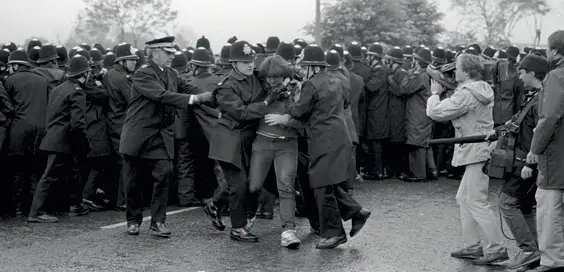
It was on Monday, 18th June, 1984 that one of the most violent clashes in British industrial history took place in a small village near Rotherham in South Yorkshire. The ‘Battle of Orgreave’ took place during the miners’ strike, which ran from March 1984 to March 1985. The industrial action by the National Union of Mineworkers, led by Arthur Scargill, was in protest at plans by the National Coal Board, led by Sir Ian Macgregor, to close coalmines across Britain, drastically reducing the number of mining jobs.
“Officers charged the pickets”
The dispute is one of the most bitter in post-war Britain. It ended eventually with the miners’ defeat. Partly because the Government had made sure that the impact of the strike was minimised by stockpiling supplies of coal at power stations before it started. There were many violent clashes between striking miners and the police during the strike. But the events of 18th June in South Yorkshire are probably remembered as the most dramatic flashpoint of the dispute.
Orgreave produced coke from coal for use in steel furnaces. The NUM organised a picket to try to prevent lorries leaving the plant. The police were said to have been aware of the NUM plans in advance, it was later claimed, through MI5 infiltration and the phone tapping of miners’ leaders. An estimated 5,000–6,000 miners faced a larger number of police in a field near the plant.
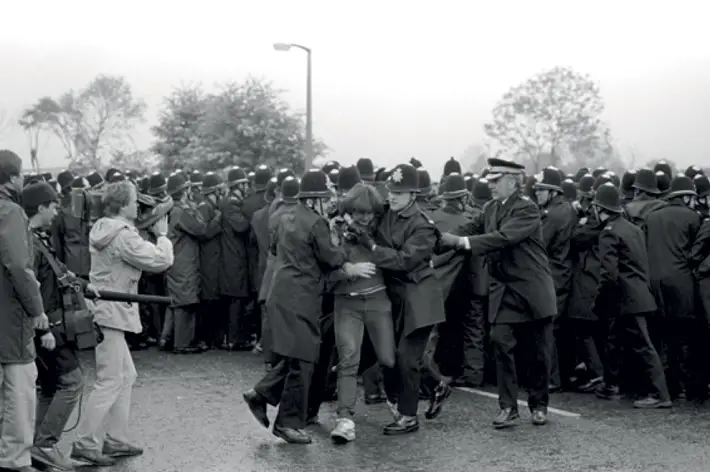
image © Press Association
In a confrontation that lasted several hours, there were repeated clashes as the miners surged forward and as the police, including around 50 mounted officers, charged the pickets. At one point Arthur Scargill stepped out in front of the picket line and was seen on TV being manhandled by police. There was also hand-to-hand fighting between police and pickets. According to official reports, there were 91 arrests that day. Fifty-one pickets and 72 police officers were injured. Almost 100 pickets were charged. But the trials of those whose cases eventually came to court collapsed.
“Only a handful of deep mines remain”
Plans to scale down the number of pits continued after 1984. By 2012 there were only a handful of deep mines remaining in Britain compared with 174 in 1983. The remaining mining in Britain is now all privately run.
 After the strike, the Orgreave Coking Plant continued in operation until 1990. The area was used for opencast mining until 2006, when extraction ceased. Since then the whole area is being redeveloped under the new name of Waverley. Plans have been approved for the building of almost 4,000 new homes. The first houses were being built in early 2012. There are also plans for offices and industrial units.
But parts of Orgreave will be retained as open land, including the area where the confrontation took place back in 1984.
‘A Place in History: Britain’s headline news stories remembered’ by Colin Philpott.
Published by Ammonite and available now from amazon.co.uk
featured image © Press Association
Battle of Orgreave: FAQs
What was the Battle of Orgreave?
A large, violent confrontation on 18 June 1984 between National Union of Mineworkers (NUM) pickets and police outside the Orgreave Coking Works near Rotherham, South Yorkshire, during the 1984–85 UK miners’ strike.
Why did it happen?
The NUM attempted mass picketing to block coke leaving Orgreave, a strategic chokepoint for supplying British Steel (Scunthorpe), to increase pressure during the strike.
How many people were involved?
Roughly 5,000–6,000 pickets faced about 6,000 police drawn from around 18 forces, including mounted units and dog handlers.
What policing tactics were used?
Mounted charges, riot-equipped cordons (long/short shields), and coordinated mutual aid organised nationally, reflecting post-1970s changes in UK public-order policing.
Were there arrests and injuries?
Over 90 arrests were made. Official tallies recorded injuries to 51 pickets and 72 police officers.
What happened to the criminal charges?
Serious public-order charges (including riot and violent disorder) ultimately collapsed in court; all cases were dropped or acquitted.
Did miners receive compensation?
Yes. In 1991, South Yorkshire Police paid £425,000 (plus legal costs) to 39 miners for assault, wrongful arrest, unlawful detention and malicious prosecution.
Was media coverage disputed?
Yes. The BBC later acknowledged a news edit that aired events out of sequence, fuelling long-running criticism of how the day was portrayed.
Were police practices questioned?
Allegations included pre-prepared statements, notebook omissions and unreliable evidence. No officers were disciplined at the time; debates continued for decades.
Has there been an official inquiry?
After earlier refusals, a national inquiry was announced in July 2025 to examine the events and policing at Orgreave.
What happened to the Orgreave site?
The coking plant closed in 1990; opencast extraction continued until 2006. The wider area is being redeveloped as Waverley (housing and business), with the confrontation field kept as open land.
How does Orgreave relate to Saltley Gate (1972)?
Saltley’s mass-picket success shaped NUM tactics in 1984. Police, however, had since centralised planning and upgraded riot gear to prevent a repeat.
Who were the key figures?
Arthur Scargill (NUM), Ian MacGregor (NCB), and senior South Yorkshire Police commanders (including ACC Anthony Clement). Steel union leader Bill Sirs also featured in supply disputes.
Why is Orgreave historically significant?
It crystallises the miners’ strike, the transformation of UK public-order policing, and debates on state power, media framing and deindustrialisation.
Can you visit the area today?
Yes. The Waverley development is accessible, and the historic field remains open space; there’s no dedicated on-site museum.






Great piece taken from @colinpmedia ‘s A Place in History on @on_magazine ‘s website: http://t.co/LtggzMYR