From Pier Arcades to Phone Screens: How Fishing Became a Favourite Slot Theme
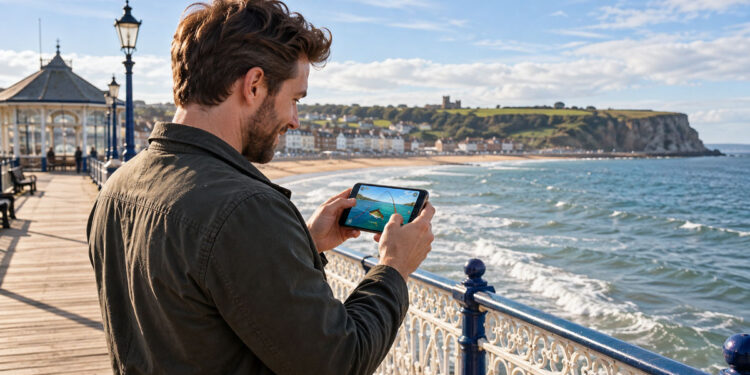
Britain’s seaside piers have long brought two pastimes together. Anglers fish from the decks, while arcades of coin-operated machines fill the pavilions and promenades.
Both have now found their way onto phone screens. Fishing has become a familiar theme in online slots, with whole series of games built around a fisherman, and the story begins on the seafront.
How the Victorians took to the piers
The earliest piers were practical. Ryde Pier on the Isle of Wight opened to boats landing passengers on 26 July 1814, and many early piers served the steamers that carried visitors to the coast.
The real boom came in the Victorian era. In a 2014 English Heritage book, Allan Brodie counts more than 20 piers begun in the 1860s and a similar number in the 1870s. According to the National Piers Society, almost a hundred piers stood at the turn of the 20th century, and only about half survive. In Yorkshire, Saltburn’s is the last of the county’s Victorian pleasure piers still standing.
Their scale varies hugely. An 1898 extension made Southend’s the longest pleasure pier in the world. At the other extreme, the pier at Burnham-on-Sea is just 117 feet long, which the National Piers Society lists as the shortest in the UK.
Pennies in the slot
Coin-operated machines took off in the same era. Percival Everitt patented a postcard dispenser in 1883, and once the design was improved it became a common sight at railway stations and post offices.
In his social history Arcade Britannia, Alan Meades notes that Britain, like many countries, developed an appetite for coin-operated amusements during the late nineteenth century. Many of the machines were imported, first from France and Germany and then from America.
In the mid-to-late 20th century, many travelling showfolk settled and opened arcades at seaside resorts around Britain. Other showfolk called those who settled “sanddancers” or “sandscratchers”, and the two groups remain closely linked. Arcades still line seafronts today, such as Great Yarmouth’s Golden Mile on the Norfolk coast.
A nation of anglers
The piers drew anglers, too. Deal Pier in Kent, opened by the Duke of Edinburgh on 19 November 1957, is internationally recognised as an angling venue, with fishing allowed on sections of the pier.
Licence figures show how popular freshwater fishing is. The Environment Agency sold 934,000 fishing licences in England in 2024 to 2025. Angling Times has since reported 973,859 licences for 2025/26, citing the agency.
Rod licences cover salmon, trout, freshwater fish, smelt and eel in England and Wales. Sea angling is counted in separate surveys. In a year-long survey to July 2024, Cefas, the government’s marine and freshwater science centre, estimated that 2.7 million angling trips were made from the shore in England and Wales.
From the pier to the phone
On screen, the theme took hold. In the free games of Blueprint Gaming’s Fishin’ Frenzy, each fisherman on the reels catches the fish and collects the values on their tags. Blueprint launched an enhanced Megaways version of the game in 2019.
Big Bass Bonanza followed in December 2020, a collaboration between Pragmatic Play and Reel Kingdom. It has since grown into a series, including Bigger Bass Bonanza in September 2021.
The Big Bass Bonanza guide from Fortune Games, a UK online casino, explains how the game’s free spins work. Three or more scatter symbols start the round, the fisherman is wild, and each fisherman that lands collects the values shown on the fish in view.
Why fishing suits the reels
Fishing gives a slot a ready-made story, built around the moment of a catch. The collect feature turns that into a simple picture: fish appear on the reels, then a fisherman can arrive and gather them all in.
The theme also travels well. Angling needs no explaining to the hundreds of thousands of people who fish in Britain, and the fisherman and fish on the reels are easy to recognise. Blueprint has called the original Fishin’ Frenzy “a big success in the UK retail sector”.
None of that changes how the games work. A theme changes the look, not the odds. Whether a fisherman lands on any spin is random, like every other result, and nothing guarantees a win.
Four piers worth the trip
These four show how varied Britain’s surviving piers are, from a Regency landing stage to a post-war concrete pier.
| Pier | Why go |
|---|---|
| Southend, Essex | Its first wooden section opened in June 1830, and the pier now reaches about 1.3 miles into the Thames Estuary. |
| Deal, Kent | A reinforced concrete pier on the site of two earlier ones; anglers can buy fishing tickets at the entrance or online. |
| Clevedon, Somerset | Opened on Easter Monday 1869 using discarded railway rails; John Betjeman called it “the most beautiful pier in England”. |
| Ryde, Isle of Wight | Usually described as the UK’s oldest seaside pier; it now runs to about half a mile. |
Southend and Deal both warn that opening times can change with the weather. It’s worth checking before you set off.
Slots are games of chance for adults aged 18 and over: every spin is random, and no strategy changes the odds. Set a budget before you play. Free support is available from the National Gambling Helpline on 0808 8020 133, and GAMSTOP lets you exclude yourself from UK-licensed gambling sites.