Why a Ten Per Cent Fall Takes More Than Ten Per Cent to Undo
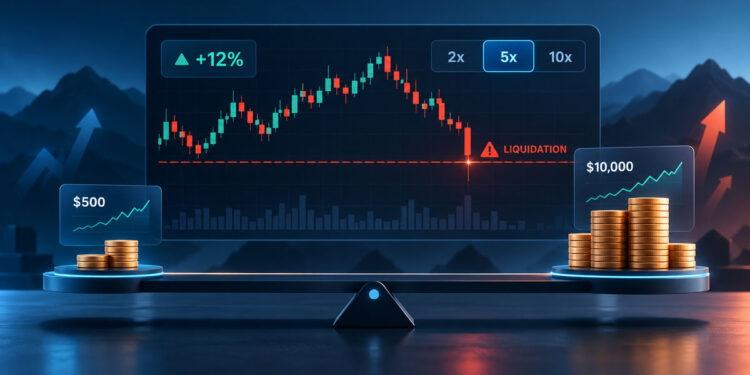
A price falls from 100 to 90, then climbs by ten per cent. Has it returned to the starting point? No. The rise takes it to 99 because the second percentage uses a smaller base. It is an ordinary piece of arithmetic that becomes harder to notice when a colourful trading screen presents every movement as an equally sized number.
Leveraged crypto adds another layer. Readers can use BitcoinMargin to estimate a liquidation threshold for a hypothetical position, but the useful exercise is understanding which quantity each percentage describes. A change in the underlying price, a return measured against margin and a distance to a modelled threshold are not interchangeable percentages.
The base changes the meaning
The journey from 100 to 90 removes ten units from a starting value of 100. Returning from 90 to 100 requires ten units on a base of 90, or approximately 11.1 per cent. The amounts reverse, but the percentages do not. Nothing about this calculation predicts whether a recovery will happen.
The same distinction matters when someone compares two screenshots. One might show the asset’s movement since yesterday. Another might show an open position’s return on its collateral. A third might show the gap between the current price and a reference level. Without the denominator and starting time, a percentage can be accurately calculated and still answer the wrong question.
The Financial Conduct Authority describes crypto as a high-risk, speculative investment. Understanding a percentage does not establish that an investment is suitable, protected or likely to recover. It simply stops one particular misunderstanding from carrying the argument.
Leverage introduces a second comparison
Imagine a simplified linear contract with 2,000 units of exposure supported by 200 units of initial margin. A one per cent adverse price movement changes the position’s value by about 20 units before costs. That is one per cent of the exposure but ten per cent of the initial margin. Both statements can be correct because they divide by different amounts.
This example is invented and leaves out fees, funding, changing collateral values and account-specific rules. It is not a calculation for a particular exchange. The important point is that calling the price move small does not tell us whether the corresponding loss is small relative to the money supporting the contract.
Nor does choosing a leverage setting establish the size of every existing position. The actual quantity and contract specification still matter. A screen showing a multiplier should lead to a question about the underlying exposure rather than a conclusion about the likely profit.
A threshold is not the bottom of a chart
Liquidation concerns whether a derivatives position still meets the venue’s collateral requirements. It does not describe the lowest price an asset could reach or the point at which the asset itself becomes worthless. A position may be reduced or closed while the underlying asset continues trading.
CME Group distinguishes initial and maintenance margin. The latter is a continuing requirement, not simply another name for the original deposit. Crypto venues use their own contract and account rules, which an illustrative calculator cannot replace.
That is why the maintenance assumption belongs beside the result. The BitcoinMargin page provides a simplified estimate and warns about omitted costs and exchange-specific differences. Treating that output as a precise exit price would give a modelling exercise a job it cannot perform. A protective order is a separate mechanism and cannot guarantee execution at an intended price during a fast market.
Keep the amounts beside the percentages
A clearer explanation reports the original amount, the changed amount, the unit and the comparison period together. Saying that an invented position lost 20 units on 200 units of initial collateral is less ambiguous than displaying a red ten per cent figure without its base.
This also helps when reading a recovery claim. Returning a collateral balance to its starting point is not necessarily the same as returning an asset price to a previous level. Charges or changes to the position may have altered the relationship. The reverse journey deserves its own calculation rather than a quick change of sign.
None of this makes crypto derivatives less risky or turns arithmetic into a reason to trade. It provides a quieter way to read an excited screen. Before asking whether a percentage looks good or bad, establish what it measures, which amount it uses and what has changed since that amount was recorded.