How to Choose a Forex Broker in the UK (Without Getting Scammed)

Choosing a forex broker is not just about finding the lowest spread or the slickest app. For UK traders, the first priority is safety: regulation, fund protection, transparent pricing, and the ability to withdraw money without friction.
A good broker will not make a trader profitable by itself. But a poor broker can make trading harder, more expensive, and in the worst cases, unsafe.
The UK Forex Market Is Safe – If Traders Know What to Check
The UK is one of the better places to trade forex because financial firms are closely regulated. That does not mean every broker targeting UK traders is safe. Scams still exist, especially online, where unregulated firms can look polished and professional.
The key is knowing what to verify before making a deposit.
Why the UK Is One of the Most Regulated Markets
Forex and CFD brokers serving UK retail clients are overseen by the Financial Conduct Authority, usually called the FCA. The UK regulatory framework sits alongside rules shaped by MiFID II, which covers areas such as investment services, trading venues, transparency, and conduct standards. The UK’s MiFID II-related framework is set out in official legislation under the Financial Services and Markets Act 2000 regulations.
This matters because regulation creates obligations. Authorised firms must meet standards around client money, risk disclosure, marketing, complaints, and financial promotions. A broker cannot simply promise anything it wants.
Where Most Beginners Still Go Wrong
Many beginners treat broker choice like a shortcut to trading success. They look for a “best forex broker UK” list, open the highest-rated account, and assume the platform will do the hard work.
That is the wrong starting point. Broker quality matters, but it does not replace strategy, risk control, or emotional discipline. Most early losses come from poor position sizing, revenge trading, overusing leverage, and entering trades without a clear plan.
The First Rule – Always Check FCA Regulation
Before comparing spreads, apps, bonuses, or charting tools, traders should check whether the broker is FCA-authorised. This is the most important filter.
What FCA Regulation Actually Means
FCA regulation means the firm has permission to provide specific financial services in the UK. It also means the broker is subject to UK conduct rules and supervision.
However, regulation is not a profit guarantee. It does not mean every trade is safe or every complaint will be resolved in the trader’s favour. It means the broker must operate within a legal framework, and traders have clearer routes for complaints and protection than they would with an offshore, unregulated firm.
How to Verify a Broker in Minutes
Traders should not rely on badges on a broker’s website. Scammers often copy FCA logos or claim to be “regulated” without giving full details.
Check:
- The broker’s legal company name, not just the brand name.
- The FCA Firm Reference Number.
- Whether the permissions match the services being offered.
- Whether the FCA register warns about a clone firm using a similar name.
The FCA’s ScamSmart and Firm Checker resources are designed to help consumers spot suspicious investment firms and avoid scams.
A legitimate UK forex broker should make its regulatory details easy to find and simple to verify.
Why Offshore Brokers Are a Red Flag
An offshore broker may offer high leverage, bonuses, or looser account rules. That can look attractive, especially to beginners with small deposits. The problem is that weaker oversight often means weaker protection.
If a broker is based in a distant jurisdiction, has no FCA authorisation, and uses aggressive sales tactics, it should be treated as high risk. Even if the platform works at first, problems often appear when traders try to withdraw funds. This is why checking a forex broker licence should come before comparing platforms or promotional offers.
What a Reliable Forex Broker Should Offer
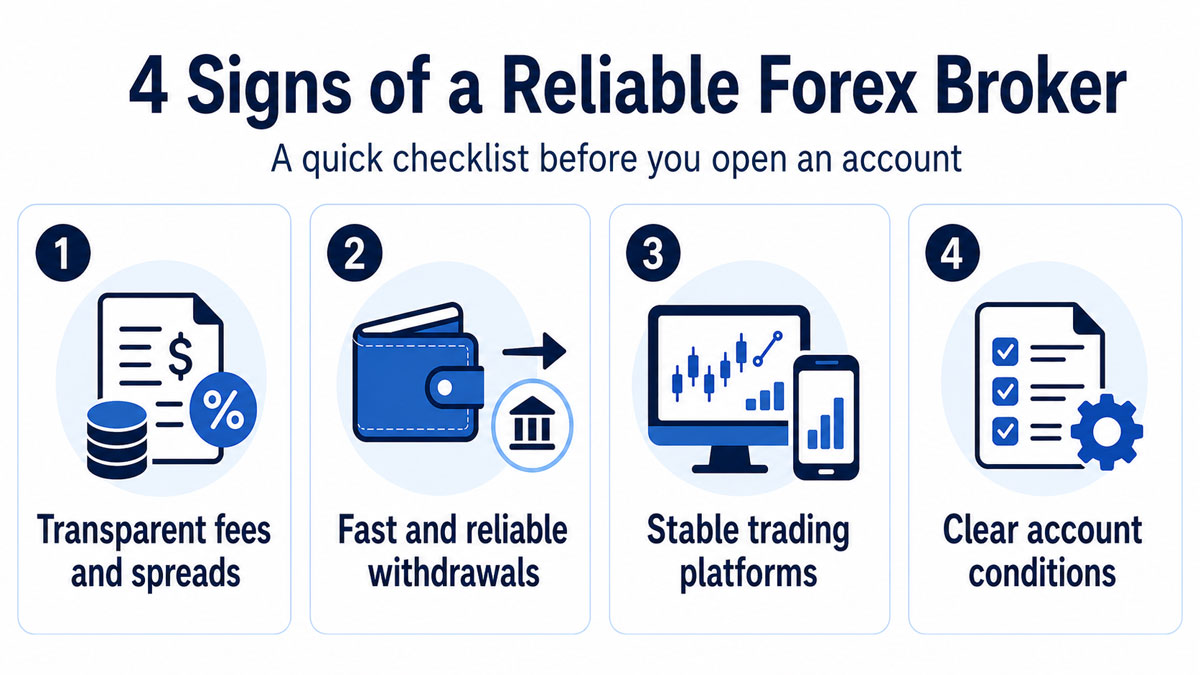
A reliable broker should make the trading conditions easy to understand before a deposit is made. If traders have to dig through vague pages to find basic costs, that is not a good sign.
Transparent Fees and Spreads
Traders should look beyond the advertised spread. A broker may promote “spreads from 0.0” but charge commission, widen spreads during volatile periods, or add overnight financing costs.
Check the full cost structure: spreads, commission, conversion fees, inactivity fees, guaranteed stop charges, and withdrawal costs. Some traders actively search for low spread forex brokers, but low spreads only matter if the wider fee structure is fair.
Fast and Reliable Withdrawals
Withdrawals are one of the clearest tests of broker quality. A trustworthy broker explains withdrawal methods, timelines, fees, and verification requirements upfront.
Delays can happen because of compliance checks, but repeated excuses, changing requirements, or pressure to deposit more before withdrawing are serious warning signs.
Stable Trading Platforms
A trading platform should be reliable, responsive, and clear. It does not need dozens of advanced tools if the trader is a beginner. It needs to let users place, manage, and close trades accurately.
Pay attention to order execution, mobile stability, chart clarity, and whether the platform freezes during active market periods.
Clear Account Conditions
Before opening an account, traders should read the terms for leverage, margin close-out rules, minimum deposits, account tiers, and product availability. If a broker makes basic conditions hard to understand, the trading experience is unlikely to improve later.
Broker Features vs Trading Results – What Really Matters
A broker is infrastructure. It gives traders market access, pricing, execution, and tools. It does not decide when they should trade, how much they should risk, or when they should stop.
Why “Best Broker” Lists Can Be Misleading
Broker rankings are useful for comparison, but they can oversimplify the decision. A broker that suits an experienced day trader may be poor for a beginner. A platform with advanced tools may be unnecessary if the priority is simple execution and low costs.
Some lists of the top forex brokers UK also focus heavily on affiliate relationships, promotional offers, or headline spreads rather than long-term suitability.
The Gap Between Tools and Real Performance
Many beginners focus too much on broker features and rankings, assuming the platform itself will determine their success. In reality, trading outcomes depend far more on decision-making and consistency. Solutions like TFXC trading help traders focus on structured strategies rather than relying solely on broker tools or generic lists of UK forex brokers.
A structured approach means having defined entry rules, exit rules, position sizing, and review habits. Without that, even the best platform becomes a place to make emotional decisions faster.
Key Criteria UK Traders Should Compare
Once FCA regulation is confirmed, brokers should be compared on practical trading factors.
Cost Structure – Spreads, Fees and Hidden Charges
Costs reduce a trader’s edge. A tight spread is helpful, but only if the overall pricing is fair. Compare average spreads, not just minimum spreads. Check whether fees change by account type or trading volume.
A proper forex broker comparison should include spreads, commissions, overnight financing, inactivity fees, deposit charges, withdrawal fees, and currency conversion costs.
Execution Quality and Slippage
Slippage happens when a trade is filled at a different price than expected. Some slippage is normal in fast markets. Consistently poor fills, unexplained rejections, or large differences between quoted and executed prices deserve attention.
Range of Markets and Instruments
If a trader only trades major forex pairs, they may not need hundreds of instruments. If they plan to trade indices, commodities, or metals too, they should check whether those markets are available under the same account.
Platform Usability and Speed
A platform should make risk easy to manage. Traders should be able to see margin, stop-loss levels, order size, and account exposure without confusion.
Customer Support Availability
Support matters most when something goes wrong. Traders should test support before depositing heavily. Ask a practical question about withdrawals, spreads, or account verification and see whether the answer is specific or scripted.
Quick Broker Evaluation Framework
| Criteria | Strong Broker | Weak Broker |
|---|---|---|
| Regulation | FCA-authorised, details match the official register | Vague “regulated” claims or offshore-only licence |
| Fees | Clear spreads, commissions, funding costs, and withdrawal terms | Headline low spreads with unclear extra charges |
| Withdrawals | Published timelines, standard verification, no pressure tactics | Delays, excuses, or requests for extra deposits |
| Platform | Stable, intuitive, transparent order management | Freezes, confusing pricing, and poor mobile reliability |
| Support | Clear answers from trained support staff | Aggressive sales calls or generic responses |
This type of framework is more useful than chasing a single best broker for forex UK result, because it forces traders to judge the broker against their own trading needs.
How Scams Typically Work in the Forex Industry
Forex scams usually do not start with an obvious fraud. They often begin with a smooth website, a friendly “adviser,” and promises that sound just believable enough.
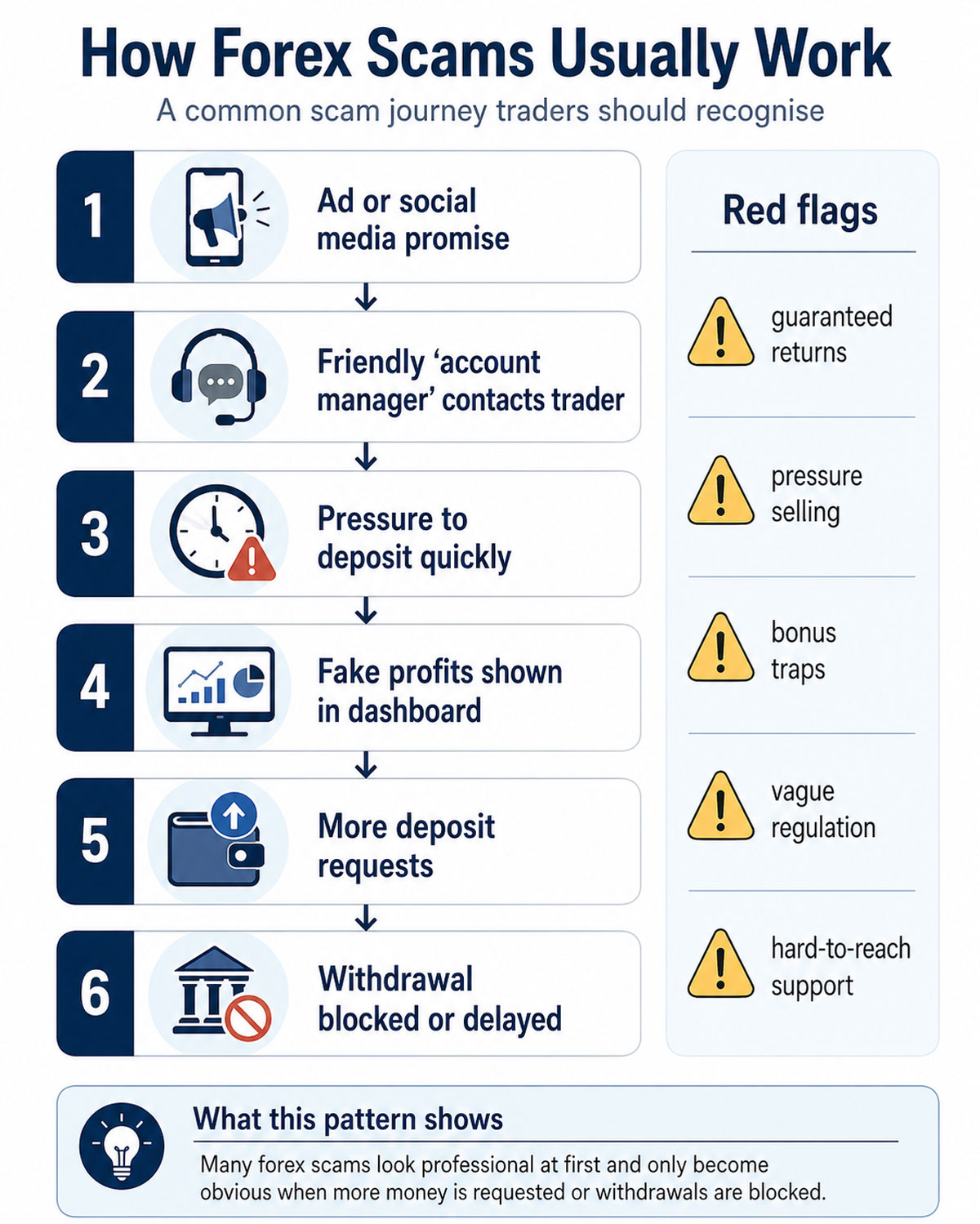
The FCA warns that unauthorised forex firms may use professional-looking platforms, fake testimonials, and pressure tactics to convince people to invest. Its ScamSmart service can help consumers check suspicious investment opportunities.
“Account Managers” and Pressure Selling
Be cautious if someone pushes traders to deposit quickly, increase their account size, or follow trades without explanation. Legitimate brokers do not need to pressure retail clients into rushed decisions.
Fake Performance Claims
Guaranteed returns, “90% win rate” claims, and screenshots of huge profits are classic warning signs. Real trading involves uncertainty. No serious broker or educator can remove market risk.
This is also where forex broker reviews need to be read carefully. Reviews can highlight real user experiences, but fake positive reviews and angry one-off complaints both exist. Look for patterns, not isolated comments.
Withdrawal Restrictions
Many scams look fine until a withdrawal is requested. Suddenly, there may be “taxes”, “unlocking fees”, “bonus conditions”, or extra identity checks that were never mentioned before. A legitimate broker explains withdrawal rules before an account is funded.
Realistic Expectations When Choosing a Broker
A safe broker reduces operational risk. It does not remove trading risk.
What a Broker Can and Cannot Do
A broker can provide market access, pricing, platforms, reporting, and support. It can also offer educational resources and risk tools.
It cannot make poor trades profitable. It cannot protect traders from overleveraging. It cannot replace a tested plan.
Why No Broker Guarantees Profit
Forex trading is probability-based. That means even good setups can lose, and profitable traders still have losing trades. The aim is not to win every trade, but to manage risk so losses are controlled and profitable periods have room to develop.
That is why the best forex broker for beginners is not necessarily the one with the most features. For a new trader, clear costs, strong regulation, simple execution, and risk controls are often more valuable than advanced tools.
The Role of the Trader vs Platform
The platform executes the trader’s decisions. The trader is still responsible for trade selection, risk per trade, stop placement, and knowing when not to trade.
This is where many beginners confuse access with readiness. Opening an account is easy. Trading with discipline is the actual challenge.
Choosing Based on Trading Style
The right broker depends on how someone trades, not just what is popular.
Low-Cost Trading vs Advanced Tools
If a trader trades frequently, spreads and commissions become more important. If they trade occasionally, platform simplicity, education, and account transparency may matter more.
Advanced tools are useful only if the trader knows how to use them. Otherwise, they can become distractions.
Short-Term vs Long-Term Trading Needs
Short-term traders need fast execution, tight spreads, and reliable platforms during volatile sessions. Longer-term traders may care more about overnight financing, charting, research, and broader market access.
This is why lists of the best forex brokers UK should be treated as starting points, not final answers.
Manual vs Assisted Trading
Manual traders need clean order controls and risk-management features. Traders using signals, copy tools, or assisted services should be even more cautious. They should understand who is making the decision, how risk is controlled, and whether performance claims are verified.
When reviewing forex brokers in UK, traders should check whether any assisted service is regulated, clearly explained, and free from unrealistic performance promises.
A Simple Checklist Before Opening an Account
Before depositing real money, traders should confirm:
- FCA registration verified
- Clear fee structure
- Demo account available
- No pressure tactics
- Transparent withdrawal policy
They should also check whether client money and investment protection may apply. The Financial Services Compensation Scheme explains that eligible investment claims can be protected up to £85,000 per eligible person, per firm, if the firm failed after 1 April 2019. Traders should always check whether their specific account and activity are covered before relying on protection.
Final Thoughts: A Broker Is a Tool, Not a Strategy
Choosing a forex broker in the UK starts with safety. Traders should verify FCA regulation, understand the fee structure, test the platform, and read the withdrawal terms before putting serious money at risk.
But they should not confuse a reliable broker with a complete trading plan. The broker gives them access to the market. Their results depend on how they manage risk, control emotions, and make decisions under uncertainty.
A safe, transparent broker is the foundation. A structured trading process is what gives that foundation real value.