Buying a Period Home? Read the Windows Before You Make an Offer
Everyone at a house viewing checks the kitchen, and nobody checks the windows. Yet in a period home the windows are the most honest witnesses in the building: they will tell you, in about five minutes, how the house has been cared for, what the next few years of ownership will cost, and whether the character that made you book the viewing is original or a veneer. Estate agents know the phrase “needs updating” hides a multitude of sins, and a surprising share of those sins sit in the window openings. This guide is the five-minute survey a specialist would run before making an offer: what to look at, what each fault genuinely costs to put right, which rules apply once you own the place, and where a set of tired old sashes becomes a bargaining chip rather than a reason to walk away.
Why the Windows Deserve Five Minutes of Your Viewing
Start with what the windows are. In a Georgian, Victorian or Edwardian house the joinery was made from slow-grown timber, jointed by hand and designed from the outset to be taken apart and serviced. That is why so much of it is still in place after a century or more, and it is also why the windows carry so much of a street’s character: the proportions of the openings, the pattern of the glazing bars and the shadow lines of a recessed sash are a large part of what makes a period elevation look right. Replace them badly and the house never quite looks itself again; a whole terrace can be read, pane by pane, as a register of which owners understood that and which did not.
Then there is the money. Windows are blamed for cold old houses more than any other component, and the blame is usually aimed at the wrong part of the window. Historic England’s research on traditional windows found that around one fifth of a home’s heating escapes through its windows, and that most of that loss is air moving through gaps rather than heat conducting through the glass; conduction through the pane accounts for less than a quarter of a traditional window’s heat loss. Older buildings as a whole lose roughly 15 to 20 per cent of their heat through draughts. The practical consequence for a buyer is cheerful: the faults that make a period house feel cold are mostly air-sealing faults, and air-sealing faults are the cheap end of window work. The expensive mistake is letting a cold first winter panic you into a full replacement quote before anyone has diagnosed what the windows need.
Know What You’re Looking At
Two families of window cover almost everything you will meet at a viewing. The vertical-sliding sash, two glazed frames sliding past each other on hidden counterweights, is the signature of Georgian and Victorian housing; the side-hung timber casement turns up on cottages, on Arts and Crafts houses and across much of the Edwardian stock. The glazing pattern is a quick date stamp. Georgian houses used many small panes, the classic six-over-six, because glass could not be made in large sheets; Victorian builders, once plate glass arrived, went to two panes over two or a single sheet in each sash; Edwardian taste often kept small panes in the upper sash over one clear sheet below.
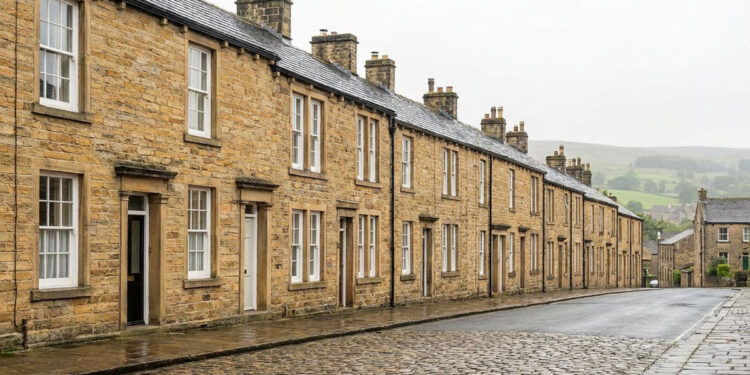
It helps to know your local stock. In Yorkshire the range is unusually wide: Georgian townhouses in York and Harrogate with tall, thin-barred sashes; mile after mile of brick terraces in Leeds and Sheffield with generous Victorian two-over-twos; stone cottages and farmhouses in the Dales where casements are set deep into thick walls. The stone terraces of the former mill towns add a local wrinkle, because stone openings are unforgiving of the flat, shallow frames of a standard modern replacement; where an original window survives in a stone reveal, it is doing more for the house’s looks than almost any other single component.
The Five-Minute Window Survey
None of this needs a ladder or a screwdriver, and all of it can be done politely during a second viewing. First, open a window in each elevation you can reach, because a window is a machine and the test of a machine is whether it works. A sash that glides and sits where you leave it has been looked after. A sash that will not budge is most often just painted shut, which is a service item, not a death sentence. One caution from Historic England is worth carrying with you, though: a window that is stuck absolutely firm may have quietly taken on a structural role as the building settled around it, and there are recorded cases of masonry moving when such a window was forced. Note it, and leave the forcing to a professional.
Second, press the timber. Rot in a timber window nearly always starts where water sits: the sill, the bottom rail of the lower sash, the feet of the frame. Press a thumbnail or a knuckle along those lines; sound timber feels hard and dry, decayed timber feels soft or papery. The distinction that matters is patch versus spread. Local decay in a sill or a rail is routine work, cut out and spliced with new timber while the rest of the window survives. Decay that has travelled through the joints, so that the frame feels spongy in several places at once, has usually claimed the window. On painted joinery, be more suspicious of thick, glossy overpainting than of flaking: flaking shows you what is underneath, while a heavy repaint is how soft timber is hidden for a sale.
Third, read the gaps. Rattle the sashes gently and look at the meeting rails, the two horizontal bars that come together at mid-height when the window is shut. Rails that meet flush, with an even gap around the sashes, describe a window that is square and serviceable. Daylight visible around the edges, or rails that ride past each other, mean wear and movement; that is where the draughts live, and draughts are the most fixable fault a sash has. While you are there, look at the cords. Broken or frayed sash cords are a small job, and the Society for the Protection of Ancient Buildings gives the sensible rule that once one cord has gone the rest of that window’s cords are on notice and should be renewed together.
Fourth, look at the glass itself, at an angle, against the light. Old hand-made glass ripples and pools; the reflections swim in it in a way float glass cannot imitate. That distortion is not a defect. It is increasingly rare, it is part of why old windows look alive from the street, and heritage bodies treat surviving historic glass as part of a building’s significance. A house that still holds its old glass deserves a gentler upgrade path, which we will come to. Finally, count the strangers: walk the outside and spot the openings where the pattern breaks, a uPVC unit in one bedroom, a modern casement punched into a Victorian bay. Mixed stock is common, tells you the originals elsewhere are survivors, and matters for the budget, because a coherent set is worth restoring coherently.
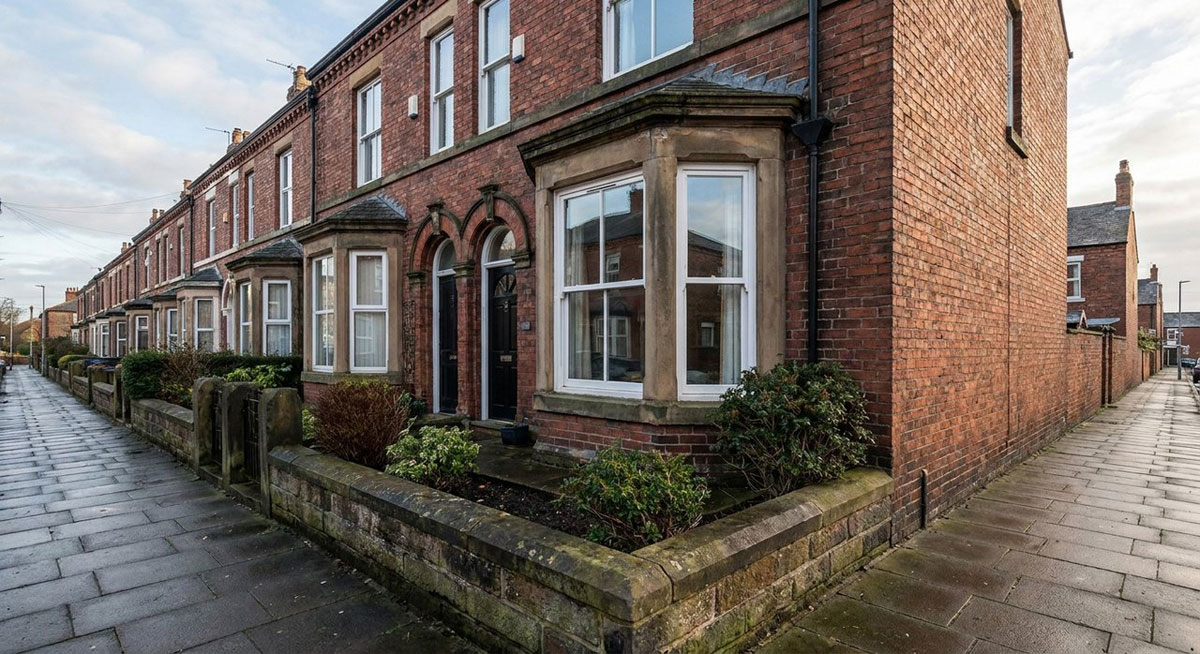
Meeting rails, cords, sills: the whole survey can be done from the pavement and the landing
Listed, in a Conservation Area, or Neither? Find Out Before You Offer
Five minutes on the council’s website answers a question that changes the whole window conversation: what protection does the house sit under? If it is listed, window alterations need listed building consent, and doing the work without consent is a criminal offence, one that attaches to the building, so a previous owner’s unauthorised windows can become the new owner’s problem. The process is less fearsome than the rule: applications are free, go through the Planning Portal and should be decided within about eight weeks. In practice consent is about method rather than prohibition; like-for-like repair is generally uncontroversial, and even glazing upgrades are approved where they respect the original frames.
Conservation areas are subtler, because the default permitted-development rights can be narrowed street by street through an Article 4 Direction. Two identical houses in the same town can carry different rights, so the only safe answer is a call to the local planning authority before you commit. Yorkshire buyers meet this more than most, from the centre of York to model villages such as Saltaire, where the whole point of the designation is that elevations, windows included, stay coherent. And for an unlisted house outside any conservation area, one line of building regulations is worth knowing: renewing glazing within the existing frames is treated differently from replacing whole windows, which is precisely what makes the repair-and-upgrade route administratively light.
What the Faults Cost to Put Right
Here is the part the viewing-day panic gets wrong: priced fault by fault, old windows are cheaper than their reputation. Service work, freeing painted-shut sashes, renewing cords and pulleys, easing and adjusting, sits at the bottom of the scale. Specialist cost guides put a full refurbishment of a timber sash window, meaning cords, pulleys, rebalancing and seals, at around £350 to £650 per window, rising to £650 to £1,200 where splicing in new timber and full redecoration are included. Hold that against the same guides’ figure of £1,200 to £2,500 for a new softwood sash window, fitted, and the arithmetic of the next few paragraphs makes itself.
Draught proofing is the highest-value line on the sheet. Done properly on a sash it means brush seals set into discreet routed carriers, and the material matters: the Energy Saving Trust’s advice is that foam strips do not work well on sliding sashes, so use brush strips or bring in a professional. On a window in good condition the effect is dramatic; Historic England cites research showing draught proofing can cut air infiltration through such a sash by as much as 86 per cent. Treat that number precisely, it measures air leakage rather than promising a bill saving, but a room that no longer stirs its own curtains needs no persuading. Historic England also reports that simply easing and overhauling a sash, before any seal goes in, can cut infiltration by up to a third. Professional routed-in draught proofing runs at roughly £200 to £400 per sash window, and there is a pleasant quirk on the invoice: professionally installed draught stripping is zero-rated for VAT until 31 March 2027, while repair work carries VAT at 20 per cent, so an itemised quote can legitimately show both rates.
Then comes the glass, in three steps of ambition. Secondary glazing, an independent pane on the room side, is the reversible option: vertical sliding units made to sit behind sashes cost in the region of £220 to £325 per window fitted, take a single-glazed window’s U-value from about 4.8 W/m²K down to roughly 2.2 to 2.9, and leave the original window, old glass and all, untouched. Slim-profile double glazing swaps the single panes for sealed units around 10 to 12mm thick within the original sashes, indicatively £600 to £800 per window, though it needs enough timber to work with, as a rule of thumb sashes about 35mm thick. Vacuum glazing is the quiet revolution of the last few years: two panes separated by an evacuated gap, only about 7.7mm thick, with a published centre-pane U-value of around 0.7 W/m²K, which is why it can slip into rebates cut for single glass and why heritage glaziers have taken to it for listed work.
The catch, and the reason this is a specialist’s job rather than a glazier’s errand, is weight. Flat glass weighs about 2.5kg per square metre per millimetre of thickness, so new units make each sash meaningfully heavier than the single pane it was built to carry, and a sash heavier than its hidden counterweights becomes a window that is stiff to lift or will not stay open. Reglazing done properly therefore includes re-cording and rebalancing the weights while everything is apart, which is why the firms that do it well employ carpenters and glaziers in equal measure. Specialists such as Chameleon Windows Restoration, who retrofit vacuum glazing into original frames including in listed buildings, treat the rebalancing as part of the glazing job rather than an extra, and that is the standard to hold any quote to. For a buyer the takeaway is simple: a period house can be brought close to modern thermal performance without losing a single original frame, one rung at a time, stopping at whichever rung the budget and the building suggest.
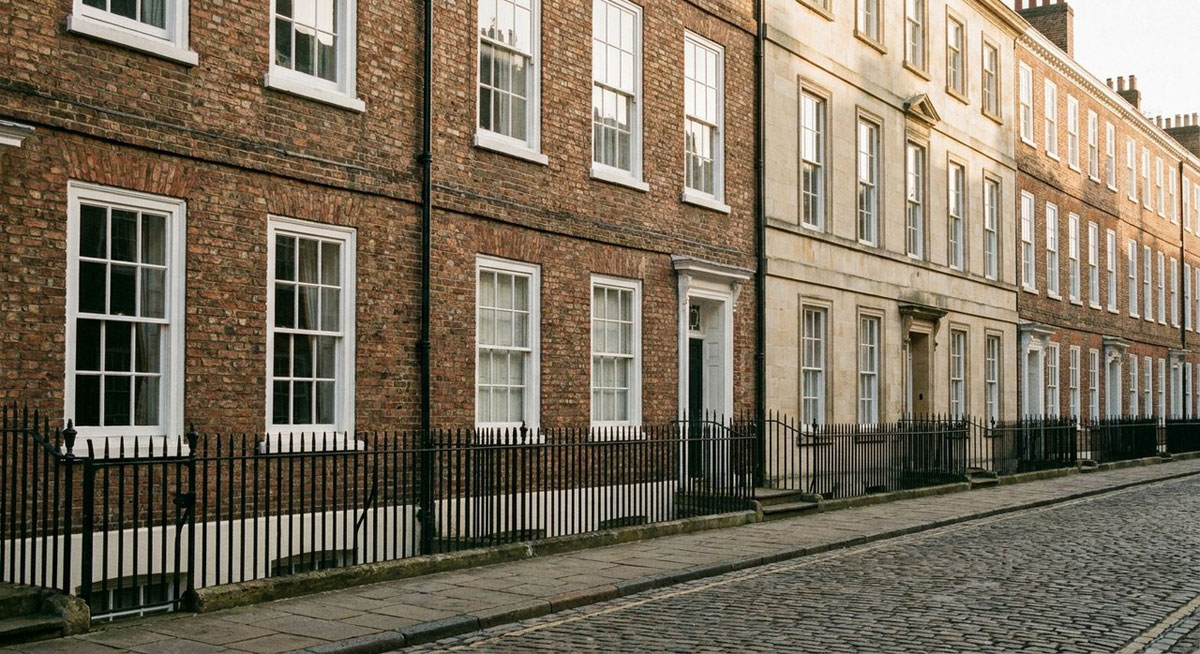
Six-over-six sashes in a Georgian row — proportion and glazing pattern are the street’s signature.
Old Glass Is a Feature, Not a Fault
It bears repeating as its own rule, because it is the mistake even careful owners make in their first year: if the survey found rippled hand-made glass, protect it. Once broken up for a reglazing job it is gone, and nothing modern replaces the way it catches low sun across a terrace. Where original glass survives, the gentle path is repair and draught-proof the window itself and let secondary glazing carry the thermal load; it generally needs no consent even in listed buildings, and it is fully reversible. One counterintuitive warning from Historic England belongs here: if you do fit secondary glazing, the original window should not be draught proofed as well, because sealing the cavity between the two traps moisture against the old timber. It is a detail, but it is the kind of detail that separates firms who know period buildings from firms who merely quote for them.
Turning What You Found into an Offer
Now put the survey to work. Nothing you found changes whether the house is worth buying; what it changes is the number and the order of works. A set of original windows that are painted shut, draughty and cosmetically shabby but structurally sound is not a defect to fear, it is a negotiating line: a few hundred pounds per window of overhaul and draught proofing, priced in writing, is the kind of figure that moves an offer without frightening anyone. Genuine rot through multiple joints, or a previous owner’s unauthorised replacements in a listed building, are heavier items and deserve a specialist’s written quote before you commit, not after.
Be honest, too, about the cases where replacement is the right answer. A house whose “period” windows are twenty-year-old replacements with no heritage value loses nothing by having them replaced well, and sashes with timber too slender or too far gone for sealed units are candidates for new double-glazed sashes made to fit the original box frames, which keeps the look of the street while renewing the moving parts. Two smaller notes for the file: paint on pre-1990s joinery may contain lead, its use in ordinary paints was not fully prohibited in the UK until 1992, so refurbishment should strip it with chemicals or careful heat rather than dry sanding, a point any competent firm will raise before you do. And if the house is a buy-to-let prospect, put one date in the diary: rented homes in England and Wales must reach EPC C by 1 October 2030, which makes window decisions part of the investment case rather than an afterthought.
The windows will not choose the house for you. But read them carefully and they will tell you what the house has survived, what it needs, and what it is quietly worth, which is more than can be said for the kitchen.
Frequently asked questions
Are original sash windows a money pit?
Usually not, and the reputation comes from confusing service items with failures. Painted-shut sashes, broken cords, seized pulleys and draughts are all routine work; specialist guides put a full overhaul with seals at around £350 to £650 per window. The genuinely expensive cases are rot that has spread through the joinery and botched past alterations. The five-minute survey above is designed to tell one from the other before you offer.
Can original windows be double glazed without replacing them?
Often, yes. Slim double-glazed units around 10 to 12mm thick can go into sashes with enough timber, roughly 35mm as a rule of thumb, and vacuum glazing at about 7.7mm suits rebates cut for single glass. The non-negotiable is rebalancing: new glass is heavier, so the hidden counterweights must be re-corded and adjusted or the window will fight you ever after. Where timber or budget rule both out, secondary glazing does most of the thermal work reversibly.
Do draughty windows mean the windows have failed?
No, draughts are wear, not failure. Historic England’s research found most heat lost through traditional windows goes through air gaps rather than the glass, and that draught proofing a sash in good condition can cut air infiltration by as much as 86 per cent; even an overhaul alone cuts it by up to a third. At roughly £200 to £400 per window professionally, zero-rated for VAT until 31 March 2027, it is the highest-value repair on the list.
What permission do I need for window work on a period house?
It depends on the designation, so check before you offer. Listed buildings need listed building consent for alterations, and working without it is a criminal offence that passes with the building; applications are free and decided in about eight weeks. In conservation areas, an Article 4 Direction can bring windows under planning control street by street, so ask the council. Renewing glazing within existing frames sits outside the rules that apply to whole-window replacement.
A window is painted shut — how bad is that?
On its own, trivial: cutting the paint seal and easing the sash is standard service work. The one caution, from Historic England, is that a window stuck absolutely firm may have taken on a structural role as the building settled, and forcing it has occasionally moved masonry. If it will not free with gentle persuasion, have a professional open it up as part of an overhaul rather than leaning on a crowbar on moving day.
Is old wavy glass worth keeping?
Emphatically. Hand-made glass with ripples and pooling is original material that heritage bodies count towards a building’s significance, and it cannot be bought back once broken. Keep it, repair and draught-proof the window, and if you need better thermal performance let reversible secondary glazing do the work; just don’t draught proof the original window as well, as sealing the cavity traps moisture against the timber.
I’m buying to let — do the windows matter for compliance?
Yes, through the energy rules: rented homes in England and Wales must reach EPC C by 1 October 2030. Draught proofing, secondary glazing or reglazing original windows all contribute to the assessment, and the costs above are modest against the value of keeping a period property lettable, so fold the window plan into the purchase sums now rather than in 2030.