The Leeds ‘Dripping Riot’ of 1865

By Harry Bratley
Possibly the strangest confrontation in the history of law and order in Leeds was the ‘Dripping Riot’ in January 1865, a rebellion that delivered a message to the middle classes of the town that the working classes were not prepared to respect the law if its implementation was unjust.
This unfortunate affair started on 23 January 1865 when Eliza Stafford, a cook to surgeon and magistrate Henry Chorley, of 8 Park Square, came before the local court accused of stealing 2lb of dripping, claiming that it was a natural perk of the job. Chorley declared that it was just one of several examples of stealing from his house, and the theft of the dripping was the final straw. Although he had a reputation as a generous and well-respected man, popular with the poor of the town, the dripping theft angered him enough to press charges against Eliza in court.
The alleged theft certainly seems a very small offence for which to prosecute a cook. Even in 1865, the offence of stealing a bit of dripping was regarded as relatively trivial. However, the case was tried, and Eliza Stafford was found guilty and sentenced to a month in Armley Jail.

“Triumphal procession”
The imprisonment was met with cries of protest from the working classes, who subjected Chorley to all sorts of annoyances, including writing ‘Chorley’s Dripping’ on walls all over the town and bombarding him with abusive letters. The Leeds Mercury, in support of the protests, judged that Mr Chorley had made a mistake in prosecuting with no better charge, which also applied to the magistrates who convicted her. The newspaper went on to say that, unless the evidence was much stronger than reported, many persons would understandably think that the servant had been severely dealt with and found guilty of theft when she had only been guilty of imprudence and was a victim of an error in judgement rather than a deliberate act of wickedness.
It had been announced by printed placards around the town that Mrs Stafford would be liberated on Saturday 18 February, and the public were invited to meet her at the jail gates between four and five o’clock to make a mass demonstration and a triumphal procession through the town, especially past the front of Mr Chorley’s house in Park Square. This turned out to be a ruse, and thousands of working men and women were the victims.
The Leeds Times had informed its readers that such would not be the case, but the general multitude did not accept the communication as correct. Thousands of people, many of them thinking that the cook had not had a just and balanced trial, had, by four o’clock, gathered at the jail. The numbers were so great that the gathering stretched all the way down to Wellington Bridge near the centre of Leeds. The throng was expecting Mrs Stafford to be escorted in jubilation by her supporters but, eventually, they realised that she would not be released that day.

“Pelting him with stones”
Feeling the effects of the miserable cold weather, many of the demonstrators moved on to Park Square to ascertain ‘how the pulse of Mr Chorley beat on this matter’. When the doctor came out of his front door to address the mob, he was greeted by shouting, upon which he stated that the cook should have received two months in prison, not one, whereupon the crowd pelted him with snowballs.
It eventually became generally known that instead of being released on the previous Saturday, her release from jail would in fact take place on Wednesday 22 February, and accordingly there was another immense gathering. Thousands of her supporters awaited her release at Armley Jail, which was expected at 9am. However, in the hope of avoiding trouble, by 7am the authorities had spirited her away to Scarborough to stay with her daughter. The announcement to the crowd that she had already been released earlier was made by the Chief Constable of Leeds. The crowd thus resented his hindrance by pelting him with stones, sticks and other missiles; one stone struck him on the back of the head. Fortunately, he sustained no serious injury, but he would be fated to a worse misfortune that afternoon.
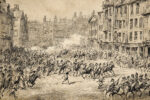
On hearing the news that Mrs Stafford had already been released, the crowd headed into Leeds and, by midday, a gathering of over ten thousand had assembled outside Mr Chorley’s house in Park Square. People in the crowd then started to throw stones, breaking several windows in the house. The police turned out in strength, reinforced by officers from Bradford and two troops of cavalry from York. In the subsequent confrontation, George Hudson, a potter, was killed; the Chief Constable fell and broke his arm; and another officer received a serious head wound.

“Lenient view”
Efforts by the police to disperse the mob were at first unsuccessful until a Riot Act notice from the Town Hall warned that, if they did not move out of the Park Square neighbourhood, they would suffer legal consequences. This measure was only temporarily effective until the evening, when a crowd of two thousand assembled outside the Town Hall, hooting and jeering. However, they were soon turned around by a force of thirty ‘bobbies’ armed with their staves. By ten o’clock the streets were cleared, the row was over and the town returned to its usual quietude. So much for the Great Dripping Case of Leeds.
Several men arrested were tried for riotous conduct, but the magistrates took a lenient view and only one was imprisoned, and then only for a week. The sentencing magistrate described the incident as ‘very silly excitement’, and the other defendants were bound over to keep the peace in the sum of £10.
As for Elizabeth Stafford, she benefited from a large cash collection, intending to open a public house in Scarborough and call it the ‘Dripping Pan’. Whether she did or not is not known, as she seems to have vanished into history.
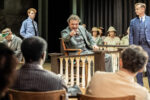
images are representational

Harry was born in Bradford and has lived in Kippax, near Leeds, for over 40 years with his wife, Ann. At school, he studied History, Geography, and English Literature, dreaming of visiting iconic places like the Grand Canyon, Taj Mahal, and Sydney Opera House. He spent much of his career in the travel industry, allowing him to explore the world and fulfil his childhood dreams. With a lifelong passion for history, Harry pursued further education upon retirement, earning a Bachelor of Arts (Honours) degree in History from university.