To Kill a Mockingbird – Review – Sheffield Lyceum Theatre

By Clare Jenkins, January 2026
If ever we needed reminding that history has a depressing habit of repeating itself, Aaron (The West Wing) Sorkin’s adaptation of Harper Lee’s 1960s Pulitzer Prize-winning novel about race relations in America’s 1930s Depression-hit Deep South couldn’t have come at a more appropriate time.
As the US is riven by political division over the recent shootings in Minneapolis, this harrowing tale of a man falsely accused of a crime, of conscience vs prejudice, the power of mob mentality and unsettling retribution, very much still has the power to shock. “One man dying because people can’t believe the evidence of their own eyes,” as the central character, Atticus Finch, says.
Richard Coyle is superb as Atticus, the “small-town lawyer who gets paid in vegetables” and who’s called upon to defend a black labourer, Tom Robinson (a sorrowful Aaron Shosanya) from the capital charge of raping a young white woman. A decent, dignified widower with two children, Atticus believes in the fundamental goodness of folk – and so persuades Tom to plead Not Guilty (which he is).

“Restless energy”
His liberalism, though, is at odds with most of his neighbours, and even with his kindly black housekeeper Calpurnia (played with powerfully suppressed anger by Andrea Davy). It does, indeed, prove to be both his and Tom’s downfall as the all-white, ‘Christian’ jury choose bigotry over truth.
Lee’s novel is narrated in flashbacks by Atticus’s tomboyish young daughter Scout. In the play, she, together with her older brother Jem and their fragile friend Dill, is both absorbed into the action and an increasingly horrified commentator on it. All three parts are played by adult actors (bold, scowling Anna Munden, on-the-verge-of-manhood Gabriel Scott and gawky Dylan Malyn). Together, they poignantly, and often comically, reprise childhood’s restless energy, outspokenness and struggles to understand a world where adults indulge in make-believe as much as children do. Though with different, distressing consequences.
Under Bartlett Sher’s unfalteringly firm direction, all three provide an effective counterpoint to the injustice being perpetrated by the adults – chiefly by Bob Ewell, the drunken and abusive father of rape victim Mayella. Oscar Pearce’s Ewell does indeed have “battery acid running through his veins”: a raging, vicious ‘low life’ racist, regularly spitting out the N-word (spoken in full onstage). Evie Hargreaves’s Mayella is a fine foil, pale and squirming in the witness box.

“Sensitively and compellingly portrayed”
The play premiered on Broadway in 2018, halfway through the first Trump presidency and two years before the murder of George Floyd and the Black Lives Matter movement. As Mayella savagely repeats her father’s white supremacist speech, the words seem to echo back and forth across the years. As does the scene where vigilantes dressed in Ku Klux Klan-type hoods and carrying ropes threaten to lynch Tom. Where recently have we seen images of masked men terrorising neighbourhoods and attacking their fellow citizens?
Sorkin’s adaptation shows Atticus not just as an heroic symbol of fair-minded tolerance – or “race-traitor” as Ewell calls him – but also a man blinded to the realities of the world as the black characters continue to experience it, 70 years after the abolition of slavery in the US. Coyle’s calmly understated performance teases out that complex interpretation: a man whose high-mindedness can at times be interpreted as high-handedness. And a man whose belief in American justice is ultimately, tragically misplaced.
The action is consistently paced over the course of its almost three hours, with every characterisation sensitively and compellingly portrayed, whether by the main actors or by the ensemble. Together they also double as stagehands, moving scenery around Miriam Buether’s bleak grey warehouse-like set, between courtroom and the Finches’ home and porch.
The result is an increasingly charged atmosphere. And when Scout repeats the play’s opening exhortation to ‘All rise’ at the end of the play, half the opening night audience do just that, in a very well-deserved standing ovation.
To Kill a Mockingbird is at Sheffield Lyceum Theatre until Saturday, then on tour
images: Johan Persson
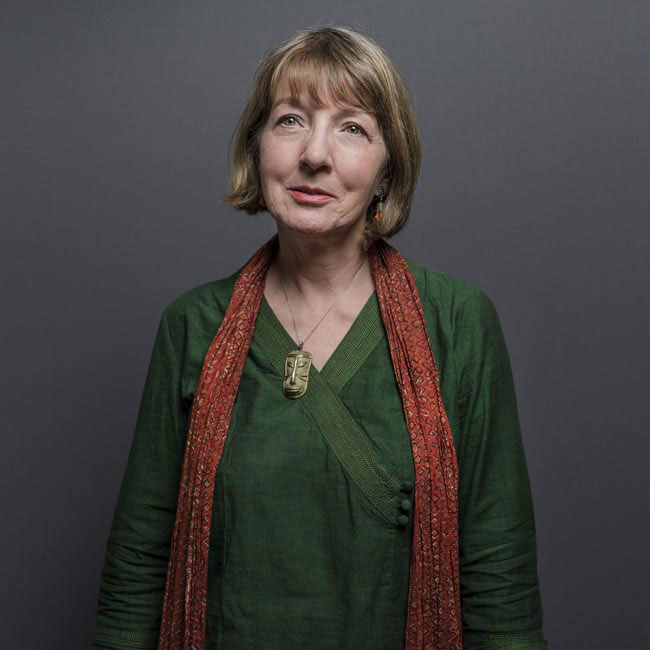
Clare’s dream is to live in a hotel suite, safe from the bother of boiler breakdowns and crashing computers. Thanks to her husband Stephen McClarence’s work as a national newspaper travel writer, she’s been lucky enough to stay at hotels across the UK, India and many other countries – and has loved (nearly) every minute. As a journalist herself, she was a regular contributor to Radio 4’s Woman’s Hour for over 20 years and has made features and documentaries for Radios 3 and 4. She’s also a former theatre reviewer for The Stage magazine and, with her husband, co-author of Teatime at Peggy’s: A Glimpse of Anglo-India.