Rise of the North: The 1992 European Championship by Neil Fredrik Jensen – Review
By Karl Hornsey
Some football tournaments live long in the memory. Sadly, the 1992 European Championship wasn’t one of them, but that doesn’t make Neil Fredrik Jensen’s account of the event any less interesting. That may, in part, be due to the fact that only the final third of the book actually focuses on events on the field in Sweden, with the previous two-thirds being devoted to the qualifying campaign, societal trends at the time, and an in-depth focus on each of the eight teams involved. The fact that the final itself garners just three pages tells its own story.
In fairness, the back story and build-up to the tournament remains one of the most fascinating ever, given the political situation across Europe around the turn of the decade and the remarkable story of a nation winning a tournament for which they failed to qualify. Jensen makes a great job of explaining the situation, particularly in Eastern Europe, at the time, as several long-standing Communist regimes were toppled by popular people’s uprisings, and this was to have a marked effect on the football scene, as well as the world at large.
Jensen’s choice of title, The Rise of the North, is an instructive one, as only one team from Eastern Europe made it to Sweden, and even then it was a name destined to become something of a quiz question in later years. With the Soviet Union collapsing, they were nominally classed as the Commonwealth of Independent States for these finals, while Yugoslavia were disqualified due to the horrific conflicts taking place in the Balkans, to be replaced by Denmark.
 “Surprises”
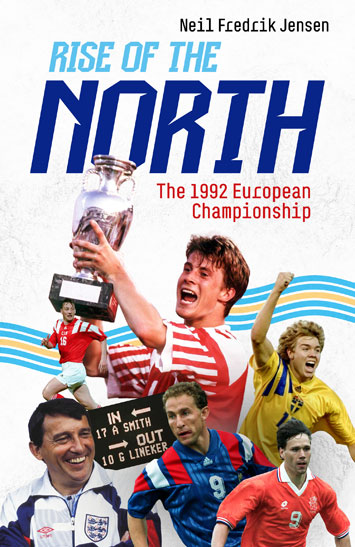
That the Danes went on to lift the trophy is reason enough to tell the story of the tournament, but Jensen also finds plenty of interesting back stories to each of the squads and their travelling supporters, while also focusing on what it meant for Sweden to host a global football tournament for only the second time in their history.
Younger readers may be amazed to learn that only eight nations were involved. These were truly very different times in the world of football, and the Euros were to expand to 16 nations for the 1996 tournament, and being one of a select few meant that qualifying rounds actually mattered much more than do now, when seemingly it’s harder not to qualify than it is to reach the final stages.
The finals also had an unusual look to them, in addition to the CIS, with both the hosts and Scotland making their debuts in European Championships finals, and the Euros still felt very minimalist and almost quaint in comparison to the World Cup. Jensen is honest enough to say that the action on the field wasn’t exactly engrossing in the early matches, with teams more afraid to lose than brave enough to chase victory.
One group panned out very much as expected – the Netherlands and Germany progressing – and the other produced the surprises, as a dismal England and France were eliminated by Denmark and Sweden. The rest, as they say, is history. The Danes beat the Dutch on penalties in the semi-final and then stunned Germany to become the most unlikely winners in the tournament’s history. This is an excellent analysis of the finals and one that feels of a different time, politically and from a football perspective, making for a fascinating read.
‘Rise of the North: The 1992 European Championship’ by Neil Fredrik Jensen is published by Pitch Publishing

Karl’s love of writing was piqued at the age of eight, when he won a Blue Peter badge in an essay-writing competition. The location of said badge might be a mystery now, but the memory never fades. Hours spent writing about sport as a teenager, in pre-internet years when you had to make your entertainment, honed his skills, and Karl has worked in TV and radio listings at PA Media for 28 years, and the age of hybrid working means 50% of that can be at home listening to Classic FM and thinking about his next visit to his beloved Yorkshire Dales.
hornskar