The Meghan Markle Effect: Why Women Are No Longer Afraid to Redesign Their Engagement Rings
In 2019, Meghan Markle did something that sent the tabloids into overdrive and quietly changed the conversation for millions of women. She redesigned her engagement ring.
The original was a trilogy design: a cushion-cut diamond flanked by two round stones from Princess Diana’s collection. It was barely two years old. Prince Harry had designed it himself, and Meghan had it reset into a thinner yellow gold band with a new micro pavé setting, the same three diamonds arranged differently. The press treated it as a scandal. But women everywhere recognised it as something else entirely.
Permission.
Not permission from Harry (he was reportedly involved in the redesign), but from the culture; to say out loud what so many women had been thinking privately for years: I love this ring’s story. But it doesn’t quite feel like mine.
Meghan wasn’t the last. In 2024, Hailey Bieber swapped her oval solitaire for a larger stone on a slimmer band. That same year, Emily Ratajkowski split her engagement ring into two separate pieces after her divorce, reclaiming the stones on her own terms, in her own design. Three high-profile moments in five years.
The years before the decision
Most people don’t see how long these decisions take when you’re not a celebrity with a jeweller on speed dial.
The typical woman who redesigns her engagement ring has been thinking about it for five to fifteen years. The Pinterest boards she’d never show anyone have been growing. Late-night Google searches for “is it ungrateful to want a different engagement ring” have become a quiet ritual. Reddit threads open with prefaces like “I know I’m going to sound terrible, but…” and “Am I a horrible person for wanting this?”
Often, what finally tips the balance is usually a life milestone. A 10th or 20th anniversary, a career change, or kids leaving home. Moments where a woman looks at her hand and realises the ring she’s wearing reflects who she was at 26, not who she is at 42.
What happens during a redesign
A persistent myth surrounds engagement ring redesigns: the idea that you’re starting over, choosing a new diamond, abandoning the original, essentially erasing history.
Many women want to keep their original stone and change the setting around it: the metalwork, the profile, the way the stone sits on the hand. Sometimes the original diamond moves to a pendant or a right-hand ring while a new stone takes centre stage. Even then, the original gets a second life rather than a drawer.
Finding the right jeweller for a redesign
This is where the process gets tricky. Redesigning a ring requires a different relationship with a jeweller than buying one new.
A redesign client isn’t browsing a catalogue. There’s a lot of emotion and memories in her ring, and very specific ideas about what she wants her ring to become. She needs a jeweller who listens before they sketch; a collaborative relationship.

A few things worth looking for:
Look at the specifics of their portfolio. Finished photos matter, but process shots matter more: CAD renders, wax models, in-progress builds. A jeweller who documents the work is typically one who’s confident in it. Pay attention to the technical detail in their setting work. Clean prong symmetry, consistent pavé spacing, flush halo construction. These details separate a skilled craftsperson from someone assembling components.
Check whether they work with remote clients. The best jeweller for your redesign might not be local, and distance is less of a barrier than you’d think. Vanessa Nicole, a master diamond setter in San Diego, California, with over 20 years of experience, notes that roughly 80% of her redesign clients work with her remotely. Secure shipping protocols, video consultations, and detailed CAD previews have made geography largely irrelevant for high-end custom work. What matters is the relationship and the craftsmanship, not the postcode.
Ask who actually makes the ring. Many jewellers, including well-known high street names, outsource their bench work. There’s nothing inherently wrong with outsourcing, but for a redesign where your original diamond is at stake, you want to know exactly who handles it. Look for a jeweller who does their own setting work, ideally a master setter who will explain how they protect your stone through every stage.
Look for a collaborator, not an order taker. A skilled jeweller won’t just execute your vision; they’ll enhance it. They’ll align sculpted prongs to the facets of your diamond so light moves through it properly, mould the band into a comfort setting you forget you’re wearing, and source accent stones that match the colour of your centre diamond so the whole ring sparkles from across the room.
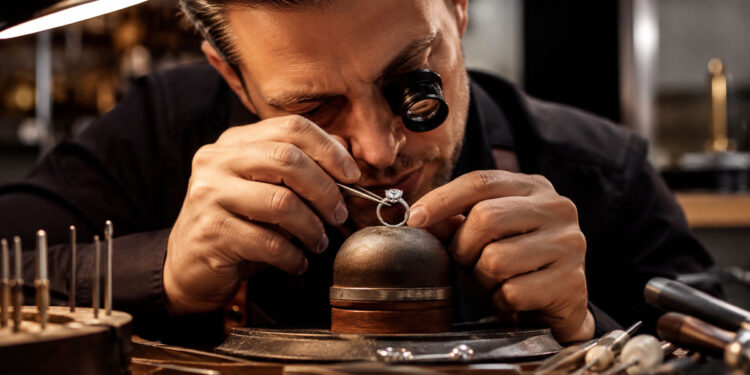
A master diamond setter will take your vision and turn it into a masterpiece.
Read reviews from redesign clients specifically. A jeweller might be brilliant at new engagement rings but less experienced with the emotional complexity of a redesign. Look for testimonials from women who came in with an existing stone and a complicated brief. Their language, whether they felt heard and whether the jeweller understood the sentimental weight, tells you more than any star rating.
Ask about their process for protecting your diamond. This is non-negotiable. A reputable jeweller will laser-inscribe or photograph your stone at intake, weigh it on camera, and keep you informed at every stage. If they dodge the question or speak in vague terms about safeguarding, keep looking.
It was always her decision to make
The cultural shift Meghan Markle helped catalyse isn’t really about celebrity influence, but more about a generation of women who refuse to accept that an engagement ring has to stay exactly as it was on the day someone placed it on their finger. A redesigned ring honours the love behind it while reflecting the woman who wears it now.